
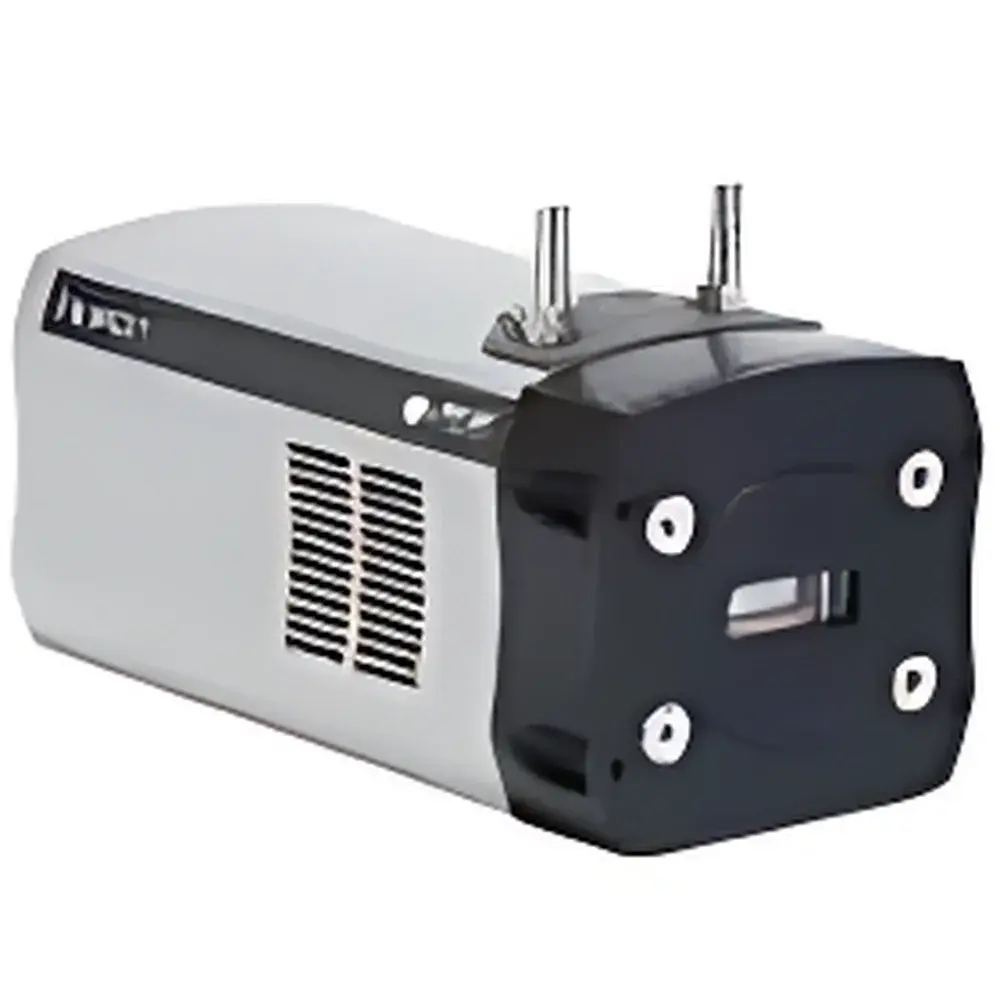
Andor NewtonEM Scientific-Grade Spectroscopic EMCCD Camera
| Brand | Andor |
|---|---|
| Origin | United Kingdom |
| Model | NewtonEM |
| Sensor Architecture | Electron-Multiplying CCD (EMCCD) |
| Pixel Format | 1600 × 200 or 1600 × 400 |
| Pixel Size | 16 µm × 16 µm |
| Cooling | Thermoelectric (TE), down to –100 °C |
| Vacuum Encapsulation | UltraVac™ |
| Interface | USB 2.0 |
| Quantum Efficiency Options | Multiple back-illuminated sensor variants available |
| Single-Photon Sensitivity | Yes |
| Primary Application Domain | Low-Light Spectroscopy, Time-Resolved Fluorescence, Raman, UV-Vis-NIR Spectral Imaging |
Overview
The Andor NewtonEM is a scientific-grade electron-multiplying CCD (EMCCD) camera engineered specifically for demanding spectroscopic applications where ultimate sensitivity, spectral fidelity, and quantitative accuracy are required. Unlike conventional CCDs, the NewtonEM integrates on-chip electron multiplication gain—achieved via a specialized serial register operated at high voltage—to amplify photoelectrons prior to readout. This architecture effectively renders read noise negligible, enabling true single-photon detection capability even at high frame rates. The camera is optimized for use with spectrometers, monochromators, and imaging spectrographs across UV–Vis–NIR wavelength ranges. Its design prioritizes photon-limited performance: ultra-low dark current, deep thermoelectric cooling, and long-term vacuum stability ensure reproducible, calibration-grade data acquisition in both laboratory and industrial analytical environments.
Key Features
- Electron-multiplying gain register delivering >1,000× on-chip signal amplification with sub-electron effective read noise
- Back-illuminated sensor options with peak quantum efficiency exceeding 95% in visible wavelengths and extended response into UV (200 nm) and NIR (1,000 nm)
- Two standard sensor formats: 1600 × 200 and 1600 × 400 pixels, both with uniform 16 µm × 16 µm pixel geometry—optimized for dispersion alignment and spectral line sampling
- Thermoelectric cooling to –100 °C, reducing dark current to <0.001 e⁻/pix/s at operating temperature
- UltraVac™ vacuum encapsulation technology ensuring >10-year maintenance-free vacuum integrity without getter reactivation or external pumping
- USB 2.0 interface supporting full-frame readout at up to 30 fps (depending on region of interest and gain settings), with deterministic latency and hardware-triggered synchronization
- On-board clocking control and programmable gain registers allow precise optimization of EM gain versus excess noise factor for application-specific SNR trade-offs
Sample Compatibility & Compliance
The NewtonEM is compatible with standard C-mount and F-mount optical interfaces, facilitating integration into OEM spectrometers and custom optical benches. Its compact footprint and low power consumption support benchtop, portable, and embedded instrumentation configurations. From a regulatory standpoint, the system complies with CE marking requirements for electromagnetic compatibility (EMC Directive 2014/30/EU) and low-voltage safety (LVD Directive 2014/35/EU). While not certified as medical or IVD equipment, its stable gain calibration, linear response over >4 orders of magnitude, and traceable dark current characterization support GLP-compliant workflows. Data provenance is preserved through embedded timestamping, sensor temperature logging, and hardware-based exposure tracking—features aligned with audit requirements under ISO/IEC 17025 and FDA 21 CFR Part 11 when deployed with compliant software environments.
Software & Data Management
Andor provides the Solis® software suite—a platform-independent, feature-rich application for acquisition, real-time processing, and spectral analysis. Solis supports full EM gain calibration, bias frame subtraction, flat-field correction, and spectral line fitting with centroiding algorithms. Raw image data is saved in standard 16-bit or 32-bit TIFF or Andor’s proprietary SIF format, preserving metadata including exposure time, sensor temperature, EM gain setting, and hardware trigger status. API access (via .NET, LabVIEW, MATLAB, and Python SDKs) enables seamless integration into automated measurement sequences, including those governed by ASTM E1317 (spectrophotometer calibration) or ISO 17025-accredited QA/QC protocols. All software modules undergo version-controlled release cycles with documented change logs for validation purposes.
Applications
- Low-light Raman spectroscopy requiring high spectral resolution and shot-noise-limited detection
- Time-resolved fluorescence lifetime imaging (FLIM) and phosphorescence decay analysis
- UV resonance Raman of biological macromolecules and catalytic intermediates
- Near-infrared photoluminescence mapping of semiconductor nanostructures
- Atomic emission spectroscopy in plasma diagnostics and laser-induced breakdown spectroscopy (LIBS)
- High-resolution Fourier-transform spectroscopy (FTS) post-detection with step-scan interferometers
FAQ
What is the typical EM gain stability over time and temperature?
EM gain exhibits <±2% drift over 8 hours at constant –80 °C sensor temperature; active thermal regulation and factory gain calibration tables mitigate thermal hysteresis.
Can the NewtonEM be used in vacuum or hazardous environments?
The camera is rated for operation in ambient air only; its UltraVac™ housing is sealed and non-serviceable—external vacuum or pressure exposure is prohibited.
Is NIST-traceable calibration available for radiometric response?
Andor offers optional factory-applied relative spectral responsivity (RSR) calibration against NIST-traceable standards (e.g., SRM 2031), delivered with certificate and uncertainty budget.
How does the 1600 × 400 sensor configuration affect spectral range and resolution compared to 1600 × 200?
The 400-row variant increases vertical dispersion tolerance and enables simultaneous multi-order or dual-grating acquisition but reduces maximum usable slit height in standard Czerny–Turner mounts; resolution per pixel remains identical due to fixed 16 µm pitch.
Does the USB 2.0 interface support hardware triggering with microsecond-level jitter?
Yes—external TTL triggers (rising/falling edge selectable) achieve <1 µs timing jitter relative to exposure start, with programmable delay and burst mode sequencing.




