
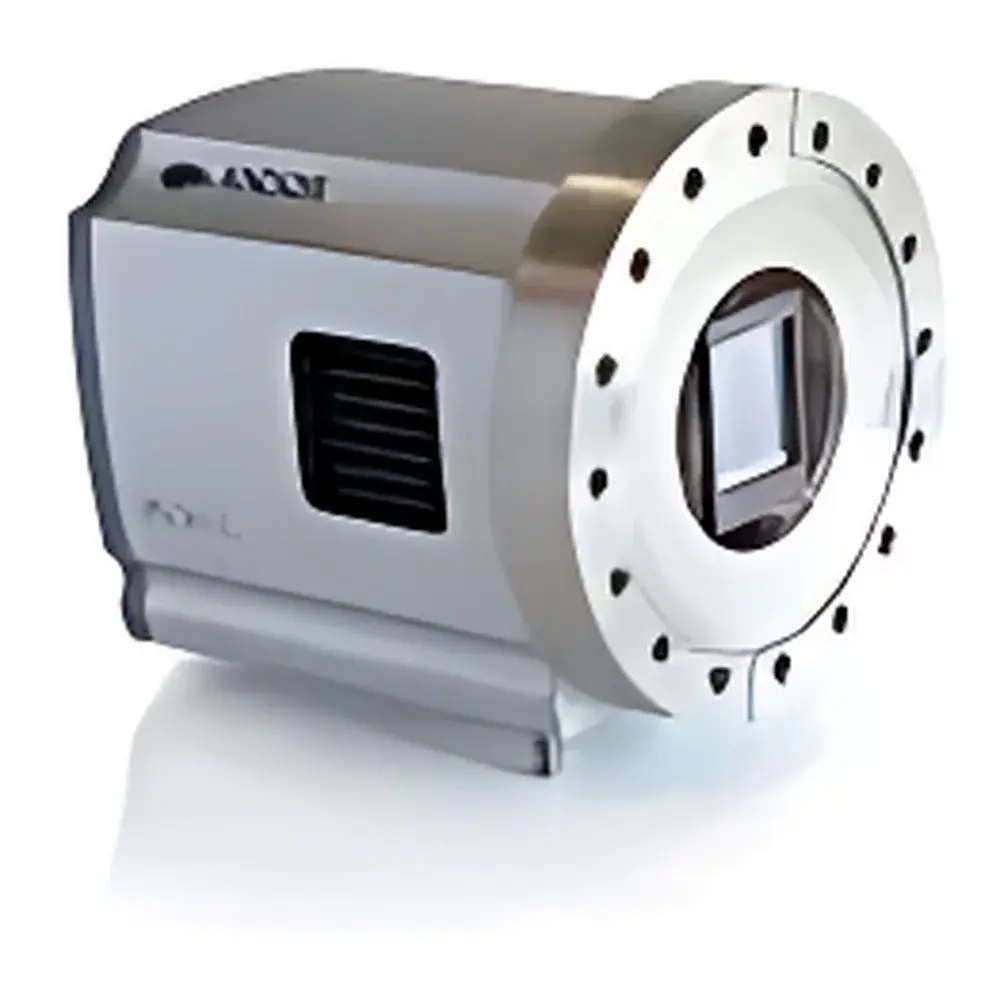
Andor DO Series X-ray CCD Camera
| Brand | Andor |
|---|---|
| Origin | United Kingdom |
| Manufacturer Type | Authorized Distributor |
| Origin Category | Imported |
| Model Series | DO Series |
| Interface | USB (select models) |
| Cooling | Deep Thermoelectric Cooling (select models) |
| Sensor Options | Front-Illuminated & Back-Illuminated CCD |
| Vacuum Flange Compatibility | ICF, ISO-K, KF |
| Readout Speeds | 0.6–3.2 fps |
| Pixel Formats | 1024×1024, 2048×2048, 2048×512 |
| Pixel Size | 13.0 µm × 13.0 µm or 13.5 µm × 13.5 µm |
| Noise Performance | Ultra-Low Read Noise (sub-3 e⁻ RMS, model-dependent) |
Overview
The Andor DO Series X-ray CCD Camera is a high-performance, vacuum-compatible imaging detector engineered for direct detection of soft to hard X-ray photons in synchrotron beamlines, laboratory X-ray sources, plasma diagnostics, and X-ray diffraction (XRD) and scattering applications. Unlike scintillator-coupled systems, the DO Series employs windowless, back-thinned (or front-illuminated) CCD sensors mounted directly within ultra-high vacuum (UHV) environments—enabling quantum efficiency exceeding 90% at energies below 1 keV and maintaining usable sensitivity up to ~12 keV. Its modular mechanical design integrates seamlessly with standard vacuum flanges (ICF, ISO-K, and KF), allowing flexible integration into custom end-stations, diffractometers, or plasma chambers without optical coupling losses or absorption artifacts. The camera’s core architecture prioritizes signal fidelity: deep thermoelectric cooling (down to –70 °C), low-noise clocking electronics, and optimized charge transfer efficiency ensure high dynamic range and photon-counting capability under low-flux conditions typical of time-resolved or microfocus experiments.
Key Features
- Vacuum-integrated, windowless direct-detection architecture eliminates absorption losses from entrance windows, maximizing QE across the 0.1–12 keV range
- Select models feature back-illuminated, deep-depletion CCD sensors with >95% peak QE at C-Kα (0.28 keV) and extended red response for higher-energy photons
- Deep thermoelectric cooling (–60 °C to –70 °C) suppresses dark current to <0.001 e⁻/pixel/s, enabling long exposures with minimal thermal noise
- Ultra-low read noise: as low as 2.3 e⁻ RMS (typ.) in slow-scan mode, supporting single-photon detection in low-signal regimes
- Multiple sensor formats: 1024×1024, 2048×2048, and 2048×512 pixel arrays—each optimized for resolution, field-of-view, or frame-rate trade-offs
- USB 2.0 interface (DO9xx series) provides plug-and-play operation with full 16-bit digitization and on-board bias correction
- Robust mechanical housing rated for UHV (<1×10⁻⁹ mbar) and compatible with bake-out protocols up to 80 °C
Sample Compatibility & Compliance
The DO Series supports both front- and back-illuminated CCD configurations, permitting application-specific optimization—for example, front-illuminated variants offer enhanced durability for routine lab use, while back-illuminated options deliver superior QE for synchrotron-based spectroscopy or coherent diffraction imaging. All models comply with CE marking requirements for electromagnetic compatibility (EMC Directive 2014/30/EU) and low-voltage safety (LVD Directive 2014/35/EU). The vacuum interface design adheres to ISO 3567 (KF), ISO 1609 (ICF), and DIN 28403 (ISO-K) dimensional standards, ensuring interchangeability with major vacuum system manufacturers (e.g., VAT, Pfeiffer, Edwards). For regulated environments—including GLP-compliant materials characterization labs—the DO Series supports audit-ready metadata logging (timestamp, temperature, exposure, gain settings) when operated with Andor Solis™ software, aligning with principles of ALCOA+ data integrity.
Software & Data Management
Andor Solis™ software (v5.x and later) provides full instrument control, real-time image preview, non-uniformity correction (flat-field, dark-frame subtraction), and batch acquisition scripting via Python API. Raw images are saved in industry-standard formats (FITS, TIFF, HDF5) with embedded metadata compliant with NeXus conventions—facilitating integration into automated analysis pipelines (e.g., DAWN, PyFAI, silx). The software supports FDA 21 CFR Part 11-compliant user access controls, electronic signatures, and audit trails when deployed in validated QA/QC workflows. Remote operation over Ethernet (via optional GigE adapter) enables centralized monitoring across multi-instrument beamlines without compromising timing precision.
Applications
- Synchrotron X-ray diffraction and scattering (SAXS/WAXS, XPCS)
- Time-resolved X-ray imaging in laser-plasma experiments
- Microfocus XRD and phase mapping in metallurgical and geological samples
- Soft X-ray microscopy and spectromicroscopy (e.g., at bending magnet beamlines)
- Crystallography beamline detectors for macromolecular crystallography (MX) screening
- Industrial X-ray inspection requiring high spatial resolution and low-dose sensitivity
FAQ
What vacuum flange types are supported by the DO Series?
The DO Series is supplied with configurable flange options including ICF (ISO Conflat), ISO-K (Kleinflansch), and KF (Quick-Release) variants—custom flange adapters can be specified at order entry.
Is the DO Series suitable for use with pulsed X-ray sources?
Yes—models with programmable external trigger input support synchronization with laser-pumped X-ray sources, RF-driven plasma emitters, or synchrotron timing signals (TTL or LVDS). Frame-to-frame jitter is <100 ns (rms).
How is calibration traceability maintained for quantitative intensity measurements?
Each DO camera is supplied with factory-measured QE curves, gain maps, and linearity coefficients traceable to NPL (UK) standards. Users may perform in-situ flat-field calibration using calibrated X-ray sources per ISO 15739:2013.
Can the DO Series operate in photon-counting mode?
While not a dedicated photon-counting detector, the ultra-low read noise and high full-well capacity (≥100,000 e⁻) enable threshold-based event detection in low-flux regimes when combined with post-acquisition centroiding algorithms.
What maintenance is required for long-term vacuum compatibility?
No routine maintenance is required. The sealed sensor chamber and metal-gasketed flange interfaces are designed for >10-year UHV service life; periodic bake-out (per vacuum system protocol) is recommended to sustain base pressure integrity.





