
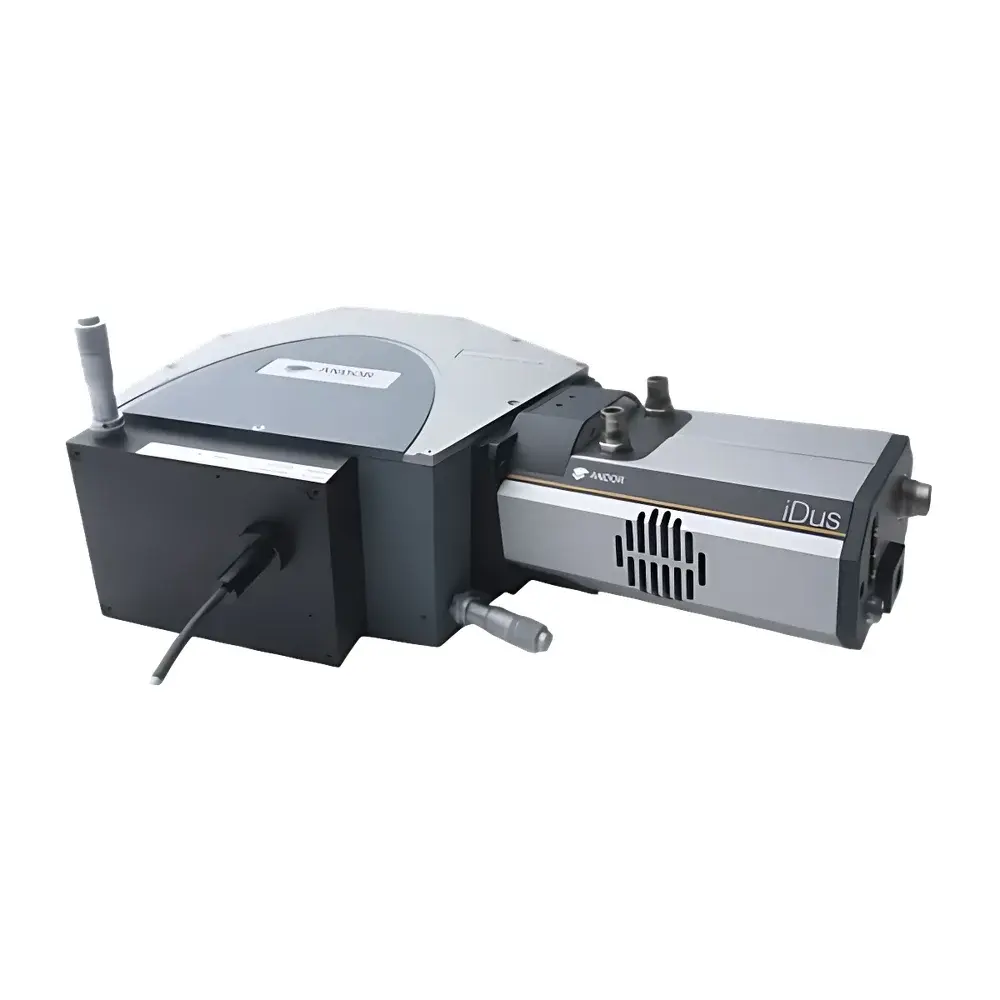
Andor Shamrock 163i Czerny-Turner Spectrograph
| Brand | Andor |
|---|---|
| Origin | United Kingdom |
| Model | Shamrock 163i |
| Focal Length | 163 mm |
| f-number | f/3.6 |
| Optical Design | Czerny-Turner |
| Grating Compatibility | Interchangeable ruled and holographic gratings |
| Input Options | Adjustable slit (10–200 µm), fiber optic coupling (SMA905, FC/PC), free-space input |
| Detector Interface | Standard Andor camera mounting (C-mount, F-mount, or direct sensor integration) |
| Wavelength Range | UV-Vis-NIR (dependent on grating and detector choice) |
| Resolution | <0.1 nm (typical, with 1200 grooves/mm grating and 10 µm slit) |
| Stray Light Rejection | <1×10⁻⁴ |
Overview
The Andor Shamrock 163i is a research-grade, compact Czerny-Turner spectrograph engineered for high-throughput, low-stray-light spectral acquisition across the ultraviolet, visible, and near-infrared (UV-Vis-NIR) regions. With a 163 mm focal length and an f/3.6 optical speed, the instrument delivers exceptional light-gathering efficiency while maintaining spatial and spectral fidelity—critical for low-light applications such as Raman spectroscopy, fluorescence lifetime imaging, plasma diagnostics, and time-resolved photoluminescence. Its modular architecture supports interchangeable diffraction gratings (ruling densities from 150 to 2400 grooves/mm), precision-adjustable entrance slits (10–200 µm), and multiple input configurations—including SMA905 and FC/PC fiber ports, lens-coupled free-space optics, and direct detector integration. Designed and manufactured in Belfast, UK, the Shamrock 163i adheres to ISO 9001-certified production protocols and is optimized for seamless integration with Andor’s iStar, Neo, and Zyla sCMOS camera platforms.
Key Features
- Czerny-Turner optical layout with kinematically aligned mirrors and thermally stable aluminum housing for long-term wavelength calibration stability (<0.05 pixels/hour drift under ambient lab conditions)
- f/3.6 aperture enables >30% throughput improvement over comparable f/4.5 instruments—particularly advantageous for weak-signal detection in confocal or single-photon counting setups
- Motorized grating turret (optional) supporting up to three gratings with automated wavelength calibration via onboard He-Ne or Hg-Ar lamp references
- Adjustable entrance slit with micrometer-driven translation (±5 µm repeatability) and integrated shutter for dark current characterization
- Standard C-mount and F-mount interfaces; optional vacuum-compatible and cryo-cooled detector adapters for extended NIR performance (up to 1700 nm)
- Compliant with RoHS and CE directives; designed for Class I laser safety environments per IEC 60825-1 when used with appropriate laser sources
Sample Compatibility & Compliance
The Shamrock 163i accommodates diverse sample excitation and collection geometries—whether fiber-coupled microspectroscopy of semiconductor wafers, free-space collimated beams from tunable lasers, or multimode fiber inputs from remote sensing probes. It supports full spectral calibration traceability to NIST-traceable emission line standards (e.g., Hg, Ne, Ar lamps). For regulated environments, the system operates within GLP/GMP frameworks when paired with Andor’s Solis or OEM SDK-controlled acquisition software, enabling audit-ready metadata logging—including timestamped grating position, slit width, exposure parameters, and environmental sensor readings (optional temperature/humidity monitoring module). While not inherently FDA 21 CFR Part 11 compliant, its data export formats (FITS, HDF5, CSV) and API-level control support integration into validated LIMS or ELN systems meeting pharmaceutical and clinical research requirements.
Software & Data Management
Control and spectral analysis are performed via Andor’s Solis software (Windows-based), offering real-time spectrum display, multi-channel background subtraction, peak centroiding with Gaussian fitting, and batch processing of time-series acquisitions. The instrument SDK provides native C/C++, Python (PyAndor), MATLAB, and LabVIEW drivers—enabling custom automation for pump-probe experiments, hyperspectral raster scanning, or closed-loop feedback in adaptive optics systems. All spectral data include embedded EXIF-style metadata: grating groove density, blaze angle, slit width, central wavelength, detector gain/offset, and optical path temperature (if equipped). Export formats conform to ASTM E131-22 (Standard Terminology Relating to Molecular Spectroscopy) and support spectral library interoperability (JCAMP-DX v5.0 compatible).
Applications
- Raman spectroscopy: High throughput enables sub-second acquisition of fingerprint-region spectra from biological tissues or battery electrode materials
- Plasma emission analysis: Resolves narrow atomic lines (e.g., O I at 777.4 nm, Hα at 656.3 nm) with minimal inter-order contamination
- Quantum dot photoluminescence mapping: Coupled with motorized XY stages for spatially resolved spectral imaging (hyperspectral cube generation)
- Laser-induced breakdown spectroscopy (LIBS): Robust against transient pulse intensities; accommodates gated ICCD synchronization
- Environmental monitoring: Field-deployable with ruggedized housing option; used in UAV-mounted air quality sensors for NO₂/SO₂ ratio quantification
FAQ
What wavelength ranges can the Shamrock 163i cover?
Depending on grating selection and detector type, the usable range spans 190–1700 nm—UV enhanced coatings extend sensitivity below 250 nm; InGaAs detectors enable operation beyond 1100 nm.
Is vacuum purging supported?
Yes—optional purge ports allow nitrogen or argon flushing to eliminate atmospheric water vapor absorption bands in the NIR region (e.g., ~1400 nm and 1900 nm).
Can it be synchronized with pulsed lasers or gated detectors?
Absolutely—the spectrograph features TTL-compatible trigger I/O for precise timing alignment with ultrafast lasers (ps/fs) and ICCD/ICMOS detectors, including delay generators for time-resolved studies.
How is wavelength calibration maintained during thermal cycling?
The monolithic aluminum baseplate and low-CTE mirror mounts minimize mechanical drift; regular recalibration using built-in lamp references ensures ±0.02 nm accuracy over 24 h at 20 ± 2 °C.
Does Andor provide OEM integration support?
Yes—full mechanical drawings, electrical interface schematics, and SDK documentation are provided under NDA for turnkey system integrators developing analytical instrumentation or industrial process monitors.







