
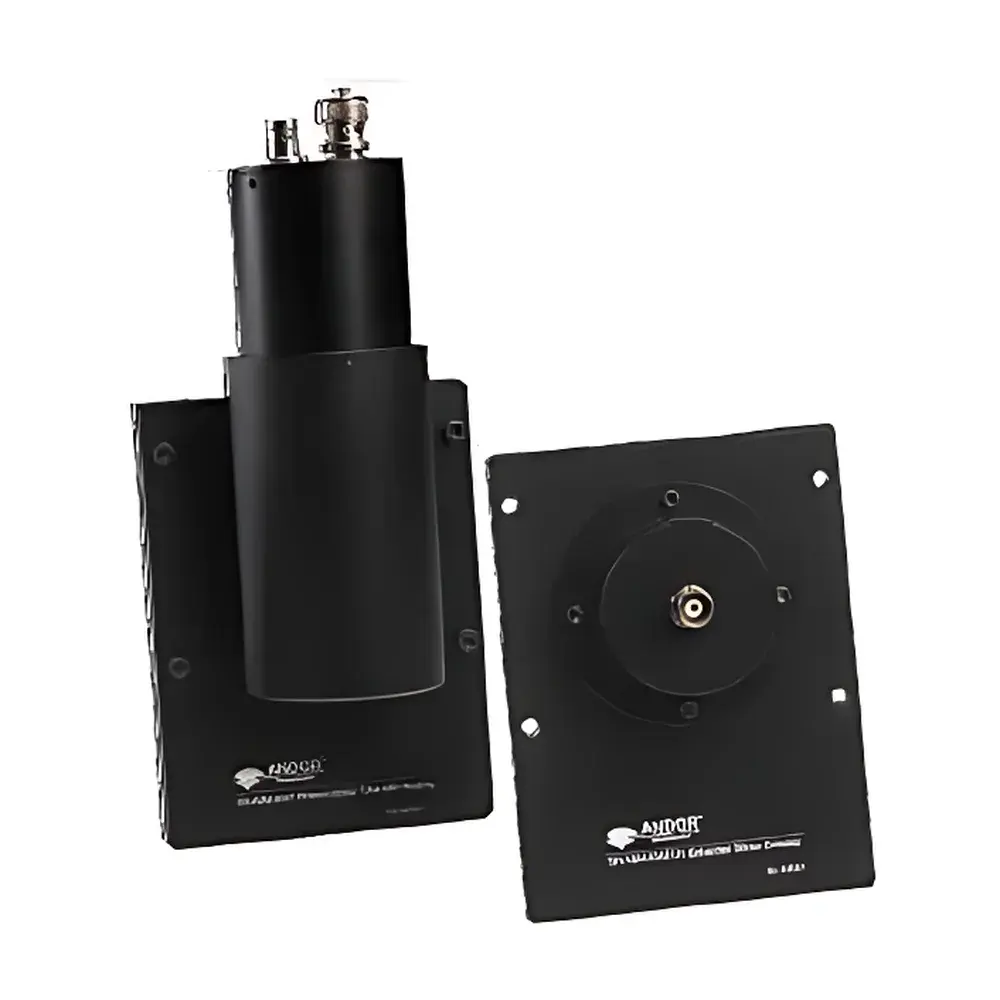
Andor Single-Point Detectors for Spectroscopy
| Brand | Andor |
|---|---|
| Origin | United Kingdom |
| Detector Types | PMT (185–900 nm), Si Photodiode (200–1100 nm), InGaAs (800–1900 nm), PbS (800–2900 nm), InSb (1–5.5 µm), MCT (2–12 µm) |
| Power Supply | High-Voltage PMT Driver |
| Data Acquisition | Single-Photon Counting Module & Analog Digitizer |
| Accessories | Sample Chambers, Filter Wheels, Fiber-Optic Coupling Kits |
Overview
Andor Single-Point Detectors are precision photonic sensing solutions engineered to extend the spectral response, dynamic range, and application flexibility of Shamrock spectrographs and other Czerny–Turner monochromators. Unlike array-based detectors (e.g., CCD or InGaAs linear arrays), these discrete-element detectors deliver superior signal-to-noise ratio (SNR), sub-nanosecond temporal resolution, and optimized quantum efficiency in targeted wavelength bands—making them indispensable for low-light, time-resolved, or high-dynamic-range spectroscopic measurements. Each detector type is selected based on fundamental photoelectric conversion physics: photomultiplier tubes (PMTs) leverage secondary electron multiplication for ultraviolet–visible sensitivity; semiconductor photodiodes rely on bandgap-limited absorption; while cryogenically cooled InSb and MCT devices exploit intrinsic carrier excitation in mid-infrared regimes. All units integrate seamlessly with Andor’s spectrograph optical benches via standardized flange mounts and fiber-optic input interfaces, supporting both free-space and fiber-coupled configurations.
Key Features
- Multi-platform compatibility: Designed for direct integration with Shamrock 163, 303i, 500, and 750 spectrographs, as well as third-party monochromators using standard 1/4″–28 or M42 mounting threads.
- Wavelength coverage spanning 185 nm to 12 µm: Achieved through seven detector technologies—PMT, silicon photodiode, InGaAs, PbS, thermoelectrically cooled InSb, and liquid-nitrogen–cooled MCT—each calibrated per NIST-traceable standards.
- Low-noise electronics architecture: PMT modules include regulated high-voltage supplies (0–1200 V, <0.01% ripple); InSb and MCT detectors feature two-stage thermoelectric or LN₂ cooling to suppress dark current below 1 nA at operating temperature.
- Modular data acquisition: Optional single-photon counting modules support >80 MHz count rates with <2 ns dead time; analog digitizers offer 16-bit resolution, 1 MS/s sampling, and hardware-triggered acquisition synchronized to external lasers or choppers.
- Robust mechanical design: Aluminum alloy housings with black-anodized finish ensure EMI shielding and thermal stability; all units comply with CE, UKCA, and RoHS directives.
Sample Compatibility & Compliance
These detectors accommodate diverse sample interaction geometries—including transmission, reflection, fluorescence, Raman scattering, and plasma emission—when paired with appropriate sample chambers, motorized filter wheels (6–12 position), and UV-grade fused silica or CaF₂ fiber bundles. Optical coupling is optimized for numerical aperture matching (NA 0.22 typical) and minimal étendue loss. From a regulatory standpoint, detector control firmware supports audit trail logging and user-access-level configuration management in accordance with FDA 21 CFR Part 11 requirements when deployed in GLP/GMP environments. Calibration certificates (including spectral responsivity curves and linearity verification) are supplied with each unit and conform to ISO/IEC 17025-accredited procedures.
Software & Data Management
Andor SOLIS software provides unified control across all detector types, enabling real-time spectral acquisition, dark subtraction, gain optimization, and photon-counting histogram analysis. The SDK (Software Development Kit) supports native integration with LabVIEW, MATLAB, Python (via PyAndor), and C/C++ applications—facilitating custom automation of kinetic scans, multi-channel synchronization, and real-time spectral fitting. Raw data export is supported in HDF5, ASCII, and Andor’s proprietary .SIF formats, ensuring long-term archival integrity and interoperability with third-party analysis platforms such as Igor Pro, OriginLab, and Thermo Scientific Omnic.
Applications
- Time-resolved fluorescence lifetime spectroscopy (TCSPC) using fast-gated PMTs
- Near-infrared process monitoring in pharmaceutical granulation (InGaAs, 900–1700 nm)
- Mid-IR absorption spectroscopy of hydrocarbons and polymers (MCT, 2.5–10 µm)
- Plasma diagnostics in fusion research (PbS and InSb for continuum and line-emission analysis)
- Low-light Raman detection under ambient conditions (high-gain PMT + notch filtering)
- UV-VIS absorbance quantification in microfluidic reaction monitoring (Si photodiode, 200–1000 nm)
FAQ
Which detector offers the highest sensitivity in the UV range (185–400 nm)?
PMT-based detectors provide the highest photon detection efficiency (PDE) in this region, typically exceeding 25% at 250 nm with bialkali photocathodes.
Can the InSb detector operate without liquid nitrogen?
Yes—thermoelectrically cooled versions are available for operation down to –196 °C; however, full spectral responsivity (1–5.5 µm) and optimal noise performance require LN₂ immersion.
Is fiber-optic coupling standardized across all detector models?
All units accept SMA 905 connectors with 500 µm core diameter fibers; optional FC/PC and FCP-2 adapters are available for OEM integration.
Does the single-photon counting module support time-tagged time-resolved (TTTR) mode?
Yes—firmware v4.2+ enables TTTR acquisition with timestamp resolution of 100 ps and buffer depths up to 16 million events.
Are calibration files traceable to national metrology institutes?
Each detector ships with a NIST-traceable spectral responsivity certificate, including uncertainty budgets calculated per GUM guidelines.




