
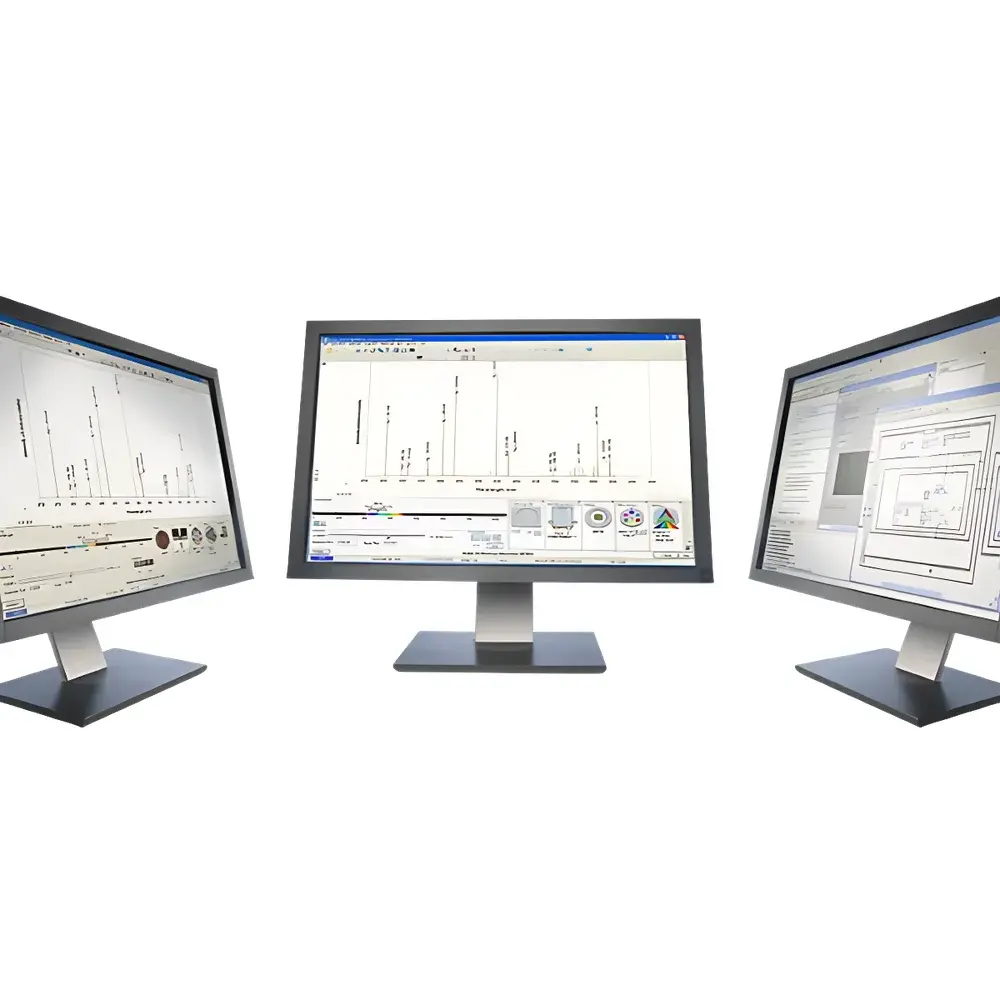
Andor Solis Software for Spectroscopy and Imaging Systems
| Brand | Andor |
|---|---|
| Origin | United Kingdom |
| Model | Solis |
| Operating Systems | Windows Vista/7/8/10 (32-bit & 64-bit) |
| Development Interfaces | C/C++, C#, VB6, LabVIEW, MATLAB, Linux-compatible SDK |
| Compatible Hardware | Andor CCD/EMCCD/sCMOS cameras, spectrographs, motorized stages, filter wheels, shutters |
| Integration Support | µ-Manager plugin architecture |
Overview
Andor Solis is a professional-grade, vendor-specific acquisition and analysis software platform engineered for precise control and quantitative data capture from Andor’s family of scientific imaging and spectroscopic instrumentation. Built on a modular architecture, Solis implements a deterministic real-time acquisition engine grounded in low-level device driver integration—enabling synchronized operation across multi-component experimental setups including cameras, spectrographs, motorized optical components, and external trigger sources. Its core design adheres to the principles of reproducible scientific measurement: deterministic timing, hardware-level exposure control, and pixel-accurate ROI-based data reduction. Solis does not function as a generic image viewer; rather, it serves as a calibrated instrument control layer that bridges raw photon detection events with traceable spectral or spatial intensity quantification—critical for applications governed by ISO/IEC 17025, ASTM E131, or USP spectroscopic validation requirements.
Key Features
- Fully integrated hardware control: Direct parameterization of exposure time, readout speed, gain mode (EM, conventional), trigger polarity, and synchronization logic across Andor cameras and peripheral devices.
- Real-time ROI processing: Configurable rectangular, circular, or polygonal regions of interest with live histogramming, line profiling, and statistical reporting (mean, std dev, min/max, SNR).
- Embedded image processing toolkit: Includes convolution-based filters (mean, median, Gaussian), edge detection operators (Sobel, Canny, Laplacian), background subtraction (rolling ball, polynomial fit), and flat-field correction with user-defined reference frames.
- Multi-dimensional acquisition support: Time-lapse, z-stack, lambda-scan, and combined hyperspectral acquisition modes with metadata-tagged file output (FITS, TIFF, ANDOR BIN, CSV).
- Deterministic timing architecture: Sub-millisecond jitter in external trigger response and hardware-gated acquisition—validated for pump-probe, time-resolved fluorescence, and synchrotron beamline applications.
Sample Compatibility & Compliance
Solis natively supports all current-generation Andor detectors—including Newton, iStar, Kymera, Shamrock, and Neo sCMOS platforms—as well as legacy systems via firmware-mapped register access. The software complies with Windows Driver Model (WDM) and Kernel-Mode Driver Framework (KMDF) standards for stable kernel-level communication. All exported datasets include embedded EXIF-like metadata conforming to the Andor Metadata Standard v3.2, ensuring auditability under GLP and GMP environments. While Solis itself is not FDA 21 CFR Part 11 certified out-of-the-box, its SDK enables integration with third-party electronic lab notebook (ELN) systems supporting electronic signatures, audit trails, and role-based access control when deployed within validated laboratory informatics infrastructure.
Software & Data Management
The Solis SDK delivers comprehensive language-agnostic APIs through native DLLs (Windows) and shared libraries (Linux), exposing over 200 documented functions for camera configuration, spectrum acquisition, motor control, and metadata injection. Pre-built wrappers are provided for C/C++, C#, VB6, LabVIEW (NI-DAQmx compatible), and MATLAB (via MEX interface). A dedicated µ-Manager adapter module allows seamless incorporation into life science microscopy workflows—supporting automatic device discovery, multi-channel acquisition sequencing, and macro-driven experiment automation. Data persistence follows FAIR principles: raw frames retain bit-depth fidelity (16-/32-bit integer or float), processed spectra are exportable in JCAMP-DX v6 format, and time-series datasets support HDF5 containerization with attribute-based indexing.
Applications
- Confocal and widefield fluorescence lifetime imaging (FLIM), where precise gate width control and photon-counting histogram accumulation are essential.
- Raman microspectroscopy requiring pixel-to-wavenumber calibration stability across thermal drift cycles.
- X-ray diffraction and XRF mapping using Andor’s high-frame-rate CCDs, leveraging ROI binning to maintain count-rate linearity.
- Time-resolved absorption spectroscopy in ultrafast laser labs, utilizing hardware-triggered burst acquisition with sub-100 ns inter-frame delays.
- Automated QC inspection in semiconductor metrology, integrating Solis with motion controllers for wafer-scale spectral scanning.
FAQ
Is Solis compatible with 64-bit versions of Windows 10?
Yes—Solis v4.32 and later fully support Windows 10 (64-bit) with signed drivers and UAC-compliant installation.
Can I use Solis to control non-Andor spectrometers or cameras?
No—Solis is exclusively designed for Andor hardware; it does not implement generic USB3 Vision or GenICam protocols.
Does the SDK support headless (no GUI) operation for automated experiments?
Yes—the SDK includes command-line execution mode and service-hosted acquisition daemons suitable for unattended long-term monitoring.
What file formats can Solis export processed spectral data?
JCAMP-DX (.jdx), ASCII CSV with wavelength/intensity columns, FITS (with WCS-compliant spectral axis keywords), and proprietary .SOLIS binary with embedded calibration tables.
Is technical support included with the software license?
Andor provides complimentary email-based support for installation and basic API usage; extended SLA contracts are available for mission-critical deployments requiring remote diagnostics and priority escalation.





