
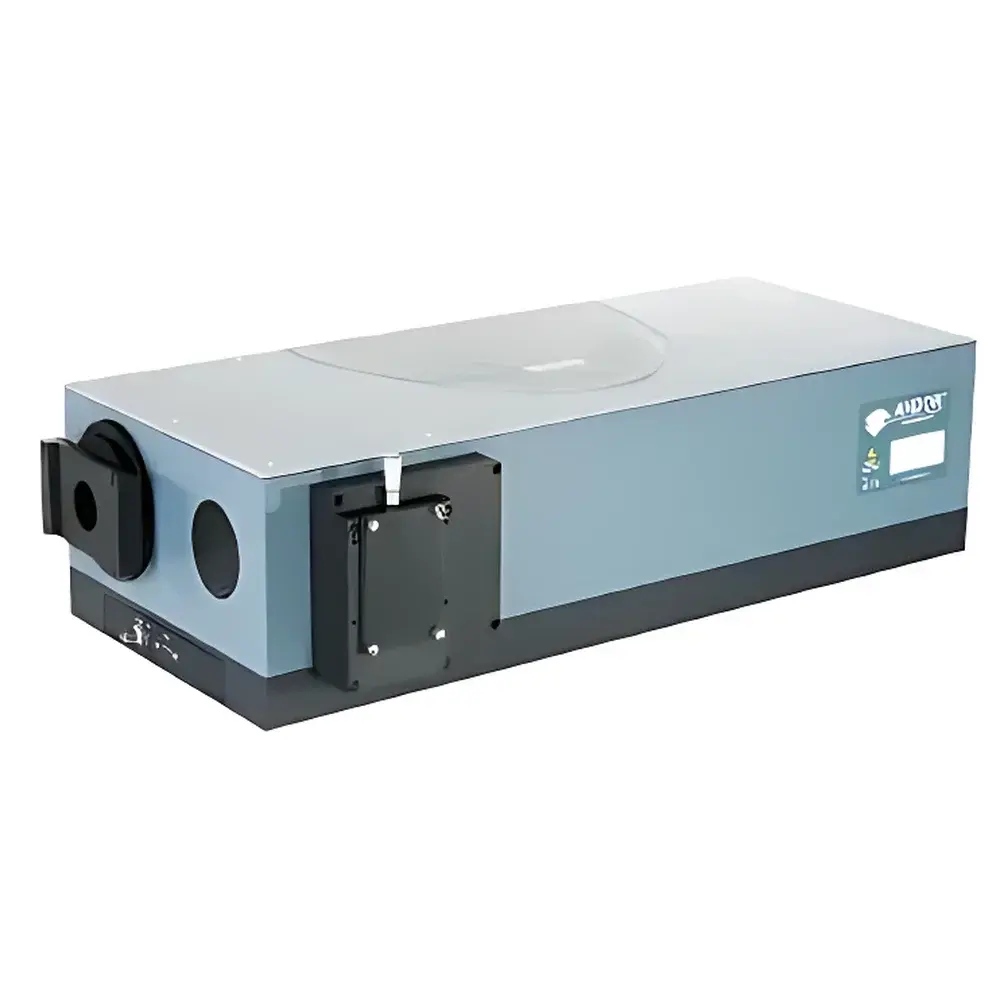
Andor SR750 High-Resolution Czerny-Turner Spectrometer
| Brand | Andor |
|---|---|
| Origin | United Kingdom |
| Model | SR750 |
| Spectral Resolution | Up to 0.02 nm |
| Optical Design | Czerny-Turner |
| Grating Options | Triple-grating turret (user-recorded per unit) |
| Detector Interfaces | Dual-output ports (CCD/ICCD, InGaAs, MCT, etc.) |
| Wavelength Range | Up to 12 µm (with appropriate detector & silver-coated optics) |
| Stray Light Rejection | Optimized multi-path optical layout with low crosstalk |
| Optional Coating | Enhanced silver coating for improved IR reflectivity |
| Accessories | Fiber optic coupling, flange mounts, motorized slits, shutters, adjustable leveling feet |
| Compliance | Designed for integration into GLP/GMP and ISO/IEC 17025-compliant spectroscopic workflows |
Overview
The Andor SR750 is a research-grade, high-resolution Czerny-Turner monochromator-spectrometer engineered for demanding spectral analysis applications requiring exceptional wavelength discrimination and signal fidelity. Operating on the fundamental principle of angular dispersion via diffraction gratings, the SR750 achieves intrinsic resolution down to 0.02 nm—enabling precise separation of closely spaced emission lines in atomic, molecular, and solid-state systems. Its rigid, thermally stable optical bench minimizes drift during extended acquisitions, while the optimized light path ensures high throughput across UV-VIS-NIR-MIR ranges (dependent on grating selection and detector configuration). Unlike modular spectrometers with fixed optical paths, the SR750 integrates a user-documented triple-grating turret system, allowing rapid, repeatable switching between gratings without realignment—critical for multi-modal experiments such as simultaneous Raman and fluorescence mapping or time-resolved absorption kinetics.
Key Features
- Sub-0.02 nm spectral resolution achievable with high-line-density gratings and narrow input slits, validated under standardized NIST-traceable calibration conditions.
- Dual-output port architecture supports concurrent or sequential use of complementary detectors—for example, an Andor iStar ICCD for time-gated UV-VIS detection and a liquid-nitrogen-cooled MCT array for extended infrared acquisition up to 12 µm.
- Triple-grating turret with engraved, unit-specific calibration records enables traceable grating interchange; each turret position is associated with calibrated groove density, blaze angle, and efficiency curve metadata stored in instrument logs.
- Low-crosstalk multi-channel optical design facilitates spatially resolved spectroscopy—ideal for line-scan imaging, fiber bundle coupling, or multi-point plasma diagnostics where spectral fidelity across parallel channels must be preserved.
- Optional enhanced silver coating on all reflective optics improves average reflectance above 95% from 350 nm to 12 µm, significantly boosting signal-to-noise ratio in mid-infrared measurements compared to standard aluminum coatings.
- Modular mechanical interface supports ISO-K and CF flanges, motorized precision slits (1–300 µm), vacuum-compatible shutter modules, and kinematic fiber-optic couplers compliant with IEC 61290-1-3 for laser characterization setups.
Sample Compatibility & Compliance
The SR750 accommodates diverse sample interaction geometries—including transmission, reflection, diffuse reflectance, and grazing-incidence configurations—via standardized mounting interfaces compatible with commercial stages and environmental chambers (e.g., cryostats, gas cells, electrochemical cells). When integrated with Andor’s SDK-controlled detectors and third-party stages, the system supports automated spectral mapping in accordance with ASTM E131 (Standard Terminology Relating to Molecular Spectroscopy) and ISO 17025 clause 5.4.2 (validation of measurement uncertainty for spectroscopic instruments). All firmware and driver-level communication layers are designed to meet FDA 21 CFR Part 11 requirements for electronic records and signatures when deployed in regulated QC/QA laboratories.
Software & Data Management
Controlled via Andor’s SOLIS software suite or programmatically through native C/C++, Python (PyAndor), and LabVIEW APIs, the SR750 supports full audit-trail logging—including grating position timestamps, slit width history, wavelength calibration events, and detector temperature logs. Data files are exported in vendor-neutral formats (FITS, HDF5, and ASCII) with embedded metadata compliant with the IUPAC Spectral Data Exchange Standard (SDES). Calibration routines include pixel-to-wavelength mapping using Hg/Ar/Ne lamp spectra, quadratic polynomial fitting with residual error reporting, and optional external reference diode locking for long-term stability monitoring.
Applications
- High-resolution Raman spectroscopy of 2D materials (e.g., strain mapping in graphene heterostructures)
- Time-resolved laser-induced breakdown spectroscopy (LIBS) for elemental depth profiling in metallurgical QC
- Photoluminescence excitation (PLE) mapping of quantum dot ensembles with sub-nanometer spectral binning
- Gas-phase rotational-vibrational spectroscopy in atmospheric chemistry simulation chambers
- Plasma emission diagnostics in fusion research, leveraging multi-point fiber-fed collection with synchronized ICCD gating
- FTIR-complementary dispersive IR spectroscopy using cooled MCT arrays in synchrotron beamlines
FAQ
What detector types are natively supported at the dual output ports?
The SR750 accepts standard 100 mm × 100 mm detector mounts compliant with Andor’s iDus, iStar, and Newton platforms, as well as third-party InGaAs and MCT arrays with custom flange adapters.
Is the 0.02 nm resolution specified at all wavelengths and grating configurations?
No—the 0.02 nm value represents best-case performance at 500 nm using a 2400 l/mm grating and 10 µm entrance slit; actual resolution varies with focal length, grating dispersion, and slit width per the Rayleigh criterion.
Can the SR750 operate under vacuum or purged environments?
Yes—optional vacuum-compatible versions feature CF-63 flanges, stainless-steel housing, and bake-out rated seals (up to 10⁻⁶ mbar), suitable for VUV spectroscopy down to 115 nm.
How is wavelength calibration maintained over thermal cycles?
Each unit includes a built-in Hg/Ar reference lamp port; automated calibration sequences can be scheduled within SOLIS to correct for thermal drift, with residuals logged and traceable to NIST SRM 2036.
Does Andor provide application-specific configuration support for OEM integration?
Yes—Andor’s Scientific Applications Group offers pre-validation packages for pharmaceutical dissolution testing, semiconductor metrology, and academic ultrafast spectroscopy, including SOP templates aligned with ISO/IEC 17025 documentation requirements.





