
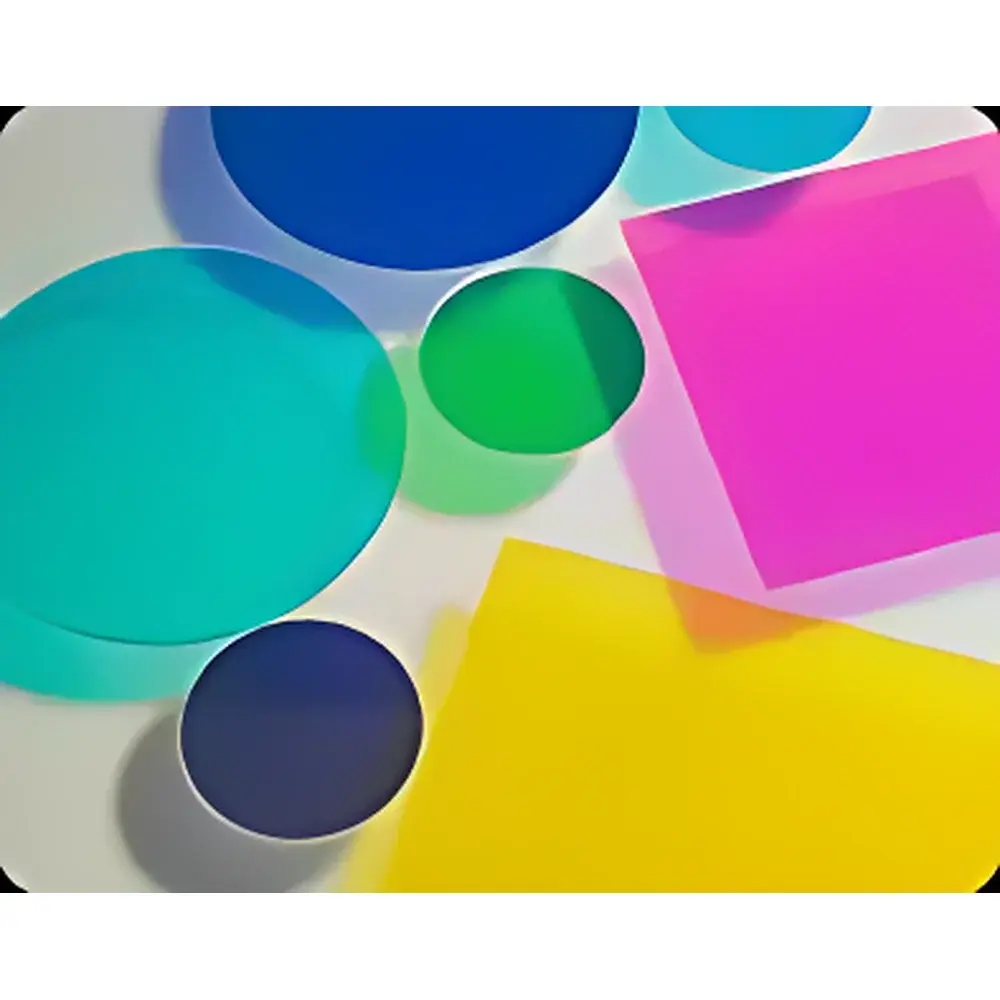
Andover Dichroic Filters
| Brand | Andover |
|---|---|
| Origin | USA |
| Manufacturer Type | Authorized Distributor |
| Product Category | Imported Optical Component |
| Model | Dichroic Filters |
| Price Range | USD 140 – 420 (per piece, depending on size and spectral specification) |
| Component Type | Optical Element |
| Size Tolerance | +0.0 mm / −0.25 mm |
| Thickness | 1.0 mm ± 0.25 mm |
| Clear Aperture | ≥95% of outer diameter |
| Substrate Material | Soda-lime glass |
| Flatness | 3–5 waves per 25 mm |
| Parallelism | ≤3 arc minutes |
| Surface Quality | 80/50 per MIL-O-13830B |
| Coating Quality | 40/20 per MIL-O-13830B |
| Environmental Durability | Compliant with MIL-C-675A (humidity & abrasion) |
| Max Operating Temperature | +100 °C |
| Mounting | Unmounted (bare substrate with thin-film coating) |
Overview
Andover Dichroic Filters are precision thin-film interference filters engineered for high-efficiency spectral separation in optical systems. Based on the principle of constructive and destructive interference in multilayer dielectric coatings, these filters exhibit sharp transition edges between high-transmission and high-reflection bands—enabling wavelength-selective beam routing without significant absorption losses. Unlike absorptive color filters, dichroic filters operate via reflection/transmission dichotomy: incident light is split into two spectrally distinct paths—typically one transmitted and one reflected—at a defined angle (commonly 0° or 45°). This makes them indispensable in fluorescence microscopy, laser beam combining/splitting, RGB color management systems, and multi-spectral imaging platforms where minimal thermal load and high optical throughput are critical.
Key Features
- High-performance dielectric thin-film coatings deposited via ion-assisted e-beam evaporation, ensuring exceptional spectral fidelity and long-term environmental stability
- Available in three functional classes: additive color filters (for RGB synthesis), subtractive color filters (for CMY color separation), and reflective dichroics (for laser line selection and harmonic separation)
- Standard substrates fabricated from optically polished soda-lime glass with stringent flatness (3–5 waves/25 mm) and parallelism (≤3 arc min) specifications
- Surface quality rated to MIL-O-13830B standards (80/50 scratch-dig for substrate; 40/20 for coated surface)
- Compliant with MIL-C-675A for humidity resistance and mechanical abrasion endurance—validated for continuous operation up to +100 °C
- Unmounted design allows integration into custom kinematic mounts, filter wheels, or OEM optical assemblies without thermal stress from metal housings
Sample Compatibility & Compliance
Andover Dichroic Filters are compatible with standard optical breadboards, cage systems (e.g., Thorlabs 30 mm and 60 mm), and automated filter changers. Their unmounted form factor supports direct epoxy bonding or mechanical clamping using low-stress retaining rings. All filters meet RoHS Directive 2011/65/EU and are manufactured under ISO 9001-certified processes. Spectral performance data—including transmission/reflection curves, edge steepness (typical Δλ10% < 15 nm), and polarization sensitivity—is traceably documented per batch and supplied with each shipment. While not explicitly certified to FDA 21 CFR Part 11, their metrological traceability and documentation support GLP/GMP-aligned validation protocols in regulated R&D environments.
Software & Data Management
No embedded firmware or proprietary software is required for operation—these are passive optical components. However, Andover provides downloadable spectral data files (CSV and SDF formats) for integration into optical design software including Zemax OpticStudio, CODE V, and FRED. Each filter part number corresponds to a unique spectral profile validated at NIST-traceable calibration labs. Users may import transmittance and reflectance curves directly into simulation workflows to model system-level throughput, crosstalk, and signal-to-noise ratios. Batch-specific test reports include angular dependence characterization (0°–45° incidence), enabling accurate modeling of off-axis performance in tilted-mount configurations.
Applications
- Fluorescence excitation/emission separation in widefield and confocal microscopes
- RGB trichroic beam combiners in digital projectors and laser display systems
- Color balancing and gamut expansion in professional imaging and printing calibration setups
- Spectral channel isolation in hyperspectral sensors and multi-band remote sensing payloads
- Harmonic separation (e.g., 1064 nm / 532 nm / 355 nm) in ultrafast and DPSS laser systems
- Photometric calibration references in astronomical instrumentation and radiometry labs
FAQ
What is the difference between additive and subtractive dichroic filters?
Additive filters transmit a narrow band while reflecting all other wavelengths—used to combine primary colors (e.g., red + green + blue light). Subtractive filters reflect a specific band and transmit the remainder—employed in CMYK color reproduction where overlapping reflections yield secondary hues.
Can these filters be used at non-normal incidence angles?
Yes—spectral performance shifts predictably with angle; 45° incidence is commonly used in cube-based dichroic systems. Transmission/reflection curves are provided for both 0° and 45° in technical datasheets.
Are custom center wavelengths or bandwidths available?
Andover offers OEM customization including non-standard CWLs, asymmetric passbands, and hybrid AR/dichroic coatings—subject to minimum order quantities and lead time verification.
Do these filters require cleaning before installation?
All filters are shipped in Class 100 cleanroom conditions with protective coatings. Light cleaning with spectroscopic-grade acetone and lint-free wipes is permissible if contamination is observed—avoid ultrasonic baths or abrasive solvents.
How does temperature affect spectral performance?
Within the specified operating range (−20 °C to +100 °C), peak wavelength drift is typically <0.02 nm/°C due to thermo-optic expansion of the dielectric stack—negligible for most laboratory applications but accounted for in high-precision interferometric systems.




