
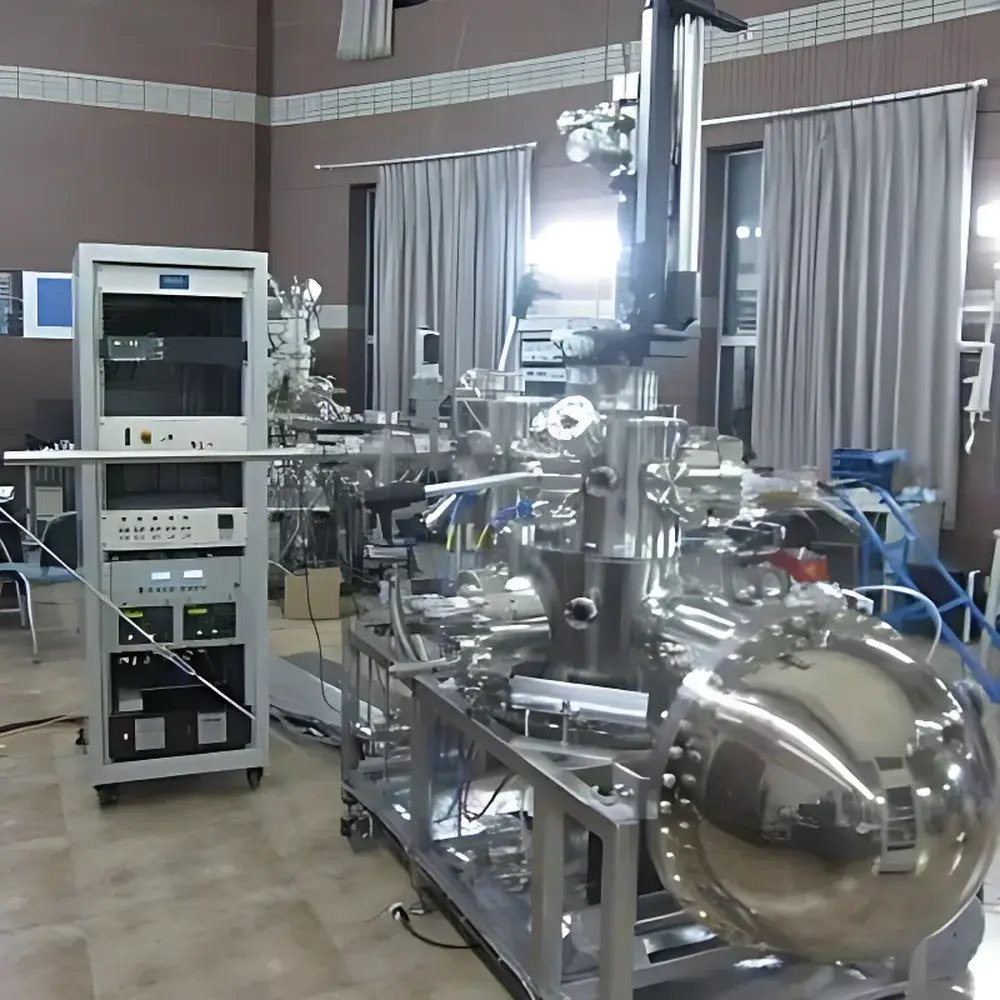
Angstrom ELS5000 High-Resolution Electron Energy Loss Spectrometer (HREELS)
| Brand | Angstrom |
|---|---|
| Origin | USA |
| Manufacturer Type | Authorized Distributor |
| Origin Category | Imported |
| Model | ELS5000 |
| Pricing | Upon Request |
Overview
The Angstrom ELS5000 is a high-vacuum-compatible, ultra-high-resolution electron energy loss spectrometer engineered for surface science investigations requiring sub-meV energy resolution and precise momentum-resolved detection. It operates on the principle of inelastic scattering of monoenergetic electrons from a highly stable, monochromated electron source—typically a thermionic or field-emission gun with energy spread <1 meV—incident upon a crystalline or nanostructured sample under ultrahigh vacuum (UHV, ≤1×10⁻¹⁰ mbar). The scattered electrons are energy-analyzed using a hemispherical electron energy analyzer (HEA) with dual-pass optics and position-sensitive detection, enabling simultaneous acquisition of energy-loss spectra across a defined angular acceptance (±0.04° full width at half maximum). When operated at a primary beam energy of 7.4 eV, the system achieves an intrinsic energy resolution of ≤0.7 meV and an angular resolution of 0.08°, corresponding to a momentum transfer resolution of ~0.002 Å⁻¹—critical for mapping phonon dispersion, surface plasmon polaritons, and interfacial electronic excitations.
Key Features
- UHV-integrated optical design: All electron-optical components—including the 4-grid tungsten electron gun (1.59 cm miniaturized aperture), LEED-compatible reverse-view optics, and MCP-based detection—are constructed without polymer-coated wiring or glass-fiber insulation, ensuring compatibility with bake-out temperatures up to 450 °C and long-term UHV stability.
- Monochromated low-energy electron source: Delivers stable beam currents from pA to nA range with tunable incidence energy (0.1–20 eV), optimized for surface-selective probing with minimal subsurface damage.
- Hemispherical energy analyzer with 2-inch standard retractable lens column (extendable to 4-inch configuration), supporting both fixed-angle and angle-resolved acquisition modes.
- Integrated lock-in amplifier and low-noise preamplifier architecture, enabling high signal-to-noise ratio detection even at ultra-low count rates typical of HREELS measurements.
- Modular flange interface: Compatible with 6″ and 8″ CF outer-diameter vacuum ports; includes full optical viewports, multi-pin electron feedthroughs, and optional integrated CCD imaging for real-time beam alignment and sample positioning.
- AES-compatible 4-grid electrostatic optics allow seamless integration with Auger electron spectroscopy modules for correlative surface chemical and vibrational analysis.
Sample Compatibility & Compliance
The ELS5000 accommodates conductive and semiconductive single crystals, epitaxial thin films, 2D materials (e.g., graphene, TMDs), and nanostructured surfaces mounted on standard Omicron-style or SPECS-compatible sample holders. Its UHV-compliant construction meets ISO 14644-1 Class 4 cleanroom assembly standards and adheres to ASTM E1577–22 guidelines for surface analysis instrumentation qualification. The system supports GLP/GMP-aligned operation when paired with audit-trail-enabled software (see Software & Data Management), and its electrical safety design conforms to UL 61010-1 and IEC 61010-1 requirements for laboratory analytical equipment.
Software & Data Management
Control and data acquisition are managed via Angstrom’s proprietary SpectraSuite™ platform, a Windows-based application supporting real-time spectral visualization, automated energy calibration (using reference gas-phase peaks or known surface phonon modes), and batch processing of momentum-resolved datasets. Raw data are stored in HDF5 format with embedded metadata (beam energy, analyzer pass energy, angular offsets, vacuum pressure logs, and timestamped hardware configurations). The software includes built-in tools for Fermi-edge normalization, background subtraction (Tougaard-type), and dispersion mapping. Full compliance with FDA 21 CFR Part 11 is available through optional electronic signature and audit-trail licensing—enabling traceable, validated operation in regulated QC/QA environments.
Applications
- Surface phonon dispersion mapping of catalytic oxides, topological insulators, and van der Waals heterostructures.
- Quantification of surface plasmon damping mechanisms in plasmonic nanomaterials and metasurfaces.
- Probing electron-phonon coupling strength at metal/oxide and semiconductor/molecule interfaces.
- Identification of adsorbate-induced vibrational modes (e.g., CO, H₂O, CH₃OH) with sub-wavenumber resolution.
- Correlative studies combining HREELS with ARPES on shared UHV end-stations to co-register electronic band structure and lattice dynamics.
- Validation of first-principles DFT calculations of surface excitation spectra, particularly for low-energy collective modes inaccessible to Raman or IR spectroscopy.
FAQ
What vacuum level is required for optimal HREELS performance?
Operation requires sustained base pressure ≤5×10⁻¹¹ mbar during acquisition, typically achieved using ion pumps combined with non-evaporable getter (NEG) strips and cryoshrouds.
Can the ELS5000 be retrofitted into an existing UHV cluster system?
Yes—the instrument uses standardized CF flanges and modular cabling; integration with common UHV platforms (e.g., Scienta Omicron, SPECS, Focus) is supported via custom adapter kits and vacuum-compatible motion feedthroughs.
Is angle-resolved data acquisition fully automated?
Yes—motorized goniometer control (±10° tilt, ±180° rotation) is synchronized with energy scanning and detector readout via SpectraSuite™, enabling automated (k∥, ΔE) grid acquisition without manual intervention.
Does the system support in situ gas dosing or temperature-controlled measurements?
It is fully compatible with commercial UHV-compatible gas dosers and cryogenic (4–300 K) or resistive-heating (up to 1200 K) sample stages—provided appropriate feedthroughs and shielding are installed per user specifications.
What calibration standards are recommended for energy scale verification?
Common references include the Si(100)-2×1 surface phonon peak at 58 meV, Cu(110) surface phonons at 22 and 32 meV, and gas-phase vibrational modes (e.g., N₂ stretch at 2330 cm⁻¹ ≈ 290 meV) introduced via calibrated leak valve.
Related Products





