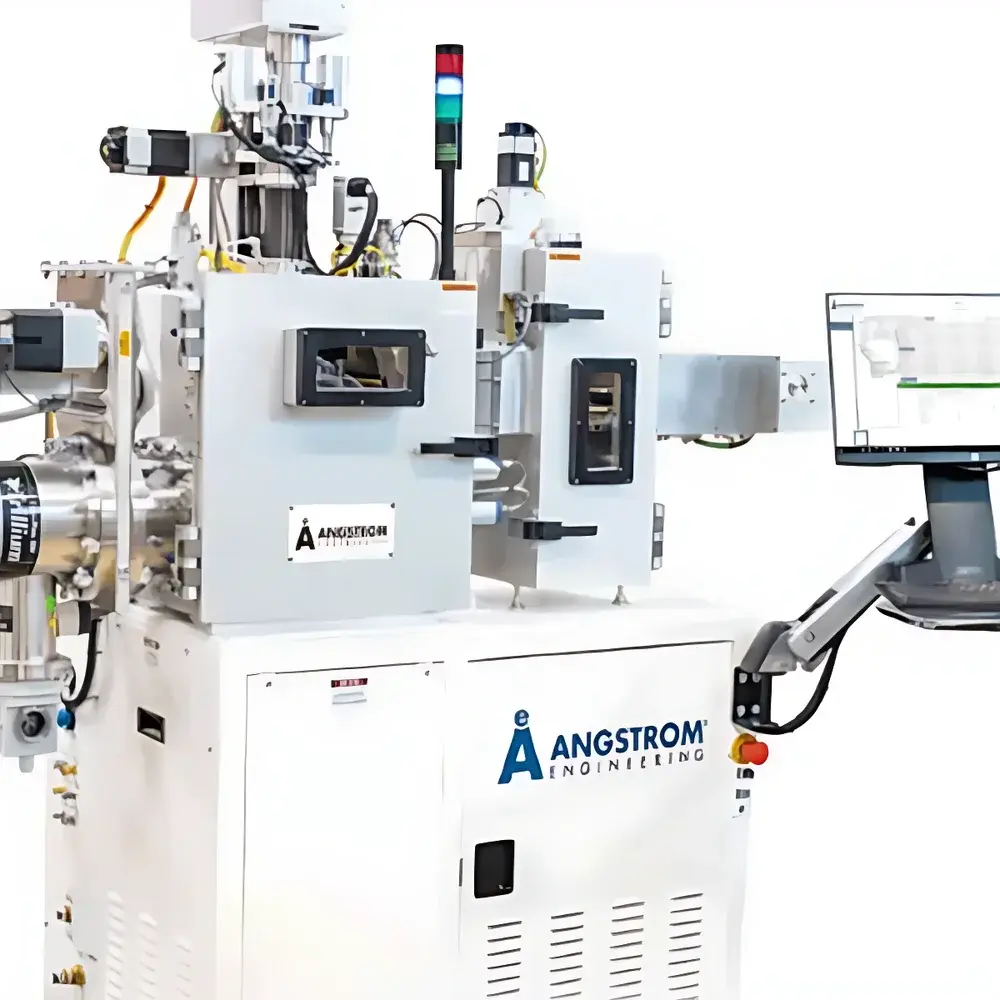
Angstrom Engineering Nexdep Physical Vapor Deposition (PVD) Platform
| Brand | Angstrom Engineering |
|---|---|
| Origin | Canada |
| Model | Nexdep |
| Substrate Size | 6-inch (150 mm) |
| Chamber Dimensions | 400 × 400 × 500 mm (L×W×H) |
| Base Pressure | <5 × 10⁻⁷ Torr |
| Vacuum Gauging | Inficon MPG400 (3.75 × 10⁻⁹–760 Torr) |
| Roughing Pump | Oil-sealed rotary vane pump, ≥9 cfm |
| High-Vacuum Pump | Turbomolecular pump, ≥685 L/s |
| Evaporation Source | Resistive-heated metal source, 2.5 kW max power, SCR-controlled |
| Thickness Monitor | Water-cooled quartz crystal microbalance (QCM) probe with rigid mounting |
| Sample Stage | Motorized rotation (10–30 rpm), tilt-free horizontal design, shutter-integrated |
| Chamber Sealing | Dual O-ring sealed front sliding door and rear hinged door with integrated anti-coating viewport |
Overview
The Angstrom Engineering Nexdep PVD Platform is a modular, high-vacuum physical vapor deposition system engineered for precision thin-film synthesis in semiconductor research, microelectronics fabrication, and advanced materials development. Operating on the fundamental principles of thermal evaporation under ultra-high vacuum (UHV) conditions, the Nexdep platform enables controlled condensation of atomic or molecular species onto substrates—achieving stoichiometric fidelity, nanoscale thickness uniformity, and interfacial integrity critical for device-grade film growth. Its architecture integrates vacuum science, thermal management, real-time process metrology, and deterministic motion control to support reproducible deposition across R&D, pilot-line, and GLP-compliant environments. Designed and assembled in Waterloo, Ontario, the system complies with international safety standards (CE, CSA) and supports integration into ISO/IEC 17025-accredited laboratories.
Key Features
- Modular UHV chamber (400 × 400 × 500 mm) with removable 304 stainless-steel liner and dual-access doors—front sliding and rear hinged—both fitted with double O-ring seals and anti-deposition viewports for continuous visual process monitoring.
- Two-stage vacuum system: oil-sealed roughing pump (≥9 cfm) paired with a high-speed turbomolecular pump (≥685 L/s), enabling base pressures below 5 × 10⁻⁷ Torr in clean, dry conditions; calibrated with an Inficon MPG400 full-range gauge (3.75 × 10⁻⁹–760 Torr).
- Resistive thermal evaporation module featuring a 2.5 kW SCR-controlled power supply and water-cooled crucible mount, optimized for metals (e.g., Al, Cr, Ti, Au) and low-melting-point alloys.
- Real-time thickness monitoring via a rigidly mounted, water-cooled quartz crystal microbalance (QCM) sensor—minimizing thermal drift and mechanical perturbation for sub-nanometer resolution in rate and endpoint control.
- Motorized, horizontally oriented substrate stage accommodating 6-inch (150 mm) wafers with precise 10–30 rpm rotation; equipped with synchronized source shutter and stage shutter for layer-by-layer sequential deposition and interface engineering.
- Programmable logic controller (PLC)-based automation framework compatible with LabVIEW, Python, and OPC UA interfaces—enabling recipe-driven operation, event logging, and audit-trail generation per FDA 21 CFR Part 11 requirements.
Sample Compatibility & Compliance
The Nexdep platform accepts standard 6-inch silicon, sapphire, glass, or ceramic substrates, with optional adaptors for smaller coupons (e.g., 10 × 10 mm chips or TEM grids). Its non-magnetic, low-outgassing chamber design ensures compatibility with oxygen-sensitive materials (e.g., MgB₂, YBCO) and avoids contamination from ferrous components. The system meets ASTM F1529-22 (Standard Guide for Vacuum System Performance Verification) and supports traceable calibration protocols aligned with ISO/IEC 17025. For regulated environments, optional data integrity modules provide electronic signatures, user access tiers, and immutable audit logs compliant with GMP/GLP documentation workflows.
Software & Data Management
Control is executed via Angstrom’s proprietary A-OS platform—a deterministic real-time OS that synchronizes vacuum sequencing, power ramping, rotation timing, and QCM feedback at millisecond resolution. All process parameters—including pressure transients, source current/voltage waveforms, rotation encoder counts, and thickness/time derivatives—are timestamped and exported in HDF5 or CSV format. Integrated metadata tagging (operator ID, lot number, ambient RH/T) facilitates cross-platform analysis in MATLAB, Python (Pandas/NumPy), or commercial statistical process control (SPC) suites. Optional cloud-sync modules enable secure remote diagnostics and multi-site parameter benchmarking without compromising firewall integrity.
Applications
- Semiconductor prototyping: deposition of gate metals (TiN, TaN), ohmic contacts (NiSi, TiAl), and diffusion barriers (TaN, W) on Si, GaN, or SiC substrates.
- MEMS/NEMS fabrication: conformal Al or Cr layers for RF resonators, piezoresistive cantilevers, and optical MEMS mirrors.
- Quantum device research: ultra-pure superconducting films (Nb, NbTiN) and proximity-coupled heterostructures requiring monolayer-level thickness control.
- Optoelectronic coatings: anti-reflective (MgF₂), high-reflectance (Ag/Al multilayers), and transparent conductive oxides (ITO precursors) on fused silica or sapphire optics.
- Corrosion-resistant functionalization: CrN, TiN, or AlCrN hard coatings on medical implant substrates (Ti-6Al-4V) validated per ASTM F2129 (electrochemical corrosion testing).
FAQ
What vacuum level can the Nexdep achieve, and how is it verified?
The system achieves a base pressure of ≤5 × 10⁻⁷ Torr after bakeout in a clean, dry environment. Vacuum performance is verified using the integrated Inficon MPG400 gauge, with optional third-party calibration certificates available per ISO 27874.
Is the Nexdep compatible with reactive evaporation (e.g., oxide formation)?
Yes—optional residual gas analyzers (RGA) and mass-flow-controlled O₂ or N₂ injection manifolds enable reactive thermal evaporation of oxides (e.g., SiO₂, Al₂O₃) and nitrides (e.g., TiN), with in situ plasma assistance available as an upgrade.
Can the system be upgraded to include sputtering or e-beam sources?
The Nexdep chassis is mechanically and electrically pre-configured for retrofitting magnetron sputtering cathodes and electron-beam evaporators; Angstrom provides turnkey integration packages with full electrical interlocks and software mapping.
Does the system support automated wafer loading?
While the standard configuration uses manual load-lock operation, robotic load-port integration (SEMI E47.1 compliant) is available as a factory-installed option for cluster tool compatibility.
What maintenance intervals are recommended for the turbomolecular pump and QCM sensor?
The turbopump requires annual bearing inspection and rotor balancing per manufacturer guidelines; the QCM crystal is consumable and typically replaced every 50–100 deposition cycles depending on material aggressiveness and cooling efficiency.