
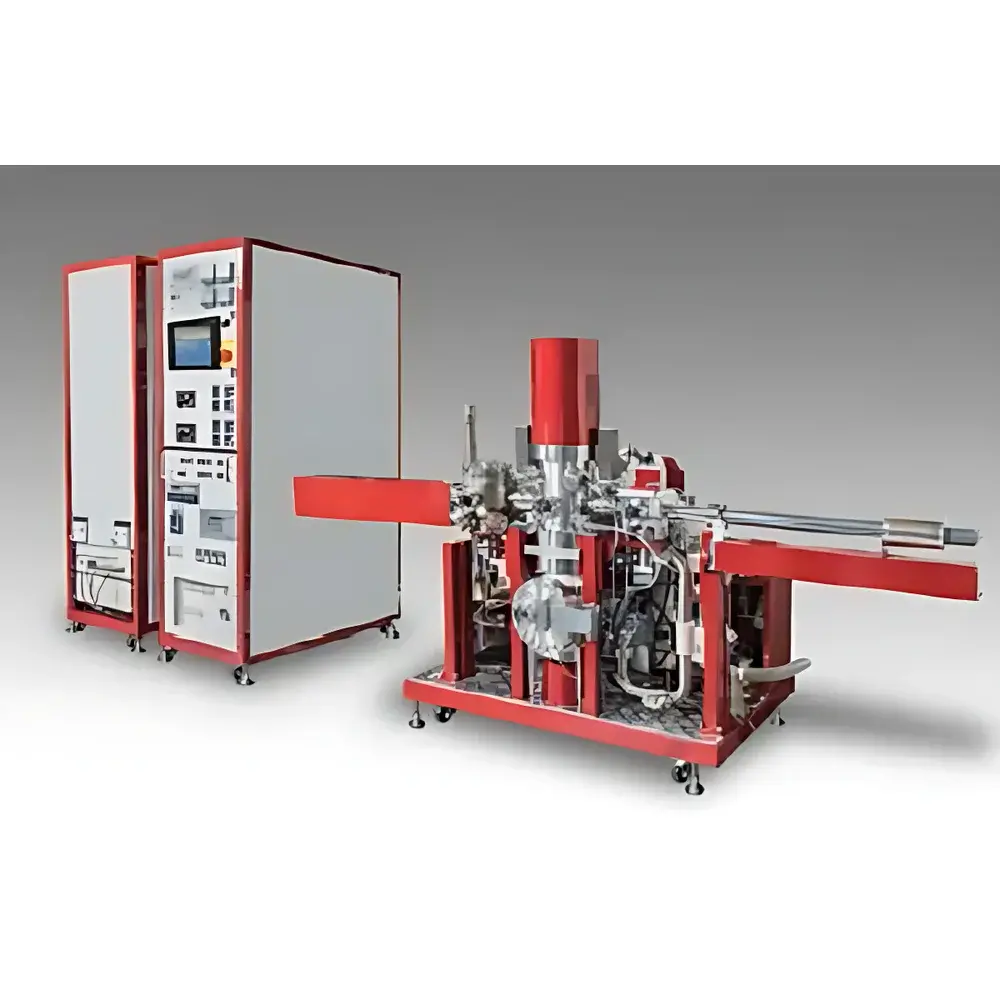
Angstrom LUMO Low-Energy Inverse Photoemission Spectrometer
| Brand | Angstrom (USA) |
|---|---|
| Origin | USA |
| Manufacturer Type | Authorized Distributor |
| Origin Category | Imported Instrument |
| Model | LUMO |
| Pricing | Upon Request |
Overview
The Angstrom LUMO Low-Energy Inverse Photoemission Spectrometer (LEIPS) is a specialized surface science instrument engineered for the direct, quantitative measurement of unoccupied electronic states—specifically the Lowest Unoccupied Molecular Orbital (LUMO) energy level—in organic semiconductors, thin-film devices, and functional interfaces. Unlike conventional photoemission techniques that probe occupied states (e.g., HOMO via UPS), LEIPS operates on the inverse principle: incident low-energy electrons (< 20 eV) undergo radiative recombination with empty states near the conduction band edge, emitting photons whose energy distribution maps the density of unoccupied states. This enables precise determination of electron affinity, interfacial energy alignment, and charge injection barriers—critical parameters in OLED, OPV, and perovskite device engineering. The system is designed for ultra-high vacuum (UHV) environments (< 5 × 10⁻¹⁰ mbar), ensuring surface integrity and minimizing beam-induced degradation during measurement.
Key Features
- Low-energy electron beam (< 5–15 eV adjustable) minimizes radiation damage to beam-sensitive organic and molecular monolayer samples.
- Energy resolution ≤ 0.15 eV FWHM at 10 eV beam energy, enabling discrimination of closely spaced unoccupied states—comparable in precision to high-resolution UPS for HOMO determination.
- Integrated UHV-compatible sample stage with automated transfer, cryo-cooling (80–300 K), and in-situ sample conditioning (annealing, gas dosing).
- Coaxial electron optics and photon detection geometry ensure uniform angular acceptance and eliminate shadowing artifacts common in off-axis configurations.
- Real-time simultaneous acquisition of total electron current (Ie) and emitted photon spectrum (LEIPS), facilitating background subtraction and normalization.
Sample Compatibility & Compliance
The LUMO spectrometer accommodates conductive, semiconductive, and insulating substrates—including ITO-coated glass, Si wafers, metal foils, and self-assembled monolayers—provided they are compatible with UHV processing. Sample mounting follows ASTM E1576-22 guidelines for surface analysis specimen preparation. All vacuum components comply with ISO 14644-1 Class 4 cleanroom standards; pressure monitoring and interlock systems meet EN 61000-6-2 electromagnetic compatibility requirements. Data acquisition and storage support audit trails compliant with FDA 21 CFR Part 11 when integrated with validated laboratory information management systems (LIMS). Routine calibration adheres to ISO/IEC 17025:2017 for testing and calibration laboratories.
Software & Data Management
The LEIPS Standard Software Suite provides a task-driven workflow for measurement setup, spectral acquisition, and quantitative analysis. Users input beam energy, dwell time, and detector gain; the software initiates synchronized current and photon detection. Vacuum level and electron affinity are calculated automatically using the secondary electron cutoff method and Fermi edge referencing. Spectral energy axes are calibrated against known reference transitions (e.g., Au 4f7/2 plasmon loss features). All raw and processed data export in CSV format for third-party analysis (e.g., MATLAB, Igor Pro). MultiPak-compatible data import enables cross-platform correlation with AES, XPS, or SIMS datasets. Audit logs record operator ID, timestamp, instrument configuration, and calibration history—essential for GLP/GMP traceability.
Applications
- Organic electronics: Quantifying LUMO offset at donor–acceptor heterojunctions in bulk heterojunction solar cells.
- Interface engineering: Measuring energy-level bending at metal–organic and oxide–organic contacts in OFETs.
- Catalysis research: Tracking evolution of unoccupied d-states in transition-metal catalysts under operando conditions.
- 2D materials: Mapping conduction band minima in graphene derivatives, MXenes, and TMD heterostructures.
- Thin-film encapsulation: Assessing trap state distribution in barrier layers for flexible OLED displays.
FAQ
What vacuum level is required for reliable LUMO measurements?
Operation requires base pressure ≤ 5 × 10⁻¹⁰ mbar to prevent surface contamination and electron scattering by residual gases.
Can the LUMO system measure insulating samples without charge neutralization?
Yes—the low incident electron energy (< 15 eV) inherently minimizes surface charging; optional flood gun integration is available for highly resistive specimens.
How is energy calibration verified?
Calibration is performed using the secondary electron cutoff of a clean Au reference and the known work function (5.1 eV); reproducibility is ±0.03 eV across weekly verification cycles.
Is depth profiling supported?
No—LEIPS is a strictly surface-sensitive technique (probe depth < 1 nm); complementary sputter-depth profiling must be conducted using integrated ion guns in hybrid UHV platforms.
Does the system support variable-temperature measurements?
Yes—integrated liquid nitrogen cooling (80 K) and resistive heating (up to 500 K) enable thermal activation studies of trap states and interface reactions.




