
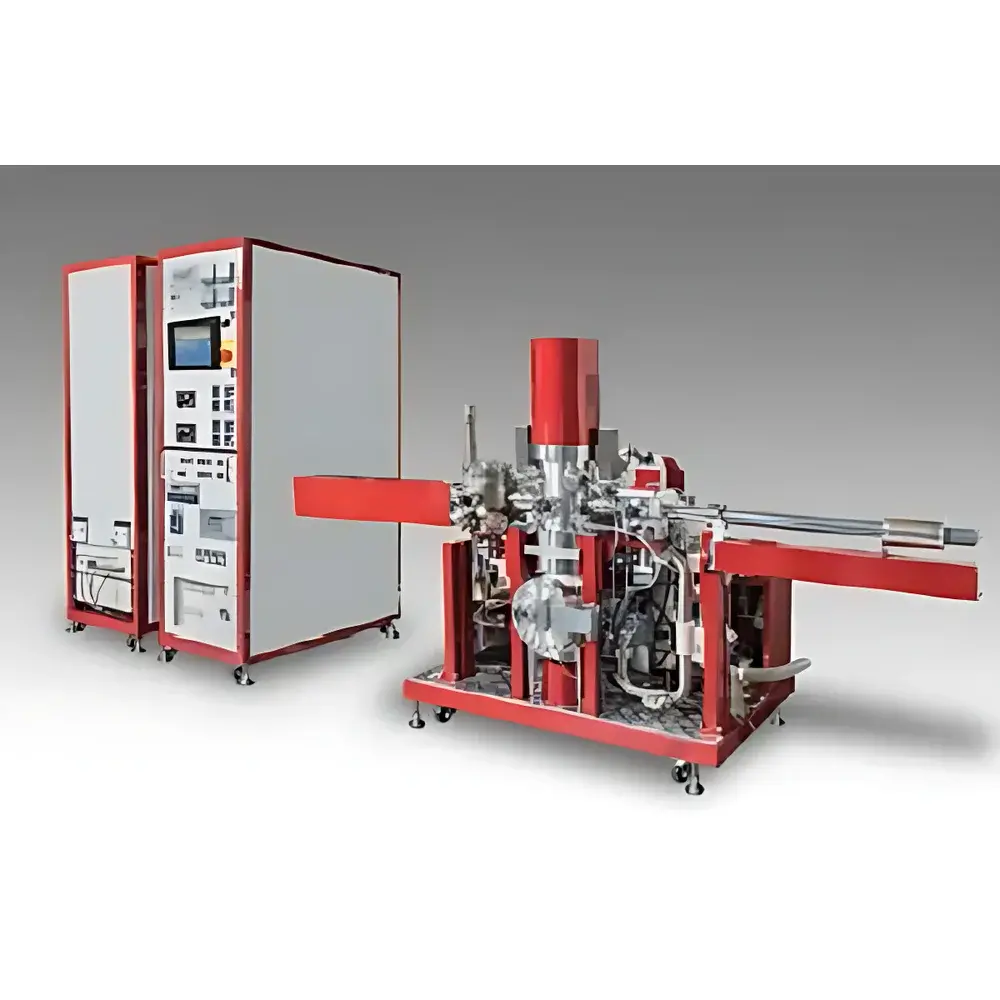
Angstrom LUMO Low-Energy Inverse Photoemission Spectrometer
| Brand | Angstrom (USA) |
|---|---|
| Origin | USA |
| Manufacturer Type | Authorized Distributor |
| Origin Category | Imported Instrument |
| Model | LUMO |
| Pricing | Upon Request |
Overview
The Angstrom LUMO Low-Energy Inverse Photoemission Spectrometer (LEIPS) is a dedicated surface science instrument engineered to quantitatively determine the unoccupied electronic states of materials—specifically the Lowest Unoccupied Molecular Orbital (LUMO) energy level—with sub-0.1 eV resolution. Unlike conventional photoemission techniques that probe occupied states (e.g., HOMO via UPS), LEIPS operates on the inverse process: low-energy electrons (< 20 eV) are injected into a sample under ultra-high vacuum (UHV, ≤ 1×10⁻¹⁰ mbar), and the resulting photons emitted upon electron-hole recombination are detected in the vacuum ultraviolet (VUV) range (typically 3–20 eV). This enables direct, absolute measurement of electron affinity, conduction band onset, and interfacial energy level alignment—critical parameters for organic semiconductors, perovskite photovoltaics, molecular electronics, and catalytic surface design. The system integrates a high-brightness, energy-filtered electron gun, a toroidal VUV spectrometer with MgF₂-coated optics, and UHV-compatible sample manipulation—all aligned for minimal beam-induced damage and maximal signal-to-noise ratio.
Key Features
- Low-energy electron injection (0.1–20 eV, <50 meV energy resolution) minimizes radiation damage to organic, polymeric, and delicate 2D materials
- Simultaneous acquisition of sample current (Ie) and LEIPS photon yield spectra ensures intrinsic normalization and quantitative reproducibility
- Compatible with standard XPS/UPS sample stages and load-lock protocols—enabling sequential HOMO/LUMO mapping on identical sample locations
- Automated vacuum sequencing: seamless transition between sample loading, pump-down, thermal conditioning (up to 400 °C), and spectral acquisition without venting
- Integrated calibration using known reference materials (e.g., Au(111), Ag(111)) for absolute energy referencing traceable to NIST standards
Sample Compatibility & Compliance
The LUMO system accommodates conductive, semiconductive, and thin-film insulating samples (with charge neutralization via low-energy electron flood gun). Compatible substrates include Si wafers, ITO/glass, MoS₂ flakes, evaporated organic layers (e.g., Alq₃, C₆₀), and epitaxial oxides. All vacuum components conform to ASTM E577-22 (UHV Practice for Surface Analysis) and ISO 14644-1 Class 1 cleanroom assembly protocols. The UHV chamber (base pressure < 5×10⁻¹¹ mbar) meets GLP-compliant environmental stability requirements for long-duration acquisition (≥ 24 h). Data acquisition logs—including electron energy, emission angle, detector voltage, and chamber pressure—are time-stamped and stored with full audit trail capability per FDA 21 CFR Part 11 Annex 11 guidelines.
Software & Data Management
The LEIPS Standard Software Suite provides a streamlined, task-driven workflow: users define electron energy ramp parameters, dwell time, and angular acceptance; the software then acquires both Ie and photon yield spectra in parallel. Post-acquisition, vacuum level correction and electron affinity calculation are performed automatically using the secondary electron cutoff method. Energy calibration is adjustable via cursor-based peak identification on any spectrum region, with real-time display of binding energy (eV) and full-width-at-half-maximum (FWHM). Raw data exports to CSV or HDF5 format support third-party analysis (e.g., MATLAB, Python SciPy). All processing steps—including background subtraction (Shirley/Tougaard), peak fitting (Voigt profiles), and density-of-states convolution—are fully scriptable and version-controlled within the software environment.
Applications
- Organic semiconductor development: Quantifying LUMO offset at donor–acceptor heterojunctions in OPVs and OLED emissive layers
- Interface engineering: Measuring band bending and dipole formation at metal/organic and oxide/organic interfaces
- Catalyst characterization: Mapping unoccupied d-states of transition metal surfaces under controlled gas exposure (via optional differential pumping stage)
- Perovskite stability studies: Tracking LUMO shift during thermal aging or moisture exposure via in-situ UHV transfer
- 2D material heterostructures: Resolving interlayer charge transfer signatures in graphene/h-BN/MoS₂ stacks
FAQ
What vacuum level is required for reliable LUMO measurements?
Ultra-high vacuum (≤ 1×10⁻¹⁰ mbar) is mandatory to suppress electron scattering from residual gases and ensure mean free path > 1 m.
Can the LUMO system measure insulating samples?
Yes—when combined with a low-energy electron flood gun (standard option) for surface charge neutralization, insulators such as Al₂O₃ or PMMA films yield reproducible spectra.
Is the system compatible with in-situ sample preparation?
The chamber supports integrated sputter ion guns (Ar⁺, 0.1–5 kV), resistive heating stages (up to 800 °C), and optional MBE-style effusion cells for in-situ deposition and annealing.
How is energy calibration verified?
Calibration uses the well-defined secondary electron cutoff of polycrystalline gold and the LUMO position of crystalline C₆₀ (−3.7 eV vs. vacuum), cross-referenced against NIST SRM 2059.
Does the software support automated batch processing?
Yes—LEIPS Standard Software includes macro scripting (Python API) for unattended multi-sample LUMO mapping, including auto-alignment, energy sweep sequencing, and report generation.






