
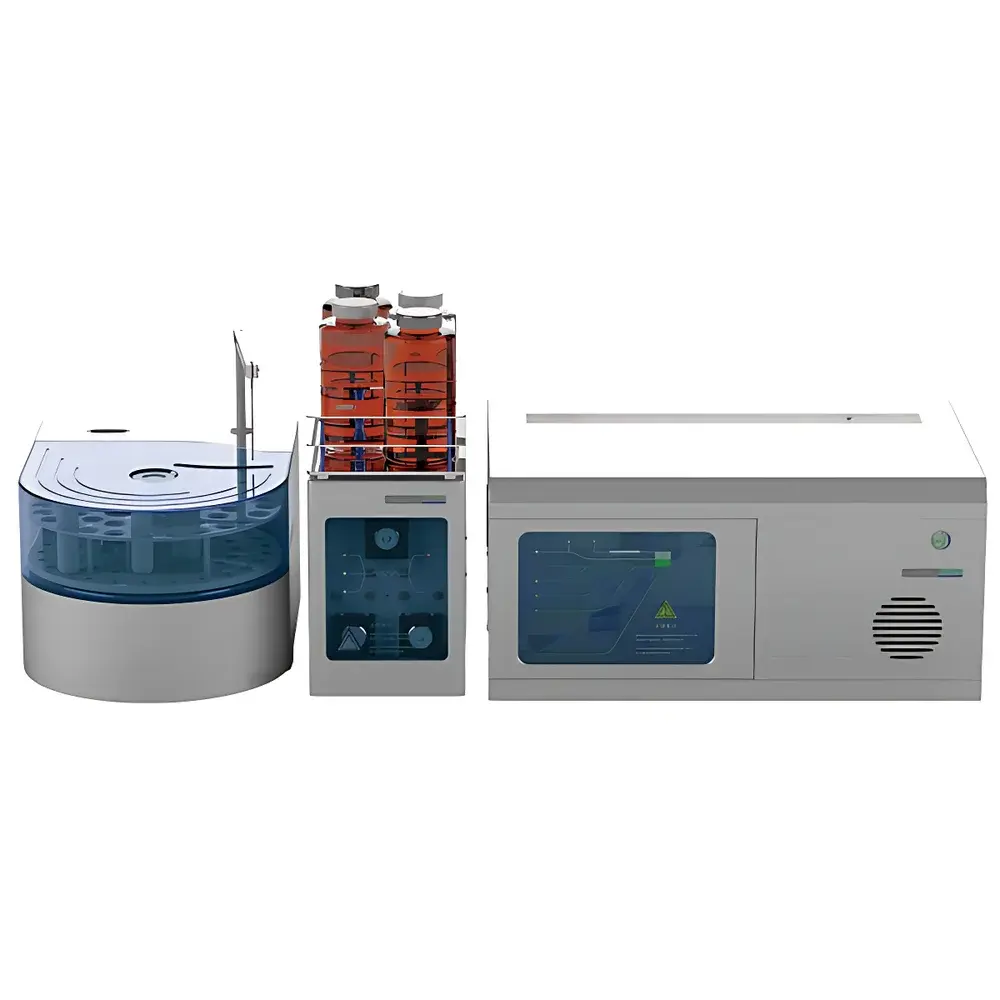
Anjie AJ-3700 Gas Phase Molecular Absorption Spectrometer
| Brand | Anjie |
|---|---|
| Origin | Shanghai, China |
| Manufacturer Type | Authorized Distributor |
| Instrument Type | Photomultiplier Tube (PMT) Detector |
| Wavelength Range | 190–900 nm |
| Spectral Bandwidth | 0.1 nm / 0.2 nm / 0.4 nm / 1.0 nm (selectable) |
| Wavelength Accuracy | ±0.2 nm |
| Wavelength Repeatability | ±0.1 nm |
Overview
The Anjie AJ-3700 Gas Phase Molecular Absorption Spectrometer is a dedicated analytical instrument engineered for the quantitative determination of nitrogen- and sulfur-containing species in aqueous matrices—specifically nitrite-nitrogen (NO₂⁻-N), ammonia-nitrogen (NH₃-N), nitrate-nitrogen (NO₃⁻-N), Kjeldahl nitrogen, total nitrogen (TN), and sulfide (S²⁻). Unlike conventional UV-Vis spectrophotometers, the AJ-3700 operates on the principle of gas-phase molecular absorption: target analytes are chemically converted into volatile, diatomic or polyatomic gaseous molecules (e.g., NO, NO₂, NH₃, H₂S) under controlled reaction conditions, swept into an optical cell, and quantified via their characteristic absorption spectra in the ultraviolet–visible region. This approach eliminates matrix interferences common in direct liquid-phase measurement, significantly enhancing selectivity, sensitivity, and robustness in complex environmental and industrial water samples.
Key Features
- Modular Architecture: All functional modules—including reagent delivery, gas generation, gas–liquid separation, drying, and optical detection—are physically and logically decoupled, enabling rapid maintenance, calibration verification, and configuration scalability.
- Single-Point Calibration Protocol: Eliminates multi-point standard preparation; only the highest concentration standard solution is required. The system performs precise serial dilution via integrated peristaltic and syringe pumps to generate a full calibration curve with traceable linearity (R² ≥ 0.999).
- Automated Sample Dilution: Integrated dilution capability supports up to 40-fold linear dilution for out-of-range samples, with real-time concentration recalculation and audit-trail logging compliant with ISO/IEC 17025 data integrity requirements.
- Dual-Mode Pressure Monitoring: Combines mechanical pressure relief valves with digital transducer-based feedback to continuously monitor reaction chamber and gas transfer line pressures—ensuring safe operation during acid–reductant reactions (e.g., sulfide liberation with HCl/Na₂SO₃).
- Stabilized Pneumatic System: Features a regulated gas source coupled with a precision mass-flow-controlled valve, allowing programmable purge duration (0–300 s) and constant flow rate (±0.5% FS), critical for reproducible gas-phase transport kinetics.
- Active Semiconductor Dehydration: Employs Peltier-cooled condensation with PWM-driven thermal regulation (±0.3 °C stability) to maintain dew point below −10 °C, minimizing water vapor absorption interference at key wavelengths (e.g., 213.9 nm for NO, 257.8 nm for NO₂).
- Integrated Sintered-Glass Gas–Liquid Separator: Enhances phase separation efficiency by >300% compared to conventional membrane or cyclonic separators—reducing carryover, improving signal-to-noise ratio, and extending PMT detector lifetime.
Sample Compatibility & Compliance
The AJ-3700 is validated for use with raw wastewater, surface water, groundwater, effluent from petrochemical facilities, and digested sludge extracts. It meets method performance criteria outlined in Chinese EPA standard HJ 1002–2018 (Determination of Nitrogen and Sulfur Species in Water by Gas-Phase Molecular Absorption Spectrometry) and aligns with technical principles referenced in ASTM D8084–21 (Standard Guide for Molecular Absorption Spectrometric Analysis of Aqueous Nitrogen Compounds). Its hardware architecture supports GLP-compliant workflows, including user access control, electronic signature support, and full audit trail retention for instrument parameters, calibration history, and raw absorbance data.
Software & Data Management
The AJ-3700 is operated via Anjie’s proprietary GPMAS Control Suite (v3.2+), a Windows-based application supporting dual-mode acquisition (continuous flow vs. discrete injection), real-time spectral visualization, and automated QC flagging (e.g., baseline drift >0.005 AU/min, peak asymmetry >1.3). All measurement data—including raw absorbance, calculated concentrations, dilution factors, and pressure/temperature logs—are stored in encrypted SQLite databases compliant with FDA 21 CFR Part 11 requirements for electronic records and signatures. Export options include CSV, PDF analytical reports, and XML formats compatible with LIMS integration (ASTM E1467–06).
Applications
Primary deployment domains include municipal wastewater treatment plant monitoring (influent/effluent TN/NH₃-N compliance), watershed-level nutrient load assessment (EPA Region 10 TMDL programs), oil refinery process water quality assurance, third-party environmental testing laboratories accredited to CNAS-CL01 (ISO/IEC 17025), and research on nitrogen transformation pathways in constructed wetlands. The instrument’s high specificity for NO, NH₃, and H₂S gases enables unambiguous speciation where ion chromatography or chemiluminescence methods face co-elution or quenching challenges.
FAQ
What regulatory standards does the AJ-3700 support for environmental reporting?
It is designed to fulfill measurement requirements in HJ 1002–2018 and provides data traceability aligned with ISO/IEC 17025 and EPA Method 300.1 principles.
Can the AJ-3700 be integrated into an existing LIMS environment?
Yes—via standardized ODBC and ASTM E1467-compliant XML export protocols, with optional API-based middleware for bidirectional sample queue synchronization.
Is routine maintenance of the gas–liquid separator user-serviceable?
The sintered-glass module is field-replaceable without tools; cleaning protocol uses 10% HNO₃ followed by ultrapure water rinse—documented in the Maintenance Logbook (Revision 4.1).
How is wavelength accuracy verified during routine operation?
Built-in holmium oxide and didymium filters enable automated wavelength validation at 241.5 nm, 279.4 nm, 361.0 nm, and 536.2 nm prior to each analytical batch.
Does the system support remote diagnostics and firmware updates?
Yes—via secure TLS 1.2-enabled Ethernet connection; remote sessions require two-factor authentication and are logged with IP address and timestamp.




