
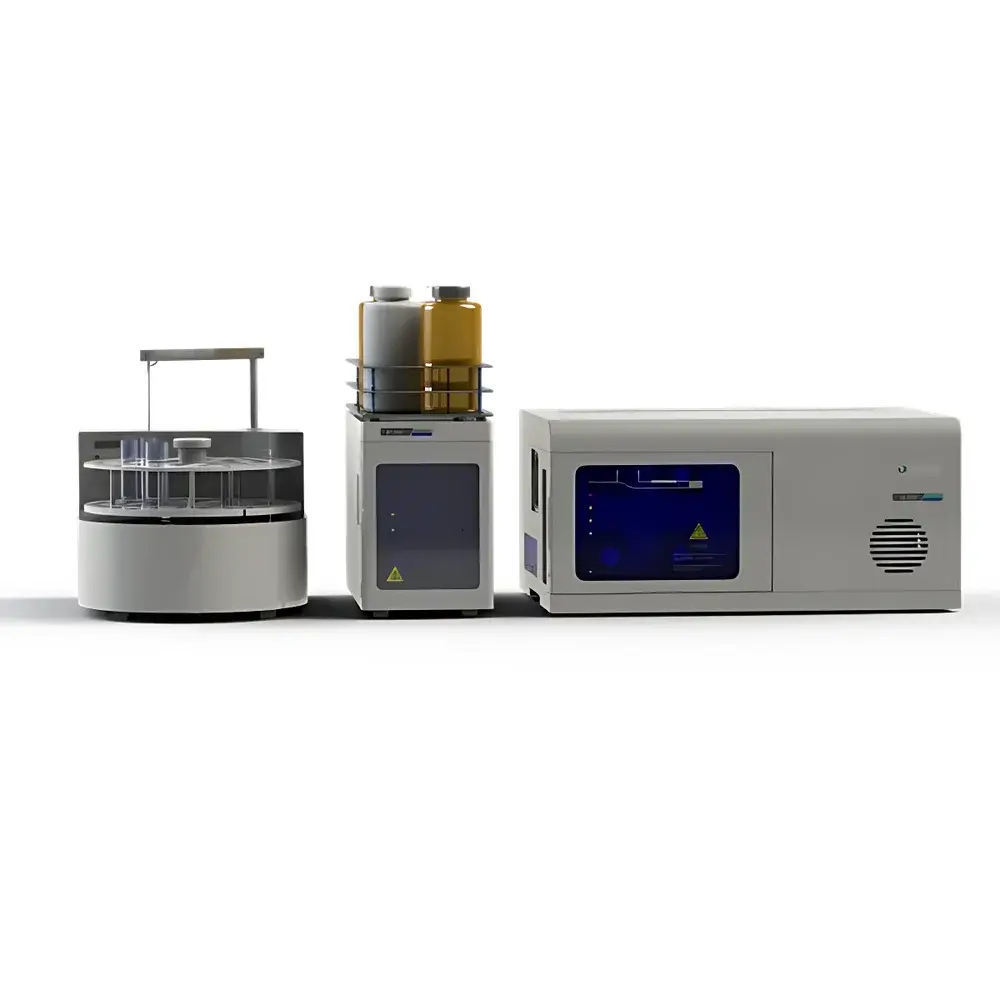
ANJIE AJ-3700 Gas-Phase Molecular Absorption Spectrometer
| Brand | ANJIE |
|---|---|
| Origin | Shanghai, China |
| Model | AJ-3700 |
| Wavelength Accuracy | ±0.2 nm |
| Wavelength Repeatability | 0.1 nm |
| Baseline Noise | ±0.0002 Abs |
| Baseline Drift | ±0.0005 Abs (30 min) |
| Linearity (r) | >0.9995 |
| Detection Limits | NH₃-N: 0.005 mg/L |
| Total N | 0.02 mg/L |
| S²⁻ | 0.005 mg/L |
| NO₂⁻-N | 0.003 mg/L |
| NO₃⁻-N | 0.006 mg/L |
| Kjeldahl N | 0.02 mg/L |
| Quantification Ranges | NH₃-N: 0.02–80 mg/L |
| Total N | 0.1–160 mg/L |
| S²⁻ | 0.02–200 mg/L |
| NO₂⁻-N | 0.012–200 mg/L |
| NO₃⁻-N | 0.03–160 mg/L |
| Kjeldahl N | 0.08–80 mg/L |
| Precision | 0.5–1.0% RSD (at specified concentrations) |
| Measurement Time | 100–280 s (including online digestion for total nitrogen) |
Overview
The ANJIE AJ-3700 Gas-Phase Molecular Absorption Spectrometer (GPMAS) is a dedicated analytical instrument engineered for the quantitative determination of nitrogen- and sulfur-containing species—including ammonia nitrogen (NH₃-N), total nitrogen (TN), nitrite nitrogen (NO₂⁻-N), nitrate nitrogen (NO₃⁻-N), sulfide (S²⁻), and Kjeldahl nitrogen—directly in aqueous environmental and industrial samples. Unlike conventional UV-Vis or atomic absorption spectrometers, the AJ-3700 operates on the principle of gas-phase molecular absorption: target analytes are selectively converted into volatile, light-absorbing gaseous molecules (e.g., NO, NO₂, SO₂, NH₃) via controlled chemical reactions in solution, purged into an optical cell, and quantified by measuring absorbance at characteristic wavelengths. This methodology eliminates spectral interferences from complex matrices and avoids reliance on hazardous reagents such as mercury chloride or Nessler’s reagent. The system integrates flow injection analysis (FIA) with segmented gas-phase detection, enabling high reproducibility, minimal reagent consumption, and robust performance in routine laboratory and field-deployable monitoring environments.
Key Features
- Linear optical path architecture: Fixed alignment between deuterium/halogen lamp sources and photodetector ensures long-term wavelength stability and eliminates mechanical switching errors associated with rotating monochromators.
- Integrated real-time safety monitoring: Continuous in-line sensing of liquid leakage, reaction temperature, and carrier gas pressure enables automatic shutdown and fault logging per IEC 61000-4-5 compliance protocols.
- Flow-through needle washing station: Prevents carryover between samples via programmable rinse cycles using inert solvent or diluent—critical for maintaining <0.5% RSD across high-throughput sequences.
- On-demand online digestion: For total nitrogen analysis, a PTFE-coated micro-reaction coil achieves complete persulfate oxidation within ≤180 seconds at 120 °C, fully integrated into the measurement cycle without manual intervention.
- Matrix-tolerant sample introduction: Capable of direct analysis of samples with turbidity up to 50 NTU and true color ≤200 Pt-Co units—eliminating pre-filtration, distillation, or coagulation steps for ammonia nitrogen and sulfide assays.
Sample Compatibility & Compliance
The AJ-3700 supports aqueous matrices including surface water, wastewater (municipal, petrochemical, metallurgical), seawater, soil leachates, and agricultural runoff. It conforms to methodological requirements outlined in Chinese EPA standards HJ 195–2019 (NH₃-N), HJ 636–2012 (TN), HJ 667–2013 (S²⁻), and HJ 634–2012 (NO₂⁻-N/NO₃⁻-N). While not certified under ISO/IEC 17025 for accredited testing, its hardware architecture and data handling protocols align with GLP principles: all calibration events, dilution factors, and raw absorbance values are timestamped and stored with immutable audit trails. Optional 21 CFR Part 11-compliant software modules support electronic signatures and role-based access control for regulated laboratories.
Software & Data Management
The embedded Windows-based control software features a single-click workflow interface optimized for non-specialist operators. Calibration routines include single-point standardization with auto-dilution series generation, dynamic range extension via internal serial dilution, and real-time outlier rejection during curve fitting. All reports adhere to ISO/IEC 17025 Annex A3 formatting guidelines, with configurable fields for analyst ID, instrument ID, QC sample IDs, LOD/LOQ flags, and uncertainty estimation (based on replicate precision and calibration variance). Raw spectral data (absorbance vs. time/wavelength) and processed peak integrals are exportable in CSV and ASTM E1382-compliant .xml formats. Emergency sample insertion, batch reprocessing, and post-acquisition baseline correction are supported without interrupting ongoing runs.
Applications
- Regulatory compliance monitoring of effluent discharge per national water quality standards (e.g., GB 3838–2002, GB 8978–1996)
- Long-term trend analysis in hydrological networks and coastal marine observatories
- Process control in wastewater treatment plants—particularly nitrification/denitrification unit optimization
- Environmental impact assessments for oil refining, steel production, and fertilizer manufacturing facilities
- Soil nutrient cycling studies requiring rapid, low-volume quantification of bioavailable nitrogen pools
FAQ
What detection principle distinguishes GPMAS from conventional UV-Vis spectrophotometry?
GPMAS measures gaseous molecular species generated *in situ* from aqueous analytes, isolating absorption signals from matrix-derived scattering or broad-band absorbance—thereby achieving superior selectivity for NH₃, NO, SO₂, and related vapors.
Does the AJ-3700 require hazardous reagents like mercury chloride or sodium nitroprusside?
No. It uses sodium hypochlorite, sulfamic acid, and persulfate salts—reagents classified as low-toxicity and non-persistent per GHS Category 5 criteria.
Can the system analyze undiluted seawater samples with high chloride content?
Yes. Chloride interference is chemically suppressed during NO₂⁻/NO₃⁻ conversion; validation data show <±3% bias at Cl⁻ concentrations up to 20,000 mg/L.
Is method validation documentation available for regulatory submissions?
ANJIE provides full IQ/OQ documentation templates, linearity verification datasets, and inter-laboratory comparison reports aligned with ISO 8466-1:2021 for calibration function validation.
What maintenance intervals are recommended for the gas-phase optical cell?
The quartz absorption cell requires cleaning every 200–300 analyses using 10% v/v HNO₃ followed by ultrapure water rinse; no optical realignment is necessary due to rigid kinematic mounting.
Related Products




