
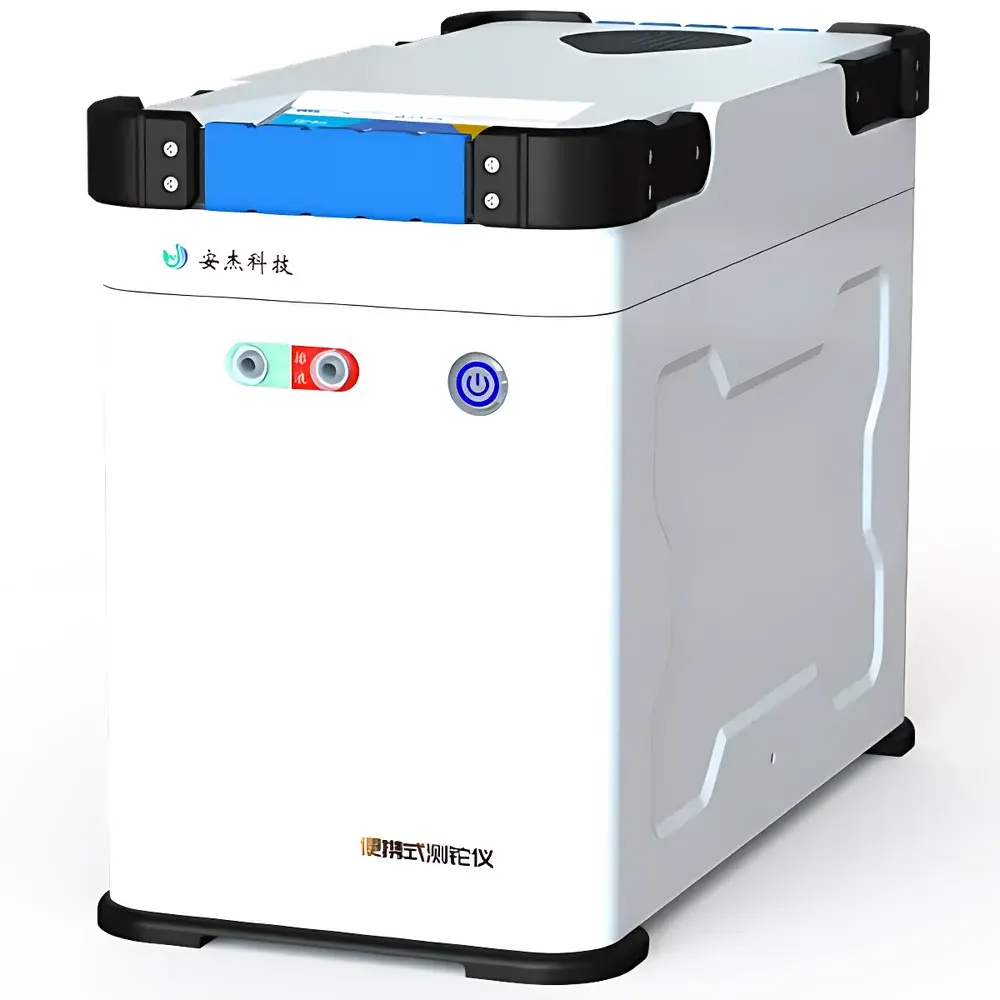
Anjie AJ-6400A Portable Thallium Analyzer
| Brand | Anjie |
|---|---|
| Origin | Shanghai, China |
| Model | AJ-6400A |
| Detection Target | Thallium (Tl) in aqueous samples |
| Response Time | ≤2 min |
| Power Supply | Integrated rechargeable lithium battery (≥12 h continuous operation) |
| Data Storage | >2000 measurement records with real-time spectral display |
| Interface | Touchscreen GUI, USB for data export & firmware update |
| Operating Environment | Ambient atmospheric pressure, no external gas supply or AC power required |
| Sample Handling | Direct liquid injection, no pretreatment |
| Calibration | Built-in standard curves + on-site curve generation capability |
| Remote Diagnostics | Supported |
Overview
The Anjie AJ-6400A Portable Thallium Analyzer is a field-deployable atomic emission spectrometer engineered for rapid, on-site quantification of dissolved thallium (Tl) in environmental water matrices. It employs liquid cathode glow discharge–atomic emission spectroscopy (LCGD-AES), a robust ambient-pressure plasma technique that generates stable microplasma directly within the sample solution—eliminating the need for high-vacuum systems, carrier gases, or consumable electrodes. Unlike conventional graphite furnace AAS or ICP-MS platforms, the AJ-6400A operates without external power sources or compressed gas cylinders, making it uniquely suited for emergency response, mobile monitoring units, and remote field deployments where infrastructure is limited. Its core analytical principle relies on the excitation of thallium atoms in the glow discharge plasma, followed by detection of the characteristic Tl I 535.05 nm emission line with high spectral selectivity. This approach delivers trace-level sensitivity (sub-µg/L range, typical for LCGD-AES), minimal matrix interference, and intrinsic resistance to electrode fouling—critical advantages in complex industrial effluents from electroplating, battery recycling, or metallurgical operations.
Key Features
- True portable architecture: Self-contained unit with integrated lithium-ion battery supporting ≥12 hours of uninterrupted analysis—no AC adapter or external gas cylinder required.
- Direct liquid sampling: No digestion, filtration, or chemical preconcentration needed; aqueous samples introduced via syringe or capillary into the liquid cathode chamber.
- Sub-2-minute turnaround: Full measurement cycle—including plasma ignition, spectral acquisition, peak integration, and concentration calculation—completed in ≤120 seconds.
- Touchscreen-driven operation: Embedded Android-based OS with intuitive graphical interface; all calibration, measurement, and data review performed locally without PC dependency.
- Dual calibration mode: Preloaded factory-certified calibration curves plus user-definable multi-point curves generated in situ using certified Tl standards.
- Onboard spectral visualization: Real-time display of acquired emission spectra with annotated Tl peak position and signal-to-background ratio assessment.
- Comprehensive data management: Internal storage for >2000 complete measurement records, including spectral snapshots, timestamps, operator IDs, and GPS-tagged location metadata (optional module).
Sample Compatibility & Compliance
The AJ-6400A is validated for use with surface water, groundwater, wastewater, and process streams containing total dissolved thallium at concentrations ranging from 0.1 µg/L to 100 µg/L (extendable via dilution). It tolerates moderate levels of common interferents—including Na⁺, K⁺, Ca²⁺, Mg²⁺, Cl⁻, SO₄²⁻, and NO₃⁻—without signal suppression or spectral overlap, owing to the narrow linewidth (85–115%), and inter-laboratory precision benchmarks. Data integrity meets GLP-compliant audit trail requirements via timestamped, non-erasable record logs and optional password-protected user roles.
Software & Data Management
Firmware v3.2 includes embedded spectral processing algorithms compliant with NIST Atomic Spectra Database reference lines. All raw spectra and processed results are stored in standardized CSV and XML formats, ensuring interoperability with LIMS platforms. USB connectivity enables secure data export (with optional encryption), firmware updates, and configuration backup. Remote diagnostics utilize TLS-secured MQTT communication, allowing authorized service engineers to monitor instrument health metrics—including plasma stability index, battery SOC, and detector dark-current drift—in real time. Audit logs record every calibration event, measurement start/stop, parameter modification, and user login, satisfying FDA 21 CFR Part 11 electronic record requirements when paired with organizational procedural controls.
Applications
- Emergency response to thallium contamination incidents (e.g., mining tailings breaches, illegal e-waste leaching sites)
- Routine compliance monitoring at discharge points of electroplating facilities and secondary battery recyclers
- Field verification of treatment efficacy in activated carbon or ion-exchange remediation systems
- Mobile surveillance during environmental impact assessments near artisanal gold processing zones
- Quality control of ultrapure water in semiconductor manufacturing rinse loops
FAQ
What is the detection limit for thallium using the AJ-6400A?
Typical method detection limits (MDL) range from 0.05 to 0.2 µg/L in deionized water, dependent on integration time and background emission stability.
Can the instrument measure other metals besides thallium?
No—the optical path and firmware are optimized exclusively for the Tl I 535.05 nm line; it is a single-element analyzer by design.
Is sample acidification required prior to analysis?
Acidification is not mandatory but recommended for samples with pH >9 or high carbonate alkalinity to prevent precipitation-induced signal loss.
How often must the liquid cathode chamber be cleaned?
Routine cleaning with 2% HNO₃ is advised after every 50 measurements or when baseline noise increases by >30% RMS.
Does the device support regulatory reporting formats such as EPA Form 3320?
Raw data exports can be mapped to EPA Form 3320 fields via configurable templates in compatible LIMS or spreadsheet tools; the instrument itself does not auto-generate completed forms.
Related Products







