
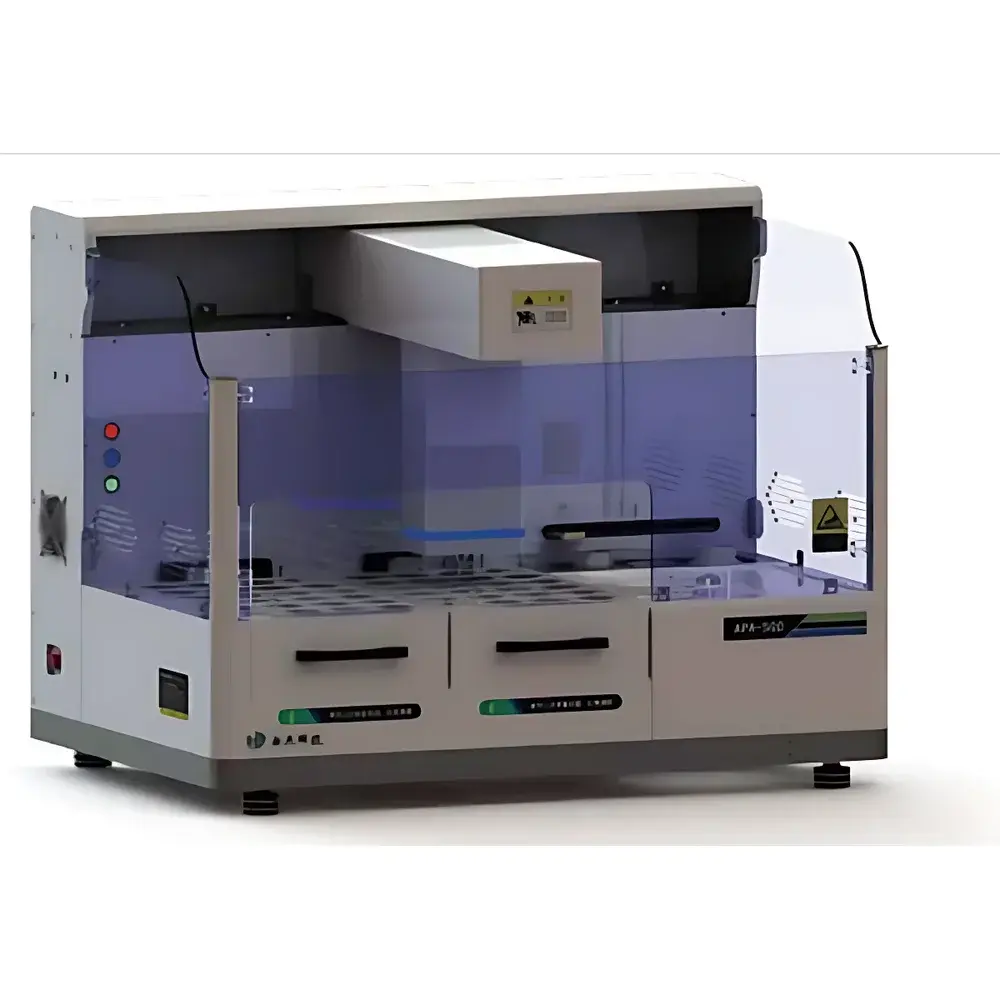
ANJIE APA-500 Fully Automated Permanganate Index (CODMn) Analyzer
| Brand | ANJIE |
|---|---|
| Model | APA-500 |
| Origin | Shanghai, China |
| Sample Capacity | 48 positions |
| Water Bath Capacity | 8 positions |
| Sample Volume | 100 mL |
| Measurement Range | 0–5.0 mg/L |
| Repeatability | RSD ≤ 2.0% |
| Detection Limit | < 0.07 mg/L |
| Titration Resolution | 1 µL |
| Analysis Time | < 4 min per sample |
| Constant-Temperature Titration Temperature Range | 40–100 °C |
| Temperature Control Accuracy | ±0.1 °C |
Overview
The ANJIE APA-500 Fully Automated Permanganate Index (CODMn) Analyzer is an integrated benchtop system engineered for precise, reproducible, and regulatory-compliant determination of the permanganate index in water samples—defined as the oxygen demand expressed in mg/L O2 consumed by potassium permanganate under controlled acidic or alkaline oxidation conditions. Based on standardized redox titration principles per GB/T 11892–1989 and GB/T 5750.7–2006, the instrument automates the complete analytical workflow: reagent dispensing, micro-boiling water bath oxidation, colorimetric endpoint detection via simulated human visual response, and digital data processing. Unlike manual or semi-automated methods, the APA-500 eliminates inter-operator variability, minimizes analyst exposure to hot baths and strong oxidants, and ensures traceable, auditable results suitable for environmental compliance reporting and routine QA/QC in accredited laboratories.
Key Features
- Fully software-controlled operation: All method parameters—including digestion temperature, duration, titrant concentration, endpoint sensitivity, and batch configuration—are defined and executed via intuitive GUI without hardware reconfiguration.
- Dual-method compatibility: Seamless switching between acidic and alkaline permanganate protocols within a single run sequence, enabling comparative analysis of diverse sample matrices (e.g., surface water vs. groundwater).
- Micro-boiling water bath design: Eight independent temperature-controlled bath wells maintain stable thermal profiles (40–100 °C, ±0.1 °C) without requiring external fume hoods—reducing facility infrastructure demands and energy consumption.
- Single-arm precision liquid handling: A single programmable syringe-based dispensing arm performs all reagent additions (KMnO4, Na2O3, H2SO4, etc.), minimizing cross-contamination risk and lowering maintenance frequency versus multi-valve systems.
- Human-vision-simulated endpoint detection: Real-time RGB imaging coupled with adaptive luminance thresholding emulates physiological photoreceptor response, delivering robust endpoint recognition across variable sample turbidity and background coloration.
- Environmental parameter monitoring: Integrated sensors continuously log ambient temperature, relative humidity, and atmospheric pressure—triggering contextual alerts and enabling automatic correction factors for high-altitude or low-barometric-pressure environments.
Sample Compatibility & Compliance
The APA-500 is validated for use with raw and treated waters including surface water, groundwater, drinking water, wastewater effluents, and process water from municipal and industrial facilities. It complies with national standard methods GB/T 11892–1989 and GB/T 5750.7–2006, and its architecture supports alignment with ISO 8467:1993 (Water quality — Determination of permanganate index) through configurable method templates. Audit-ready data integrity is ensured via built-in electronic signatures, time-stamped event logs, and full video recording of each titration cycle—supporting GLP and GMP-aligned workflows. The system meets requirements for 21 CFR Part 11 readiness when deployed with validated LIMS integration and user access controls.
Software & Data Management
The proprietary ANJIE Analytical Suite provides comprehensive method development, run scheduling, real-time monitoring, and report generation. It supports multi-format export (PDF, DOCX, XLSX, CSV, RTF, HTML) with customizable templates compliant with internal QA formats or regional regulatory submissions. Batch-level metadata—including operator ID, calibration history, reagent lot numbers, environmental conditions, and video timestamps—is embedded in every output file. The software includes native RESTful API endpoints for bidirectional LIMS integration and optional dashboards for centralized laboratory performance tracking. Remote access enables secure mobile viewing of live status, historical results, and alarm notifications via encrypted HTTPS channels.
Applications
- Regulatory environmental monitoring programs for national and provincial ecological bureaus
- Routine quality assurance in municipal drinking water treatment plants and distribution networks
- Compliance testing for discharge permits under wastewater management regulations
- Research-grade CODMn profiling in hydrological and limnological field studies
- Method validation and reference material certification in metrology laboratories
- Support for ISO/IEC 17025 accreditation documentation through full digital chain-of-custody
FAQ
Does the APA-500 support both acidic and alkaline permanganate index methods in one batch?
Yes—method selection is configured per sample group; up to 48 heterogeneous samples can be processed with mixed acidic/alkaline protocols without manual intervention.
How is endpoint detection validated against manual titration?
Each instrument undergoes factory calibration using certified reference materials and NIST-traceable standards; endpoint concordance studies demonstrate ≥98.5% agreement with trained analyst results across matrix types.
Can video recordings be exported and archived externally?
Yes—recordings are stored in MP4 format with embedded metadata; users may configure automatic transfer to network drives or cloud storage via scheduled tasks.
Is the system compatible with third-party LIMS platforms?
Yes—the software exposes documented API endpoints supporting HL7, ASTM E1384, and custom JSON/XML schemas; implementation assistance is available under service agreements.
What maintenance is required for long-term operational stability?
Routine tasks include quarterly syringe calibration, biannual optical path cleaning, and annual verification of bath temperature uniformity and titration resolution—documented in the included Maintenance Logbook module.







