
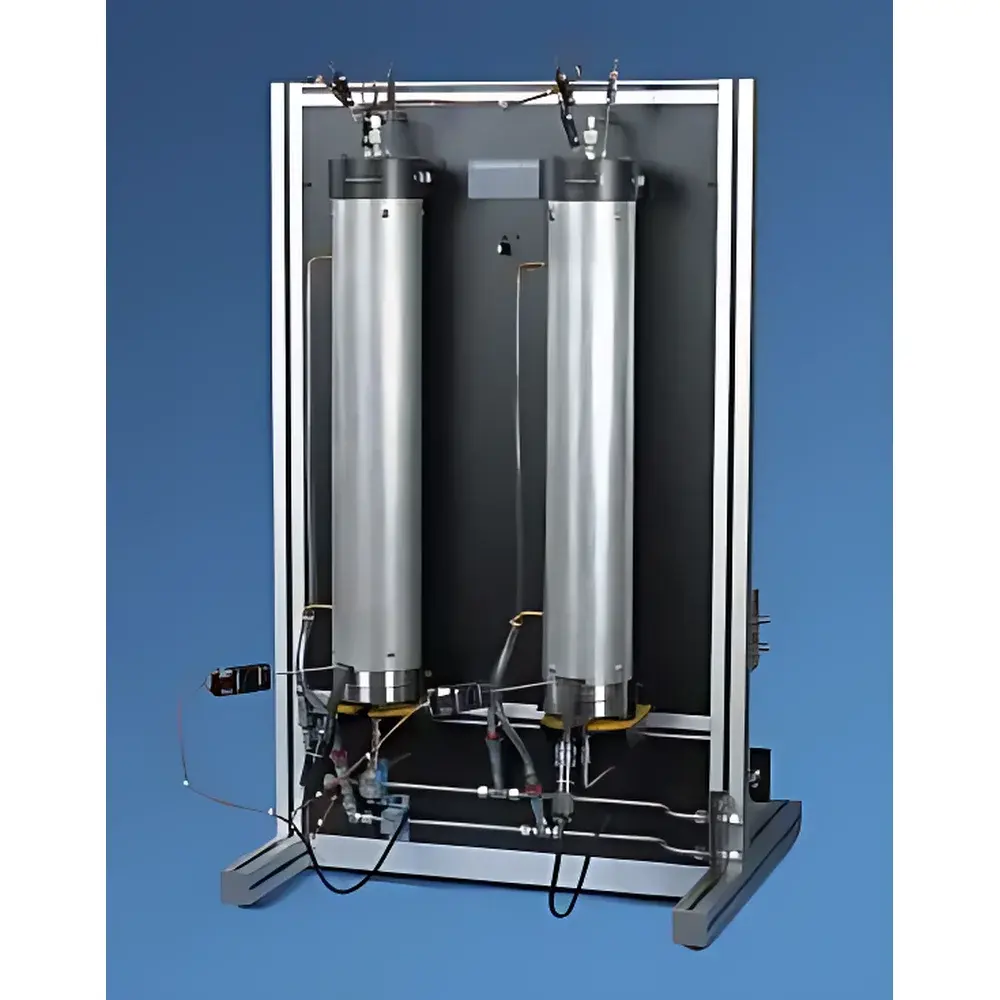
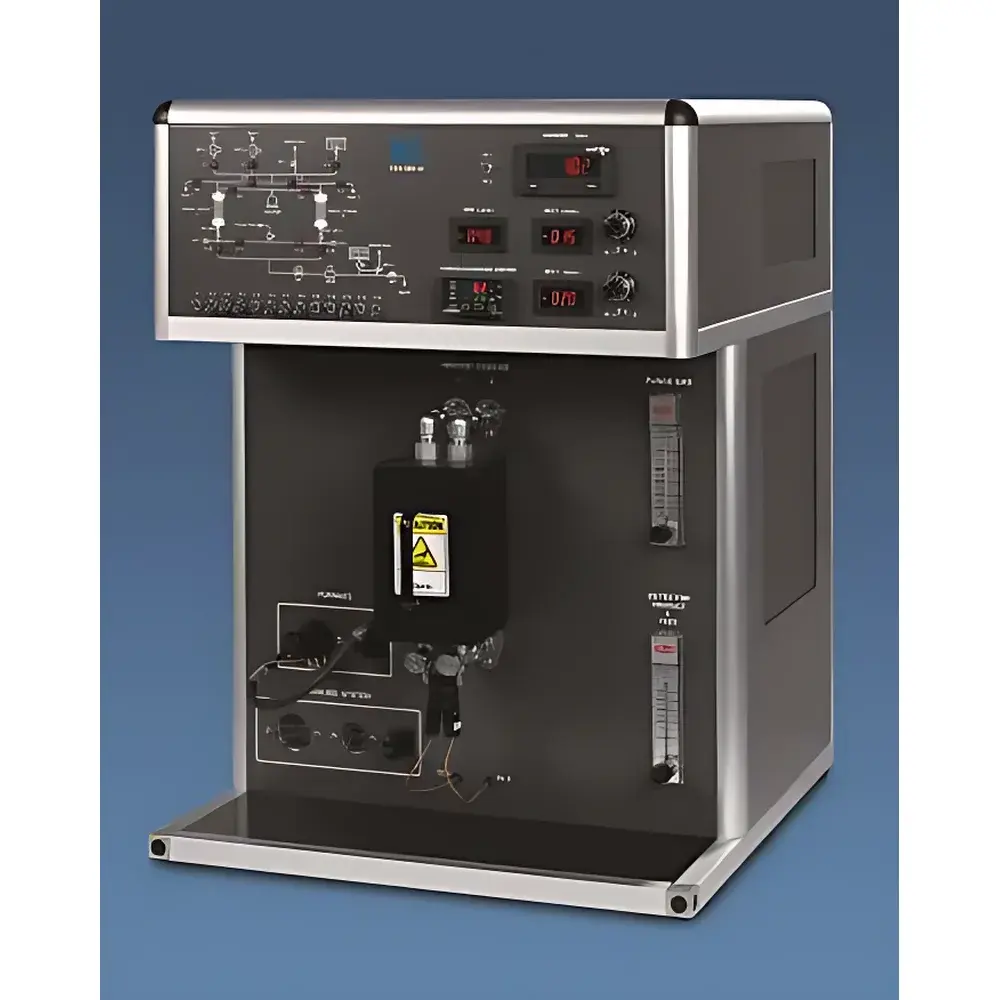
Ankersmid VariPSA-300LC & VariPSA-1000 Automated Pressure Swing Adsorption Systems
| Brand | Ankersmid |
|---|---|
| Origin | USA |
| Model | PSA-300LC and PSA-1000 |
| Gas Inlets | 2 (customizable) |
| Heating Temperature Range | 0–350 °C |
| Isothermal Stability | ±0.1 °C |
| Pressure Range | 0–1000 psi (68.9 bar) |
| Test Function | Simulated PSA/TSA/VSA Cycles, Breakthrough Curve Analysis, Multicomponent Gas Adsorption |
Overview
The Ankersmid VariPSA-300LC and VariPSA-1000 are fully automated, benchtop-scale pressure swing adsorption (PSA) simulation systems engineered for rigorous kinetic and thermodynamic characterization of advanced porous adsorbents—including zeolites, metal–organic frameworks (MOFs), covalent organic frameworks (COFs), activated carbons, and silica gels—under industrially relevant high-pressure and variable-temperature conditions. Unlike conventional static volumetric or gravimetric gas sorption analyzers, these instruments implement dynamic flow-through operation based on the fundamental principles of mass transfer-limited adsorption in fixed beds, enabling direct measurement of breakthrough curves, saturation capacities, selectivity under mixed-gas conditions, and cyclic performance metrics across full PSA, temperature swing adsorption (TSA), and vacuum swing adsorption (VSA) protocols. The systems comply with core methodology standards referenced in ASTM D6617 (Standard Practice for Determining Adsorption Isotherms), ISO 15901-2 (Pore size distribution by gas adsorption), and IUPAC recommendations for dynamic adsorption testing.
Key Features
- Dual-bed modular architecture—configurable as single-bed, dual-bed, or up to four independent adsorption columns for parallel or sequential cycling experiments;
- Integrated high-precision mass flow controllers (MFCs) and pressure transducers calibrated to NIST-traceable standards, supporting reproducible gas dosing across wide flow ranges (1 cc/min to 25 L/min);
- Programmable thermal management system with independent heating/cooling zones, enabling precise isothermal operation (±0.1 °C stability) from ambient to 350 °C and controlled ramp rates for TSA studies;
- High-pressure stainless-steel fluidic path rated to 1000 psi (68.9 bar), with optional H₂S-, CO₂-, and moisture-resistant internal coatings for corrosive or reactive gas service;
- Automated valve sequencing logic synchronized with real-time data acquisition, eliminating manual intervention during multi-step PSA cycles (e.g., pressurization, feed, blowdown, purge, evacuation);
- Modular column design accommodating customizable bed dimensions—from microscale (2 cc, ¼″ ID × 4″ L) in the PSA-300LC variant to pilot-relevant volumes (up to 3500 cc, 2″ ID × 72″ L) in the PSA-1000—ensuring scalability from academic screening to process development.
Sample Compatibility & Compliance
The VariPSA platforms accept powdered, pelletized, or extruded adsorbent forms without pre-compaction requirements. Sample holders feature standardized Swagelok® end fittings and integrated thermocouple ports for localized bed temperature monitoring. All hardware meets ASME B31.3 Process Piping Code requirements for high-pressure gas service. Software complies with FDA 21 CFR Part 11 for electronic records and signatures, including full audit trail logging, user role-based access control, and secure data export (CSV, HDF5, XML). Instrument validation documentation supports GLP and GMP laboratory environments, with IQ/OQ/PQ templates provided for regulatory submissions.
Software & Data Management
Ankersmid’s proprietary VariPSA Control Suite provides a unified interface for experiment definition, real-time visualization of pressure, temperature, flow, and detector signals (via optional TCD/FID/GC integration), and post-run analysis of breakthrough times, dynamic capacity, cycle efficiency, and regeneration energy demand. Built-in modeling modules support linear driving force (LDF), Langmuir–Freundlich, and dual-site isotherm fitting; transient axial dispersion models can be exported for Aspen Adsorption or gPROMS simulation. Raw data is stored in vendor-neutral HDF5 format with embedded metadata (gas composition, pressure setpoints, valve states), ensuring long-term FAIR (Findable, Accessible, Interoperable, Reusable) compliance.
Applications
- Quantitative evaluation of CO₂ capture performance in flue gas (15% CO₂ / 85% N₂) or direct air capture (0.04% CO₂) mixtures;
- Hydrogen purification from syngas (H₂/CO/CH₄/CO₂) and ammonia cracker off-gas streams;
- O₂/N₂ separation using LiX and CaX zeolites under medical-grade or industrial PSA conditions;
- Adsorbent deactivation studies under realistic trace contaminant exposure (e.g., H₂O, SOₓ, NOₓ, siloxanes);
- Accelerated lifetime testing via accelerated cyclic aging protocols (≥1000 cycles) with in-situ capacity tracking;
- Validation of process simulation tools through benchmark breakthrough datasets at varying P/T/composition conditions.
FAQ
Can the system operate with corrosive gases such as H₂S or Cl₂?
Yes—optional Hastelloy C-276 wetted parts and fluoropolymer-sealed valves are available for extended service life with aggressive species.
Is it possible to integrate an external GC or MS for effluent analysis?
Absolutely—the system includes standard ¼″ VCR ports and TTL-triggered sampling valves compatible with commercial GC/MS autosamplers.
What level of automation is supported for unattended overnight operation?
Full cycle autonomy is enabled, including automatic sample conditioning, multi-step PSA sequences, and safety interlocks (pressure/temperature fault shutdown, gas leak detection).
Do you provide application-specific method templates?
Yes—preconfigured methods for CO₂ capture, H₂ purification, air separation, and VOC recovery are included, with editable parameters for custom gas mixtures and cycle timing.
Is remote monitoring and control supported?
The Control Suite supports secure HTTPS-based remote access via enterprise IT infrastructure, with role-based dashboard views for lab managers and researchers.



