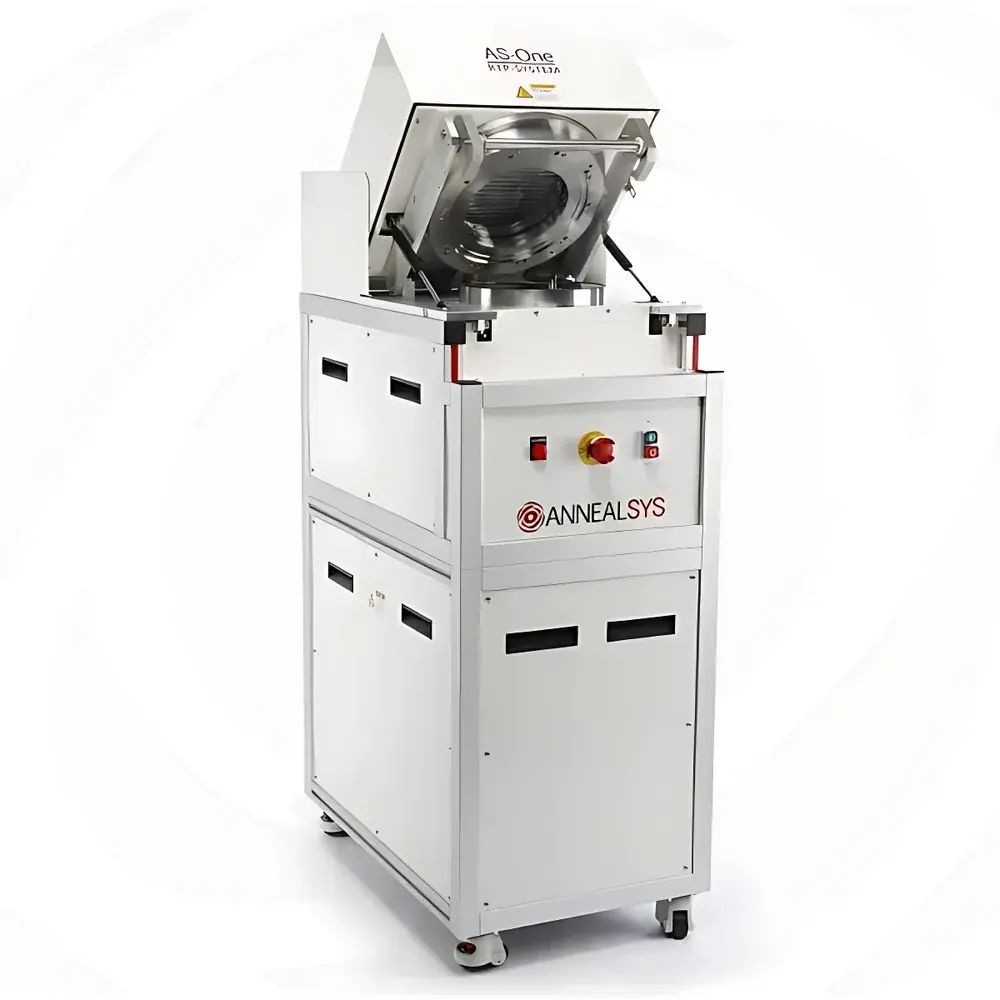
Annealsys AS-ONE 100 High-Vacuum Rapid Thermal Annealing Furnace
| Brand | Annealsys |
|---|---|
| Origin | France |
| Instrument Type | High-Vacuum Rapid Thermal Annealing (RTA) Furnace |
| Sample Diameter | 150 mm (6-inch wafer) |
| Temperature Range | Up to 1200 °C |
| Max. Ramp Rate | 160 K/s |
| Max. Cool-down Rate | 240 K/s |
| Temperature Accuracy | ±1% of setpoint |
| Temperature Uniformity | ±1% across wafer surface |
| Vacuum Base Pressure | ≤1×10⁻⁶ Torr (with turbomolecular pump) |
| Process Gas Control | 5-channel MFC system |
| Heating Source | Array of high-power infrared lamps (18 lamps, 34 kW total) |
| Temperature Measurement | Dual-range pyrometry (150–1100 °C and 400–1500 °C) + K-type thermocouple |
| Control System | Digital PID with real-time feedback loop |
| Compliance | Designed for GLP/GMP-aligned semiconductor R&D and pilot-line fabrication |
Overview
The Annealsys AS-ONE 100 is a high-vacuum rapid thermal annealing (RTA) furnace engineered for precise, reproducible, and contamination-controlled thermal processing of semiconductor wafers up to 150 mm (6-inch) diameter. Based on resistive infrared heating architecture, the system delivers ultra-fast thermal transients—achieving ramp rates up to 160 K/s and cooling rates up to 240 K/s—enabling sub-second thermal cycles critical for dopant activation, silicide formation, oxide growth, and defect engineering in advanced Si, SiC, GaN, and 2D material systems. Its vertical chamber design minimizes gravitational distortion during heating, while the optimized lamp array geometry ensures radial symmetry in radiant flux distribution. The furnace operates under programmable ambient conditions: high vacuum (≤1×10⁻⁶ Torr), inert gas (N₂, Ar), reactive gases (O₂, NH₃, H₂, forming gas), or controlled partial-pressure atmospheres—making it suitable for both research-grade process development and pre-production qualification.
Key Features
- High-vacuum capability enabled by integrated turbomolecular pumping system (base pressure ≤1×10⁻⁶ Torr), ensuring ultra-low residual hydrocarbon and oxygen partial pressures essential for clean interface formation.
- Dual-sensor temperature monitoring: fast-response K-type thermocouple for closed-loop control below 1100 °C; calibrated dual-wavelength pyrometer (150–1100 °C and 400–1500 °C ranges) for non-contact, emissivity-compensated measurement above 400 °C.
- 18 high-intensity IR lamps (34 kW total power) with individual current regulation and forced-air cooling, enabling spatially uniform irradiance and long-term lamp lifetime stability.
- Real-time digital PID controller with adaptive tuning algorithms, supporting multi-segment ramp-hold-cool profiles with <1% temperature deviation from setpoint and ±1% spatial uniformity across full 150 mm wafer area.
- Five independent mass flow controllers (MFCs) for precise delivery of process gases—including oxidizing, reducing, nitriding, and carburizing chemistries—with leak-tight quartz process lines and bake-out compatible fittings.
- Modular chamber architecture with quick-release flanges, quartz viewport (for in-situ optical monitoring), and integrated purge/vent sequences compliant with SEMI S2/S8 safety standards.
Sample Compatibility & Compliance
The AS-ONE 100 accommodates standard 150 mm (6-inch) silicon, sapphire, SiC, GaAs, and quartz wafers—both bare and film-coated (e.g., SiO₂, SiNₓ, TiN, Al₂O₃, MoS₂, graphene). Substrate thickness range: 200 µm to 1.5 mm. Chuck design supports flat and slightly warped wafers without mechanical clamping, minimizing edge stress. All wetted materials comply with ASTM F2627 (semiconductor-grade stainless steel 316L, oxygen-free copper, high-purity alumina ceramics). The system meets ISO 9001 manufacturing traceability requirements and supports FDA 21 CFR Part 11-compliant electronic records when paired with optional audit-trail software modules. Full documentation package includes IQ/OQ protocols aligned with ICH Q7 and SEMI E10 guidelines.
Software & Data Management
Control is executed via Annealsys’ proprietary RTA-Control Suite v4.x—a Windows-based application supporting recipe-driven operation, real-time parameter logging (≥100 Hz sampling), and synchronized acquisition of temperature, pressure, gas flows, and lamp power. Data export formats include CSV, HDF5, and XML for integration into MATLAB, Python (Pandas/NumPy), or MES platforms. Optional features include remote monitoring via HTTPS-secured web interface, automated calibration logging, and GLP-compliant electronic signature workflows. All process data are timestamped with NTP-synchronized clocks and stored with immutable metadata (operator ID, equipment ID, environmental conditions), satisfying GMP traceability requirements for regulated semiconductor R&D labs.
Applications
- Rapid thermal oxidation (RTO) of Si for gate dielectric formation with controlled oxide thickness (0.5–10 nm) and interfacial trap density reduction.
- Activation annealing of ion-implanted dopants (B, P, As) in CMOS and FinFET structures, minimizing transient enhanced diffusion (TED).
- Metal-silicon reactions: NiSi, CoSi₂, TiSi₂ formation with phase-selective nucleation control.
- Nitridation of Si surfaces and high-k dielectrics (e.g., AlN, Si₃N₄) using NH₃ or N₂ plasma-assisted RTP.
- Graphene CVD annealing and carbon nanotube catalyst activation under CH₄/H₂ mixtures at 1000–1200 °C.
- Crystallization of amorphous silicon, IGZO, and phase-change materials (Ge₂Sb₂Te₅) for memory and display applications.
- Thermal densification of low-k porous dielectrics without pore collapse, enabled by millisecond-scale dwell times.
FAQ
What vacuum level can the AS-ONE 100 achieve, and is a load-lock option available?
The standard configuration achieves ≤1×10⁻⁶ Torr using a turbomolecular pump backed by a dry scroll pump. A manual load-lock module (with separate chamber and gate valve) is available as an OEM option for batch processing in high-throughput R&D environments.
Can the system be integrated into a cluster tool or fab automation environment?
Yes—the AS-ONE 100 supports SECS/GEM communication protocol (via RS-485 or Ethernet) and provides SEMI E30/E40-compliant event reporting for seamless integration into factory host systems.
Is emissivity correction supported for non-silicon substrates like GaN or sapphire?
Yes—the dual-wavelength pyrometer allows user-defined emissivity tables and real-time spectral compensation, validated for substrates with emissivity values ranging from 0.15 (polished SiC) to 0.85 (oxidized Si).
What maintenance intervals are recommended for lamp arrays and vacuum components?
IR lamps are rated for ≥5,000 cycles at 1200 °C; routine inspection is advised every 500 cycles. Turbomolecular pump oil replacement is required every 12 months or 8,000 operating hours, whichever occurs first.
Does the system support in-situ optical diagnostics such as reflectometry or ellipsometry?
The top-mounted quartz viewport (Ø50 mm, AR-coated for 300–2000 nm) is compatible with commercial in-situ spectroscopic tools; optical alignment fixtures and feedthroughs for fiber-optic coupling are available as accessories.