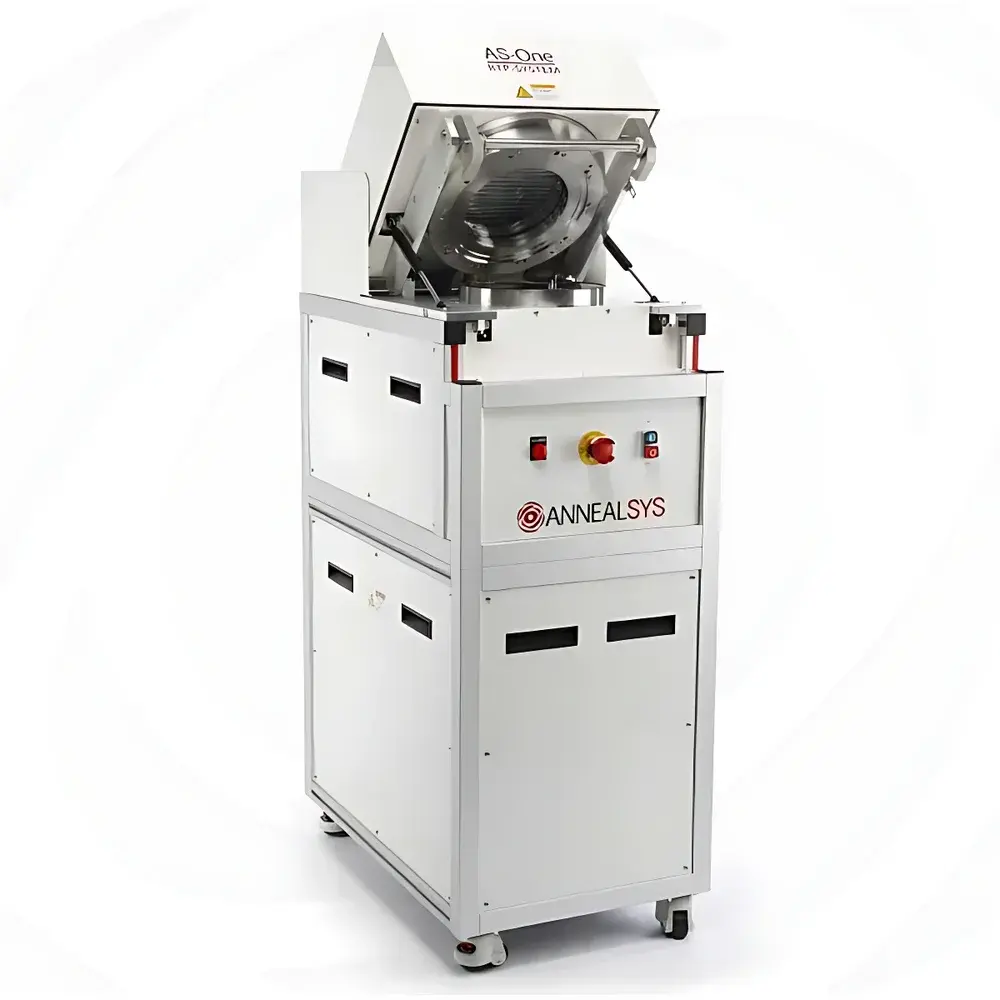
Annealsys AS-ONE 150 High-Vacuum Rapid Thermal Annealing Furnace
| Brand | Annealsys |
|---|---|
| Origin | France |
| Model | AS-ONE 150 |
| Instrument Type | High-Vacuum Rapid Thermal Annealing Furnace |
| Maximum Sample Diameter | 150 mm (6-inch) |
| Temperature Range | Up to 1200 °C (standard), up to 1300 °C (optional high-temp configuration) |
| Max. Heating Rate | 160 K/s |
| Max. Cooling Rate | 240 K/s |
| Temperature Accuracy | ±1% of setpoint |
| Temperature Uniformity | ±1% across wafer surface |
| Vacuum Base Pressure | ≤1×10⁻⁶ Torr (with turbomolecular pump) |
| Process Gas Control | 5-channel MFC system |
| Lamp Configuration | 18 high-power infrared lamps (34 kW total) |
| Chamber Dimensions | Ø200 mm × 25 mm |
| Temperature Sensing | Dual-range pyrometry (400–1100 °C & 400–1500 °C) + K-type thermocouple |
| Controller | Digital PID with real-time thermal profiling |
| Footprint | 510 mm × 1425 mm × 800 mm |
| Weight | 240 kg |
Overview
The Annealsys AS-ONE 150 is a high-vacuum rapid thermal annealing (RTA) furnace engineered for precision semiconductor process development and R&D in academic, government, and industrial cleanroom environments. Based on resistively heated halogen lamp arrays and optimized quartz chamber geometry, the system delivers ultra-fast, spatially controlled thermal cycles via radiative heating—enabling true rapid thermal processing (RTP) with minimal thermal mass interference. Its design adheres to fundamental principles of transient heat transfer in thin-film and bulk semiconductor substrates, where precise control over ramp rate, peak temperature, and dwell time directly governs dopant activation, defect annihilation, interfacial reaction kinetics, and phase transformation behavior. The AS-ONE 150 operates under high vacuum (≤1×10⁻⁶ Torr) or controlled reactive/inert atmospheres, making it suitable for processes requiring oxygen-free or chemically active ambient conditions—such as silicide formation, nitridation, and graphene CVD.
Key Features
- High-power infrared lamp array: 18 individually controllable halogen lamps delivering up to 34 kW total radiant power for reproducible heating profiles
- Ultra-high heating and cooling rates: Programmable ramp rates from 0.1 °C/s to 160 K/s; forced-gas-assisted quenching enables cooling at up to 240 K/s
- Dual-sensor temperature monitoring: Integrated K-type thermocouple for low-temperature calibration and dual-range pyrometer (400–1100 °C / 400–1500 °C) for non-contact, emissivity-compensated high-temperature measurement
- High-vacuum capability: Standard turbomolecular pumping system achieves base pressure ≤1×10⁻⁶ Torr—critical for oxide integrity, metal contamination suppression, and repeatable surface chemistry
- Modular gas delivery: Five independent mass flow controllers (MFCs) support sequential or simultaneous introduction of N₂, O₂, NH₃, H₂, forming gas, or custom mixtures beneath the quartz viewport
- Real-time digital PID control: Closed-loop thermal regulation with sub-second response time and programmable multi-step recipes (up to 99 segments)
- Robust mechanical architecture: Stainless-steel vacuum chamber with water-cooled flanges, ceramic insulation, and vibration-isolated optical viewport for in situ process observation
Sample Compatibility & Compliance
The AS-ONE 150 accommodates standard 6-inch (150 mm) silicon, SiC, GaN, Ge, sapphire, and quartz wafers—including patterned, coated, or heterostructured substrates. Its uniform heating zone (±1% temperature deviation across the full 150 mm diameter) ensures consistent activation and interface engineering across device wafers. The system complies with ISO 14644-1 Class 5 cleanroom integration requirements and supports GLP/GMP-aligned operation through optional audit-trail-enabled software logging. All vacuum components meet ASTM F2781 standards for high-purity semiconductor tooling, and gas lines are electropolished SS-316L with VCR fittings to minimize particulate generation and outgassing.
Software & Data Management
Control is executed via Annealsys’ proprietary RTAStudio™ software, running on an embedded industrial PC with Windows OS. The interface supports full recipe definition—including ramp/soak/cool stages, gas sequencing, pressure ramping, and lamp power zoning—and provides real-time graphical display of temperature, pressure, gas flows, and lamp status. Data export conforms to ASTM E1395 and SEMI E133 standards (CSV, XML, HDF5). Optional 21 CFR Part 11 compliance package includes electronic signatures, role-based access control, and immutable audit trails for regulated environments. Remote monitoring and diagnostics are enabled via secure Ethernet (TCP/IP) with TLS 1.2 encryption.
Applications
- Dopant activation in ion-implanted Si, Ge, and compound semiconductors (e.g., As, P, B, Sb)
- Formation of low-resistance metal silicides (NiSi, CoSi₂, TiSi₂) and germanides
- Rapid thermal oxidation (RTO) and nitridation (RTN) for gate dielectric engineering
- Crystallization of amorphous silicon, IGZO, and metal oxides for TFT backplanes
- Graphene growth via thermal decomposition of SiC and catalytic CVD on Cu/Ni foils
- Post-deposition annealing of ALD/HfO₂, Ta₂O₅, and perovskite thin films
- Defect healing and strain relaxation in III–V heterostructures and quantum well stacks
- Sulfidation and selenization of CZTS, CIGS, and perovskite precursors for photovoltaic absorber layers
FAQ
What vacuum level does the AS-ONE 150 achieve, and which pump configuration is required for high-vacuum operation?
The standard configuration includes a dry scroll pump for rough vacuum (≤1×10⁻² Torr) and a turbomolecular pump for high vacuum (≤1×10⁻⁶ Torr). Molecular pump selection is optimized for low hydrocarbon backstreaming and compatibility with reactive gas chemistries.
Can the system be integrated into a cluster tool or automated material handling environment?
Yes—the AS-ONE 150 supports SECS/GEM (SEMI E30/E37) communication protocols and offers load-lock interface options with atmospheric or vacuum transfer modules for integration into multi-chamber platforms.
Is emissivity compensation available for non-silicon substrates such as GaN or sapphire?
Yes—RTAStudio™ includes user-definable emissivity tables and real-time pyrometer calibration routines validated against NIST-traceable reference sources for materials with varying spectral emissivity profiles.
What safety certifications does the system carry for installation in Class 100 cleanrooms?
The furnace meets UL 61010-1, IEC 61000-6-2/6-4 (EMC), and CE marking requirements. Vacuum and gas subsystems comply with PED 2014/68/EU and ATEX Directive 2014/34/EU for Zone 2 hazardous area compatibility.
Does Annealsys provide application support and process optimization services?
Yes—dedicated process engineers offer remote and on-site support, including thermal profile modeling (using COMSOL Multiphysics®-based radiation-conduction models), recipe transfer from legacy RTP tools, and DOE-based parameter optimization for specific material systems.
Related Products