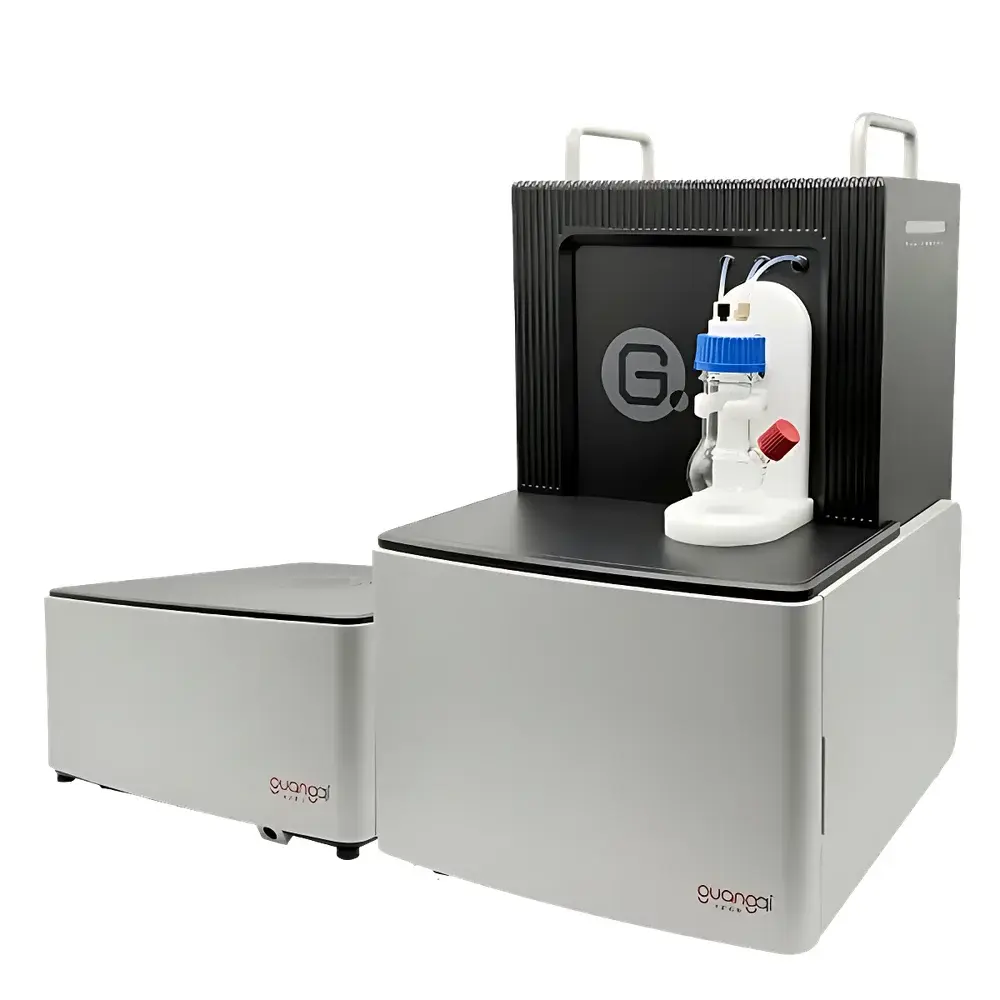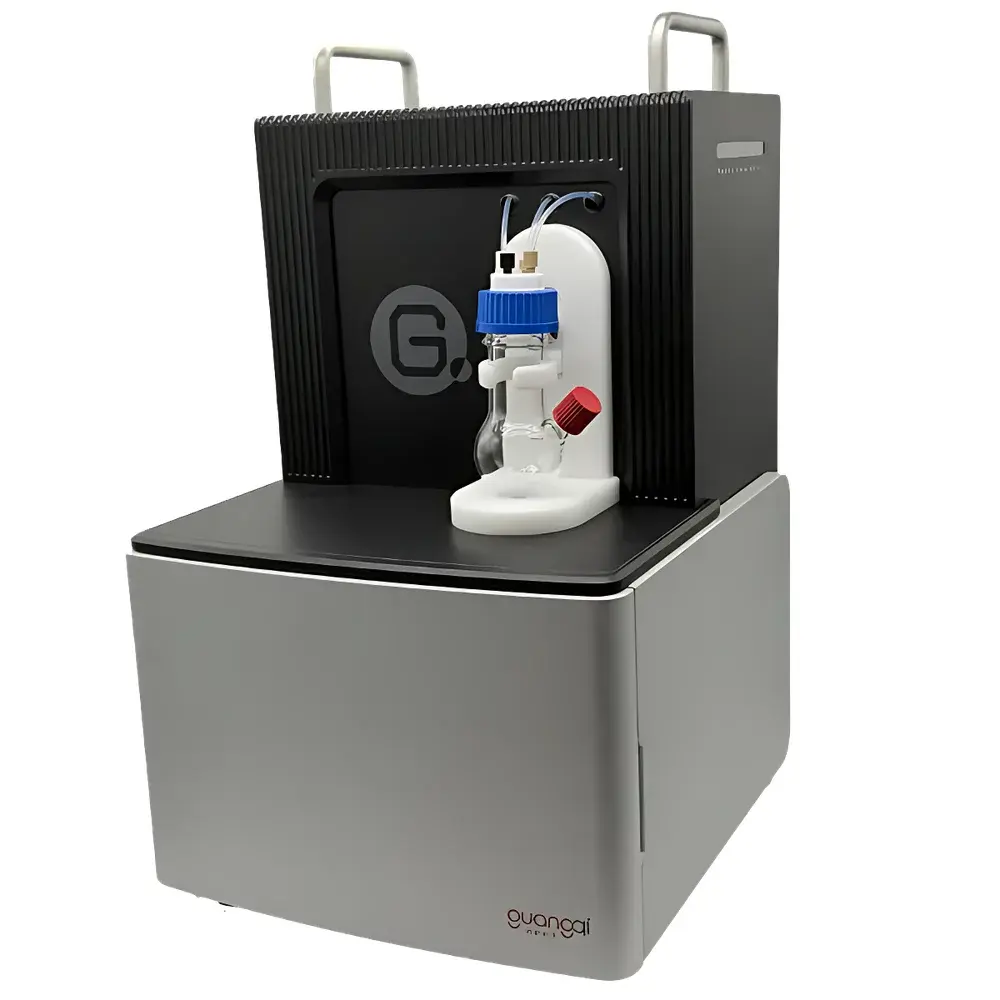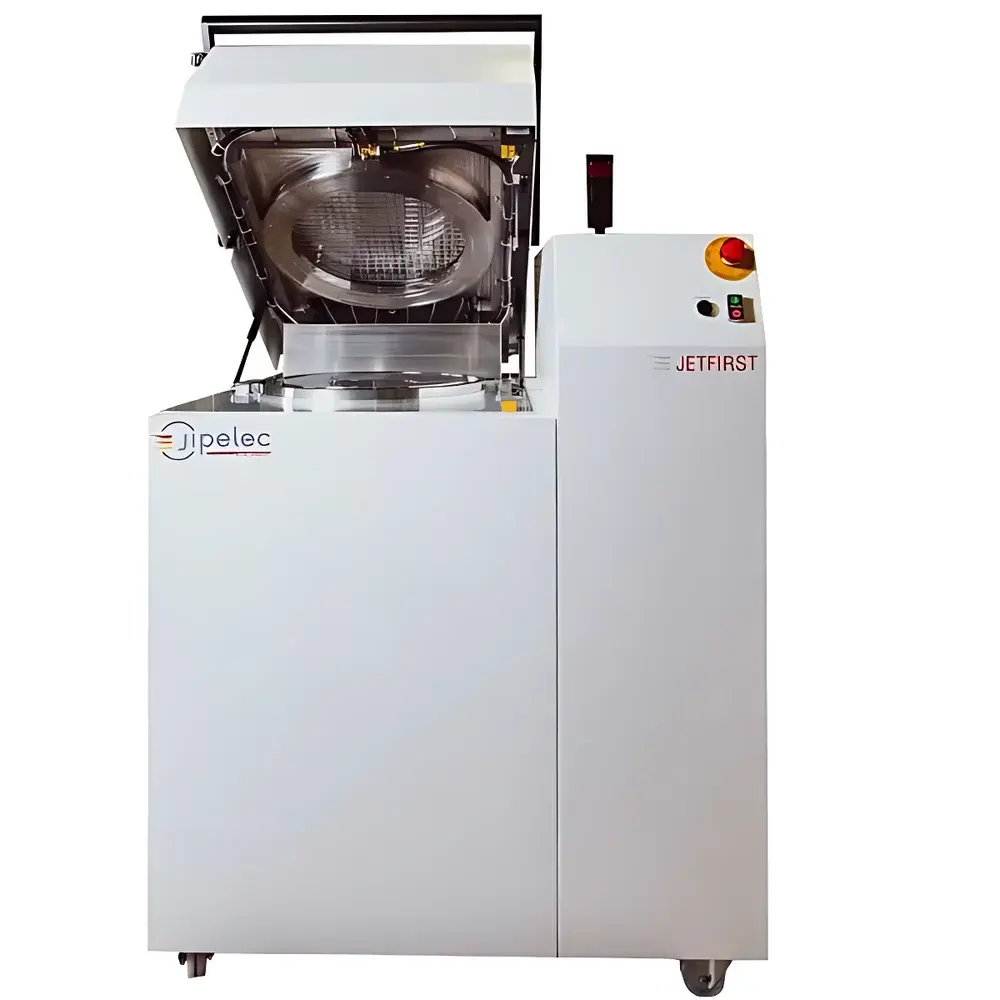
Annealsys JetFirst 300 12-inch High-Vacuum Rapid Thermal Annealing Furnace
| Brand | Annealsys |
|---|---|
| Origin | Germany |
| Model | JetFirst 300 |
| Sample Size | 12-inch (300 mm) |
| Temperature Range | 0–1200 °C |
| Max. Ramp Rate | 150 °C/s |
| Max. Cool-down Rate | 200 °C/min (from 1000 °C to 400 °C) |
| Temperature Accuracy | < ±1% of setpoint |
| Temperature Uniformity | < ±1% across wafer surface |
| Vacuum Level | ≤10⁻⁶ hPa (high-vacuum configuration) |
| Heating Source | Dual-zone halogen lamp array (top + bottom) |
| Gas Control | 4-channel MFC-controlled process gas lines (N₂, Ar, O₂, H₂/N₂ mix) |
| Cooling | Water-cooled chamber + N₂ backside purge |
| Control System | SIMATIC S7-based PLC with 7″ HMI touchscreen |
| Programmable Recipes | 50 stored profiles, up to 50 segments per recipe |
Overview
The Annealsys JetFirst 300 is a high-precision, benchtop rapid thermal annealing (RTA) furnace engineered for semiconductor process development and advanced materials research. It operates on the principle of radiant heating via high-intensity, spectrally optimized halogen lamps—providing rapid, controllable, and highly uniform thermal energy delivery to 300 mm (12-inch) wafers. Unlike conventional tube or box furnaces, the JetFirst 300 achieves sub-second thermal response through direct infrared absorption by the substrate, minimizing thermal mass effects and enabling precise transient thermal profiling. Its architecture supports both high-vacuum (<10⁻⁶ hPa) and controlled-atmosphere processing (inert, oxidizing, or reducing), making it suitable for applications demanding strict stoichiometric control, minimal interfacial diffusion, and repeatable thermal budgets—critical in post-ion-implant activation, silicide formation, gate oxide densification, and low-k dielectric stabilization.
Key Features
- High-vacuum capability down to 10⁻⁶ hPa, with optional turbomolecular pumping and bake-out compatibility for ultra-clean processing environments.
- Dual-zone (top + bottom) halogen lamp array with real-time power modulation ensures radial and axial temperature symmetry across full 300 mm wafers—validated per SEMI F26 and ASTM F1921 standards.
- Thermal ramp rates up to 150 °C/s and controlled cool-down at 200 °C/min (1000 °C → 400 °C), enabling millisecond-scale soak times and precise thermal budget management.
- Integrated water-cooled chamber housing and nitrogen backside purge system suppress thermal drift and enhance repeatability during multi-cycle processing.
- Four independent mass flow controllers (MFCs) support programmable gas sequencing for N₂, Ar, O₂, and H₂/N₂ (5% or 10%)—fully compliant with ISO 8573-1 Class 2 compressed air/gas purity requirements.
- SIMATIC S7-1200 PLC core with CE-certified 7″ resistive touchscreen HMI enables deterministic real-time control, alarm logging, and full traceability of all process parameters (temperature, pressure, gas flows, lamp power, cooling status).
Sample Compatibility & Compliance
The JetFirst 300 accommodates standard 300 mm silicon, SiC, GaN, SOI, and glass substrates—compatible with bare wafers, patterned devices, and bonded stacks (e.g., solar cell heterojunctions). Chuck design supports both electrostatic and mechanical clamping options (optional upgrade). All vacuum and gas interfaces conform to ISO-KF 40 and VCR standards. The system meets CE Machinery Directive 2006/42/EC, EMC Directive 2014/30/EU, and RoHS 2011/65/EU. For regulated environments, optional audit-trail-enabled firmware complies with FDA 21 CFR Part 11 electronic record requirements when paired with validated SOPs and user access controls.
Software & Data Management
Process recipes are defined and executed via the embedded HMI interface—supporting up to 50 stored programs, each with 50 independently configurable segments (ramp, soak, cool). All thermal and environmental data (including time-stamped lamp voltage/current, chamber pressure, MFC setpoints/actuals, and thermocouple readings) are logged internally at 100 ms resolution and exportable via USB or Ethernet (Modbus TCP). Optional PC-based software (JetControl Pro) provides remote monitoring, statistical process control (SPC) charting, DOE template integration, and GLP/GMP-compliant report generation—including digital signatures and revision history tracking.
Applications
- Ion implant activation and damage recovery in CMOS and FinFET node development.
- Rapid thermal oxidation (RTO) and nitridation (RTN) for ultra-thin gate dielectrics (≤1.2 nm EOT).
- Salicide (NiSi, CoSi₂) and contact metallization annealing with sub-5 nm interfacial control.
- Low-κ dielectric (e.g., SiCOH, porous organosilicates) densification without carbon loss or pore collapse.
- Polycrystalline silicon and metal oxide (e.g., IGZO, MoOₓ) crystallization for display and photovoltaic applications.
- Wafer-level bonding activation (e.g., Si-Si, SiO₂-SiO₂) under controlled partial pressure conditions.
FAQ
What vacuum level does the standard configuration achieve?
The base configuration includes a two-stage rotary vane pump achieving ≤10⁻³ hPa; high-vacuum operation (≤10⁻⁶ hPa) requires optional turbomolecular pump and vacuum gauge package.
Is the system compatible with automated wafer handling?
Yes—the JetFirst 300 features SECS/GEM protocol support (via optional RS-422 or Ethernet port) and mechanical interface alignment for integration with front-end cluster tools or load-lock modules.
How is temperature uniformity verified and maintained?
Uniformity is measured using calibrated multi-point pyrometry and wafer-mapped thermocouple arrays during factory acceptance testing (FAT); drift compensation algorithms continuously adjust lamp power based on real-time edge-center differential feedback.
Can the system be used for hydrogen passivation processes?
Yes—hydrogen-containing atmospheres (e.g., 5% H₂/N₂) are supported with leak-tight VCR fittings, catalytic recombiner option, and integrated H₂ sensor interlock for safety-critical operation.
What maintenance intervals are recommended for lamp arrays and cooling systems?
Halogen lamps are rated for ≥2,000 hours at nominal power; preventive replacement is advised every 18 months under continuous R&D use. Water chiller filters require quarterly inspection; nitrogen purge lines should be purged monthly to prevent moisture ingress.