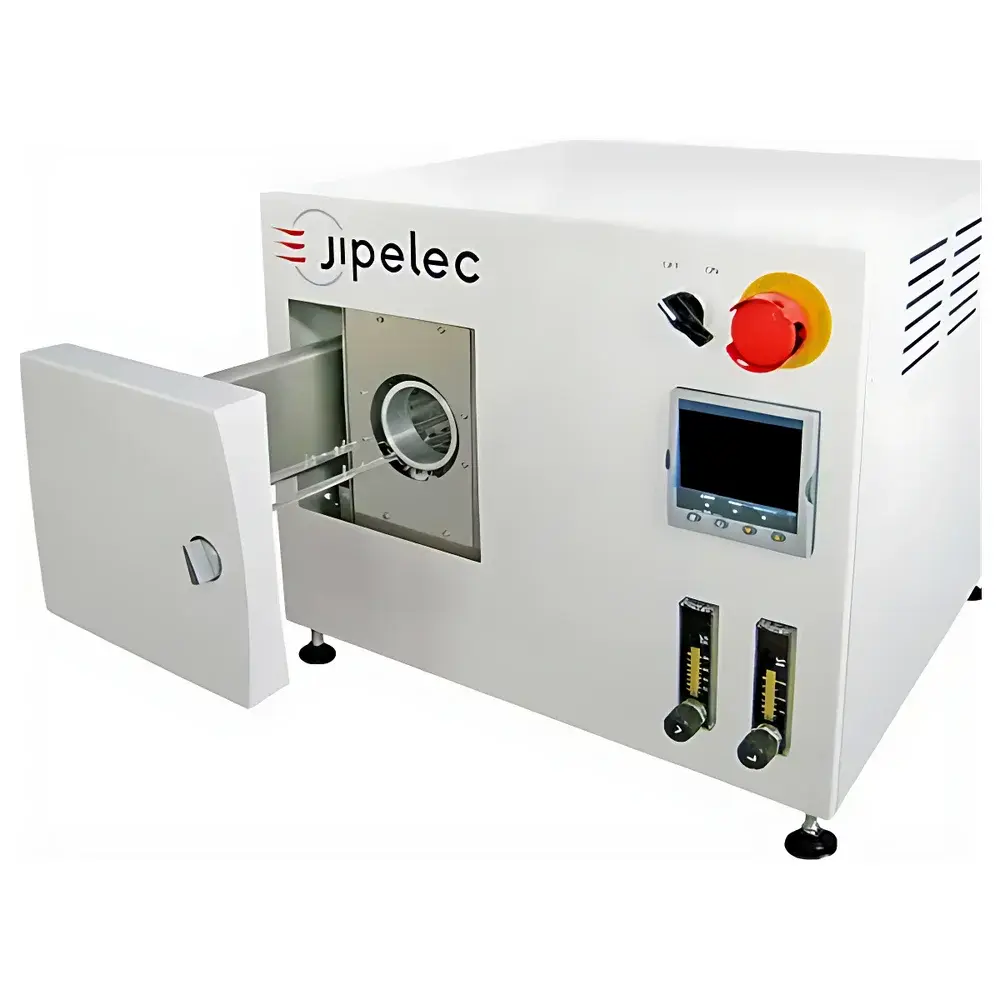
Annealsys JetLight High-Vacuum Rapid Thermal Annealing Furnace
| Brand | Annealsys |
|---|---|
| Origin | France |
| Model | JetLight |
| Instrument Type | High-Vacuum Rapid Thermal Annealing Furnace |
| Sample Size | Up to 3-inch (76 mm) diameter wafers |
| Temperature Range | Ambient to 1450 °C |
| Max Heating Rate | 150 °C/s |
| Max Cooling Rate | 200 °C/s |
| Temperature Accuracy | ±1 °C |
| Temperature Uniformity | ±1% across wafer surface |
| Vacuum Capability | Compatible with turbomolecular pumping systems |
| Heating Source | Array of IR halogen lamps |
| Cooling Method | Forced-air (low-noise, no compressed air required) |
| Chamber Design | Cold-wall, water-cooled quartz chamber with dual stainless-steel enclosure |
| Control Interface | Ethernet-connected PC-based software with programmable ramp/soak profiles |
| Gas Handling | Up to 3 process gases with digital mass flow controllers (MFCs) |
| Optional Configurations | SiC-coated graphite susceptor, molecular pump integration, dual-chamber architecture |
Overview
The Annealsys JetLight is a high-performance, laboratory-scale rapid thermal annealing (RTA) furnace engineered for precision semiconductor process development and materials research. It operates on the principle of radiant heating via a tightly controlled array of infrared halogen lamps, enabling ultra-fast thermal transients while maintaining exceptional spatial and temporal temperature fidelity. Unlike conventional resistance-heated furnaces, the JetLight’s lamp-based architecture delivers direct, volumetric energy coupling to the substrate—minimizing thermal lag and eliminating furnace wall memory effects. Its cold-wall design, featuring a water-cooled quartz reaction chamber enclosed within dual-layer stainless steel, ensures rapid heat dissipation, high process repeatability, and intrinsic contamination control. The system supports both atmospheric and high-vacuum environments (down to 10−7 mbar with optional turbomolecular pumping), making it suitable for implant activation, contact formation, dielectric growth (RTO/RTN), and 2D material synthesis—including graphene CVD—under rigorously defined thermal histories.
Key Features
- Infrared halogen lamp array with power-based (not voltage-based) regulation—ensures long-term thermal reproducibility independent of lamp aging or partial replacement.
- Cold-wall, water-cooled quartz chamber with optimized gas inlet geometry: process gases introduced tangentially at wafer level to eliminate cold spots and enhance radial temperature uniformity.
- Dual N-type thermocouples mounted at wafer center and edge enable real-time, position-resolved temperature feedback for closed-loop PID control with ±1 °C accuracy and ±1% uniformity over 3-inch substrates.
- Programmable thermal profiles executed via Ethernet-linked PC software—supporting multi-segment ramps, holds, and dynamic rate modulation without overshoot.
- Modular gas delivery system with up to three digitally controlled mass flow controllers (MFCs), needle-valve purging capability, and compatibility with inert, oxidizing, and reducing chemistries.
- Optional dual-chamber configuration isolates pre- and post-anneal handling zones, preventing cross-contamination between process sequences—critical for low-defect-density fabrication workflows.
- SiC-coated graphite susceptor available for small-area samples (<1 cm²), improving thermal coupling and emissivity consistency for non-standard substrates.
Sample Compatibility & Compliance
The JetLight accommodates substrates up to 76 mm (3-inch) in diameter—including silicon, SiC, GaN, sapphire, quartz, and flexible metal foils—without mechanical clamping. Its open susceptor design permits rapid loading/unloading and compatibility with standard wafer handling protocols. The system conforms to ISO 9001-certified manufacturing practices and supports audit-ready operation under GLP and GMP frameworks. Vacuum integrity meets ASTM E595 outgassing requirements for space-qualified hardware qualification. When equipped with a turbomolecular pump and residual gas analyzer (RGA), it satisfies UHV-compatible process specifications per SEMI F20 and ITRS roadmap benchmarks for advanced node annealing.
Software & Data Management
Control and data acquisition are managed through Annealsys’ proprietary RTA Studio software, running on Windows-based workstations via Gigabit Ethernet. The interface provides full traceability: every thermal cycle is timestamped, logged with thermocouple readings, lamp power outputs, gas flows, and vacuum pressure traces. Export formats include CSV and HDF5 for integration into statistical process control (SPC) platforms. Audit trails comply with FDA 21 CFR Part 11 requirements when configured with user authentication, electronic signatures, and immutable log archiving. Remote monitoring and alarm notification (via SMTP or SNMP) are supported for unattended overnight runs.
Applications
- Rapid thermal annealing (RTA) for dopant activation following ion implantation in CMOS and power device fabrication.
- Ohmic contact formation on III–V and wide-bandgap semiconductors (e.g., Ti/Al/Ni/Au on GaN).
- Rapid thermal oxidation (RTO) and nitridation (RTN) of silicon gate stacks with sub-second dwell times.
- Graphene and transition metal dichalcogenide (TMD) synthesis via rapid thermal chemical vapor deposition (RTCVD).
- Post-deposition annealing of high-k dielectrics (HfO₂, Al₂O₃) and ferroelectric oxides (HfZrO, PZT).
- Thermal stability assessment of nanoscale metallization schemes under transient thermal stress.
FAQ
What vacuum level can the JetLight achieve with the standard pumping configuration?
The base configuration includes a scroll pump and capacitance manometer, reaching ≤10−3 mbar. With optional turbomolecular pump integration, ultimate pressure improves to ≤5×10⁻⁸ mbar.
Is the system compatible with corrosive process gases such as Cl₂ or NF₃?
Yes—when specified with quartz-lined gas lines, Hastelloy C-276 MFCs, and chemically resistant O-rings, the JetLight supports reactive chemistry processing under controlled flow and pressure regimes.
Can temperature uniformity be validated per SEMI PV25 or ASTM F2628 standards?
Absolutely—the dual-point thermocouple layout, calibrated against NIST-traceable reference sensors, enables compliance verification using wafer-mapped pyrometry or embedded thermocouple test wafers.
Does the dual-chamber option support independent vacuum isolation between chambers?
Yes—each chamber features dedicated vacuum valves, pressure gauges, and gas inlets, allowing simultaneous or sequential processing under differing ambient conditions without cross-talk.
What maintenance intervals are recommended for lamp arrays and quartz components?
Lamp lifetime exceeds 2,000 hours under nominal power; quartz chamber inspection is advised every 500 cycles or after exposure to particulate-generating processes. Full preventive maintenance kits and calibration services are available directly from Annealsys.