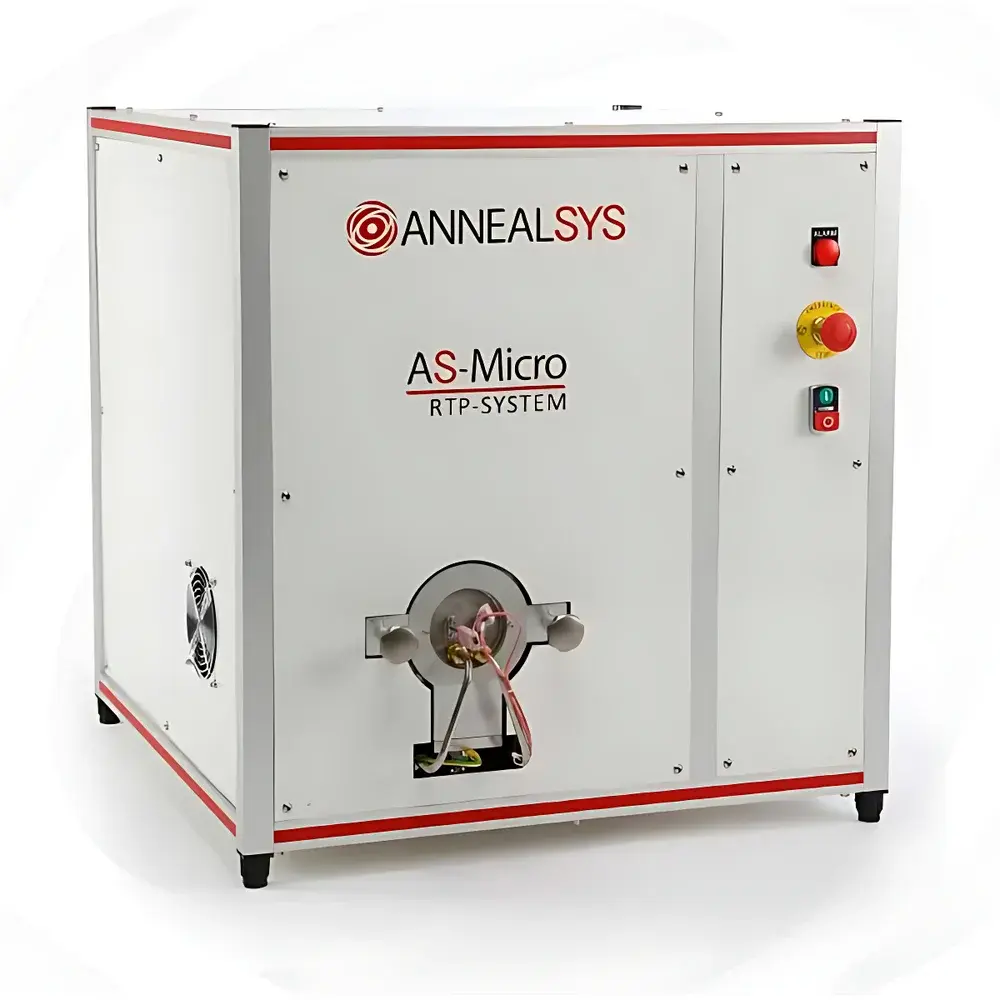
Annealsys AS-Micro High-Vacuum Rapid Thermal Annealing Furnace
| Brand | Annealsys |
|---|---|
| Origin | France |
| Model | AS-Micro |
| Instrument Type | High-Vacuum Rapid Thermal Annealing Furnace |
| Maximum Sample Size | 3-inch (76 mm) diameter or square |
| Temperature Range | Ambient to 1450 °C |
| Max Heating Rate | 150 °C/s |
| Max Cooling Rate | 200 °C/s |
| Temperature Accuracy | ±1 °C |
| Temperature Uniformity | ±1% across wafer surface |
| Heating Source | IR Halogen Lamps |
| Cooling Method | Forced-air (low-noise, no compressed air required) |
| Chamber Design | Dual-chamber optional |
| Vacuum Capability | Compatible with turbomolecular pump for ≤10⁻⁶ mbar base pressure |
| Control Interface | Ethernet-connected PC software with full PID programmability |
| Gas Handling | Up to 3 process gases, digitally controlled mass flow controllers (MFCs) |
| Thermocouple Configuration | Dual N-type (center + edge) for direct wafer-temperature feedback |
Overview
The Annealsys AS-Micro is a high-precision, high-vacuum rapid thermal annealing (RTA) furnace engineered for semiconductor R&D laboratories requiring reproducible, contamination-controlled thermal processing. It operates on the principle of radiant heating via high-intensity infrared halogen lamps, enabling precise spatial and temporal control of thermal energy delivery to substrates. Unlike conventional resistance-heated furnaces, the AS-Micro delivers ultra-fast thermal transients—up to 150 °C/s heating and 200 °C/s cooling—while maintaining exceptional temperature accuracy (±1 °C) and uniformity (±1% across a 3-inch substrate). Its cold-wall quartz chamber design, actively water-cooled stainless-steel enclosure, and wafer-level gas inlet geometry eliminate thermal memory effects and suppress cold-spot formation during ramping. The system supports both atmospheric and high-vacuum environments (down to 10⁻⁶ mbar with optional turbomolecular pumping), making it suitable for implant activation, ohmic contact formation, rapid thermal oxidation (RTO), rapid thermal nitridation (RTN), and low-temperature graphene CVD.
Key Features
- Infrared halogen lamp array with power-based (not voltage-based) regulation ensures consistent irradiance over lamp lifetime—even after partial lamp replacement—preserving thermal reproducibility and cross-wafer uniformity.
- Cold-wall architecture with integrated water-cooling maintains chamber walls below 80 °C during operation, eliminating outgassing and enabling high-purity processing without thermal hysteresis.
- Dual N-type thermocouples mounted at wafer center and edge provide real-time, localized temperature feedback directly from the sample plane—critical for closed-loop PID control under transient conditions.
- Modular gas delivery system supports up to three process gases, each regulated by digital mass flow controllers (MFCs) with <1% full-scale accuracy and Ethernet-based setpoint synchronization.
- Optional dual-chamber configuration physically isolates pre- and post-anneal steps, preventing cross-contamination between material systems (e.g., Si and III–V compounds) and meeting stringent cleanroom-grade process segregation requirements.
- PC-based control software (Windows-compatible) enables full recipe programming—including multi-segment ramps, holds, and cooldown profiles—with audit-trail logging compliant with GLP and internal QA documentation protocols.
- Quartz process chamber accommodates substrates up to 3-inch (76 mm) diameter or square; optional SiC-coated graphite susceptor available for sub-10 mm samples to minimize thermal mass and improve response fidelity.
Sample Compatibility & Compliance
The AS-Micro is validated for use with silicon, SiC, GaN, sapphire, quartz, and metal-oxide substrates ranging from <1 mm² test dies to full 3-inch wafers. Its vacuum integrity (<10⁻⁶ mbar with turbomolecular pump), low particulate generation (<Class 100 cleanroom compatible), and absence of oil-based pumping media meet ISO 14644-1 Class 5 requirements when installed in appropriate enclosures. All electrical and safety subsystems conform to CE marking directives (2014/30/EU EMC, 2014/35/EU LVD), and vacuum components comply with ISO 286-2 tolerance standards. For regulated environments, the control software supports user access levels, electronic signatures, and 21 CFR Part 11–compliant audit trails upon request.
Software & Data Management
Control is executed via Annealsys’ proprietary RTA-Studio software, running on a standard Windows PC connected via Gigabit Ethernet. The interface provides real-time plotting of temperature, power, gas flows, and vacuum pressure, with synchronized timestamped data export in CSV or HDF5 format. Recipes are stored in encrypted project files with version history and metadata tagging (operator ID, timestamp, chamber ID). Raw thermocouple signals are sampled at 100 Hz and filtered using adaptive digital FIR algorithms to suppress EMI-induced noise. Data logs include full system health diagnostics (lamp current balance, cooling fan RPM, MFC valve position), supporting predictive maintenance and root-cause analysis per ISO/IEC 17025 clause 7.8.2.
Applications
- Ion implant activation in Si, Ge, and strained-Si channels
- Ohmic contact sintering for Al/Ti/Ni-based metallization stacks
- Rapid thermal oxidation (RTO) of ultrathin gate dielectrics (≤2 nm SiO₂)
- Rapid thermal nitridation (RTN) for SiON interfacial layer engineering
- Low-temperature (≤900 °C) graphene synthesis via rapid thermal CVD on Cu/Ni foils
- Post-deposition annealing of high-k dielectrics (HfO₂, Al₂O₃) and ferroelectric oxides (HfZrO)
- Thermal budget optimization studies for advanced node CMOS and memory devices
FAQ
What vacuum level can the AS-Micro achieve with standard and optional pumping configurations?
With the included scroll pump and capacitance manometer, base pressure reaches ≤5×10⁻³ mbar. With optional turbomolecular pump and cryo-trap, ultimate pressure is ≤1×10⁻⁶ mbar.
Is the system compatible with reactive gas chemistries such as NH₃ or O₂?
Yes—the gas manifold includes stainless-steel wetted parts, VCR fittings, and MFCs rated for corrosive and oxidizing gases per SEMI F57-0218 specifications.
Can temperature uniformity be verified independently per wafer lot?
Yes—integrated thermocouple mapping mode allows automated multi-point calibration across the wafer plane using certified NIST-traceable reference sensors.
Does the dual-chamber option support independent vacuum and gas control per chamber?
Yes—each chamber has dedicated vacuum lines, MFCs, and pressure regulation, enabling fully asynchronous process execution.
What is the mean time between failures (MTBF) for the lamp array under typical R&D usage?
Based on accelerated life testing and field data, MTBF exceeds 12,000 hours at 80% nominal power, with automatic lamp-balance compensation maintaining uniformity throughout service life.
Related Products