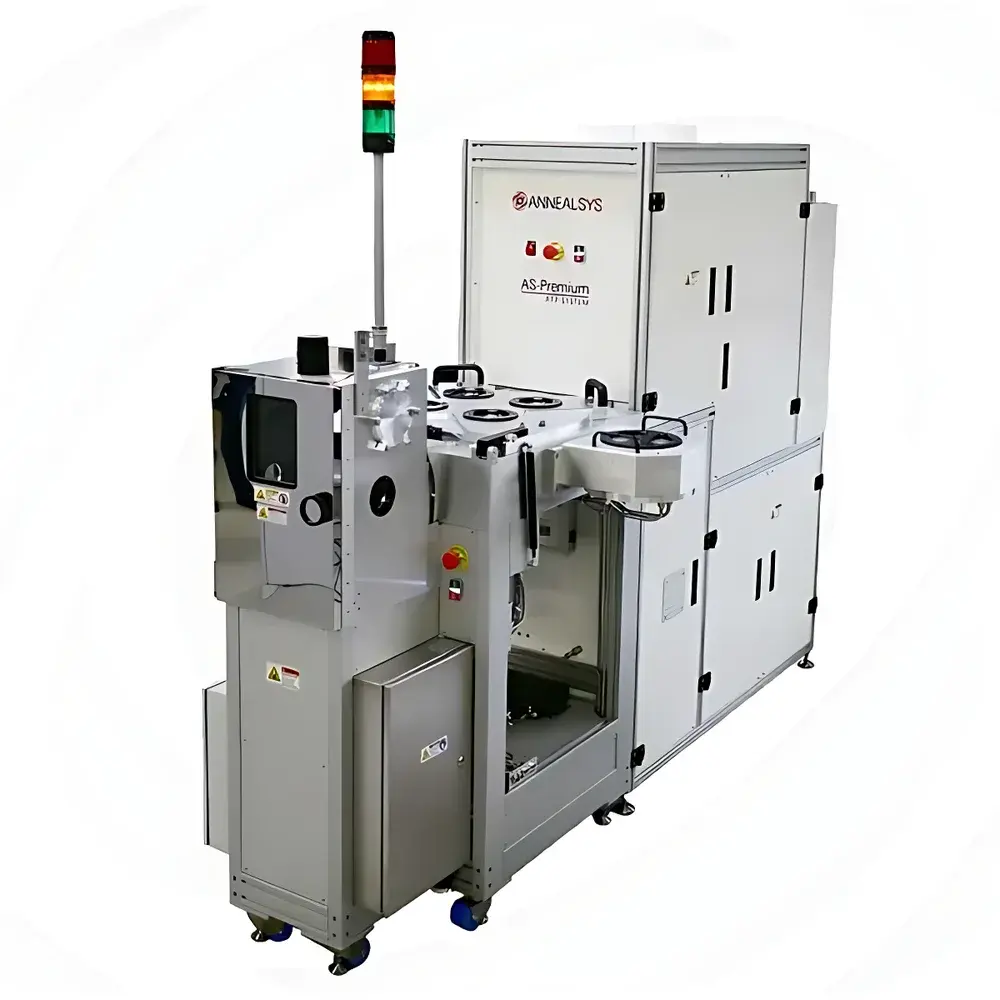
Annealsys AS-Premium High-Vacuum Rapid Thermal Annealing System with Load-Lock
| Brand | Annealsys |
|---|---|
| Origin | France |
| Model | AS-Premium |
| Instrument Type | High-Vacuum Rapid Thermal Annealing Furnace |
| Sample Size | 150 mm (6") / 200 mm (8") / 300 mm (12") wafers |
| Temperature Range | 0–1200 °C |
| Max. Ramp Rate | 150 °C/s |
| Max. Cool-down Rate | 200 °C/s (from 1000 °C to 400 °C) |
| Temperature Accuracy | < ±1% of setpoint |
| Temperature Uniformity | < ±1% across wafer surface |
| Vacuum Base Pressure | ≤ 1 × 10⁻⁶ hPa (with turbo-molecular pump and load-lock) |
| Heating Configuration | Dual-side (top & bottom) halogen lamp array |
| Susceptor Materials | Graphite or SiC-coated graphite |
| Process Atmosphere | Inert (N₂, Ar), oxidizing (O₂), reducing (H₂/N₂), or vacuum |
| Standard Temperature Monitoring | Dual-channel pyrometry + optional thermocouple |
| Control System | SIMATIC S7-based PLC with 7" HMI touchscreen |
| Programmable Recipes | 50 stored profiles, up to 50 segments per recipe |
Overview
The Annealsys AS-Premium is a high-vacuum rapid thermal annealing (RTA) system engineered for precision semiconductor process control in research, development, and pilot-line fabrication environments. Based on the fundamental principle of radiative heating via high-intensity halogen lamps, the AS-Premium delivers ultra-fast, transient thermal cycles with sub-second response and exceptional spatial temperature uniformity—critical for ion implant activation, contact alloying, oxide/nitride growth, and defect engineering in advanced compound and elemental semiconductors. Its dual-side lamp configuration ensures symmetric radiant flux distribution, minimizing thermal gradients across large-area substrates (up to 300 mm diameter). Integrated load-lock architecture enables sequential processing without breaking high vacuum (<1×10⁻⁶ hPa), eliminating oxygen contamination during silicon surface smoothing, getter activation, or oxygen-sensitive III–V and wide-bandgap (e.g., SiC, GaN) material treatments.
Key Features
- Dual-zone halogen lamp heating system with independent top/bottom power control for optimized thermal symmetry and wafer-scale uniformity
- High-vacuum chamber equipped with turbo-molecular pumping and integrated load-lock, enabling oxygen-free (<1 ppm O₂ equivalent) processing environments
- Fast digital PID temperature controller with dual-sensor input (pyrometer + optional thermocouple), delivering temperature reproducibility better than ±1% of setpoint over repeated cycles
- Programmable ramp/soak/cool profiles (50 recipes, 50 segments each), supporting complex multi-step RTA, RTO, RTN, RTE, and selenization sequences
- Modular platform design accommodating manual loading, cluster tool integration, or glovebox interfacing via standardized flanges and motion feedthroughs
- Process gas delivery with up to four mass flow controllers (MFCs) for precise regulation of N₂, Ar, O₂, H₂/N₂ mixtures, or forming gas
- Water-cooled chamber walls and nitrogen-assisted substrate cooling ensure rapid thermal quenching and thermal budget minimization
Sample Compatibility & Compliance
The AS-Premium supports wafers up to 300 mm (12″) in diameter or square substrates up to 156 × 156 mm². Compatible substrates include Si, SiGe, GaAs, InP, GaN, SiC, LiNbO₃, PZT, and sol-gel-derived oxides (e.g., TiO₂, ZnO). The system meets key regulatory and quality framework requirements for semiconductor R&D labs: vacuum integrity and leak rate performance comply with ISO 2859-1 sampling standards; temperature calibration traceability aligns with ISO/IEC 17025-accredited metrology practices; software operation supports audit trails and user access control consistent with GLP and pre-GMP documentation needs. Optional 21 CFR Part 11-compliant electronic signature and data integrity modules are available for regulated process development.
Software & Data Management
Control is executed via a Siemens SIMATIC S7 PLC platform with an intuitive 7-inch resistive touchscreen HMI. All thermal, vacuum, gas, and safety parameters are logged synchronously at ≥10 Hz resolution. Raw data export is supported in CSV and MATLAB-compatible formats. Recipe management includes version tagging, timestamped execution logs, and real-time deviation alerts. Optional Ethernet/IP or OPC UA interfaces enable integration into factory MES systems. Data storage complies with IEC 62443-3-3 cybersecurity guidelines for industrial control systems.
Applications
- Ion implant activation annealing (Si, SiGe, GaAs, SiC)
- Ohmic contact formation and metal–semiconductor alloying (e.g., NiSi, TiSi₂, Al–GaAs)
- Rapid thermal oxidation (RTO) and nitridation (RTN) for gate dielectric engineering
- Piezoelectric/pyroelectric thin-film crystallization (e.g., PZT, AlN)
- Solar cell processing: CIGS selenization, CdTe annealing, perovskite densification
- Low-k dielectric curing and porosity stabilization
- Getter layer activation in SOI and epitaxial substrates
- Sol-gel derived oxide annealing (TiO₂, VO₂, HfO₂) for optical and memristive applications
FAQ
What vacuum level does the AS-Premium achieve with the standard turbo-pump and load-lock configuration?
The base pressure is ≤1 × 10⁻⁶ hPa under clean, baked conditions—sufficient for oxygen-sensitive processes such as Si surface reconstruction and III–V regrowth.
Can the system be configured for single-side heating only?
Yes—the chamber design supports both single- and dual-side lamp configurations depending on process requirements and substrate transparency constraints.
Is thermocouple-based temperature measurement supported alongside pyrometry?
Thermocouple input is optional and configurable; however, non-contact pyrometry remains the primary, factory-calibrated method for closed-loop control due to its immunity to thermal drift and compatibility with transparent or reflective substrates.
What safety interlocks are implemented for vacuum, temperature, and cooling subsystems?
Hardware-level interlocks monitor chamber pressure, coolant flow rate, lamp power supply status, and door position; any fault triggers immediate power cutoff and safe cooldown sequence per IEC 61508 SIL-2 functional safety principles.
Does the system support remote monitoring and diagnostics?
Standard Ethernet connectivity enables secure remote access via VPN for real-time parameter viewing, log retrieval, and limited recipe editing—subject to role-based authentication and TLS 1.2 encryption.