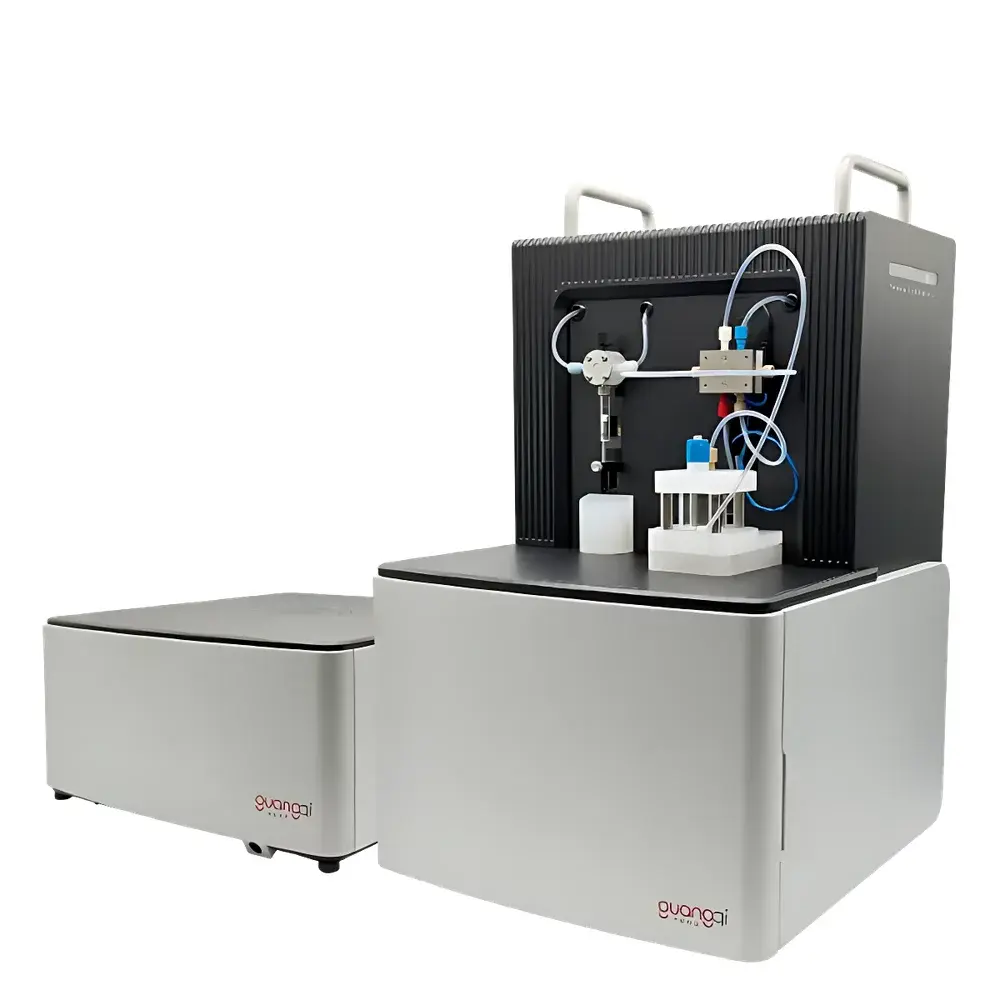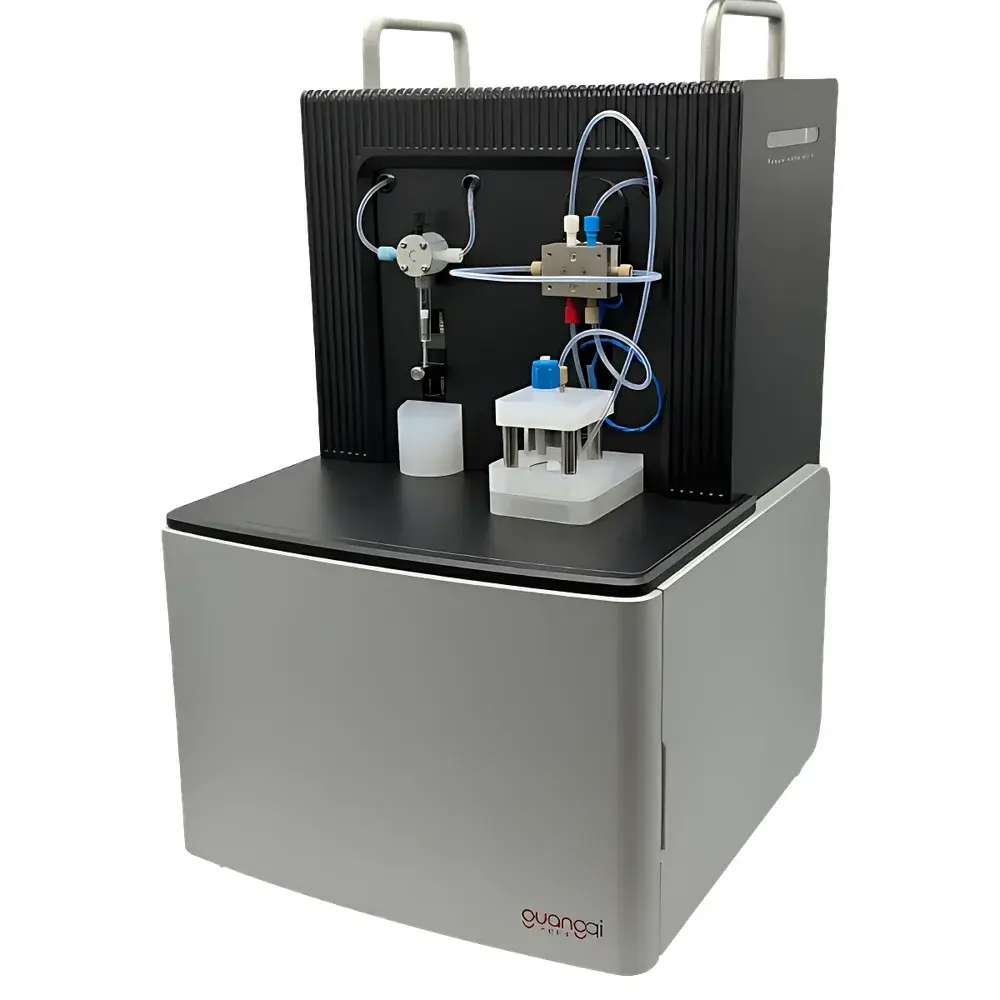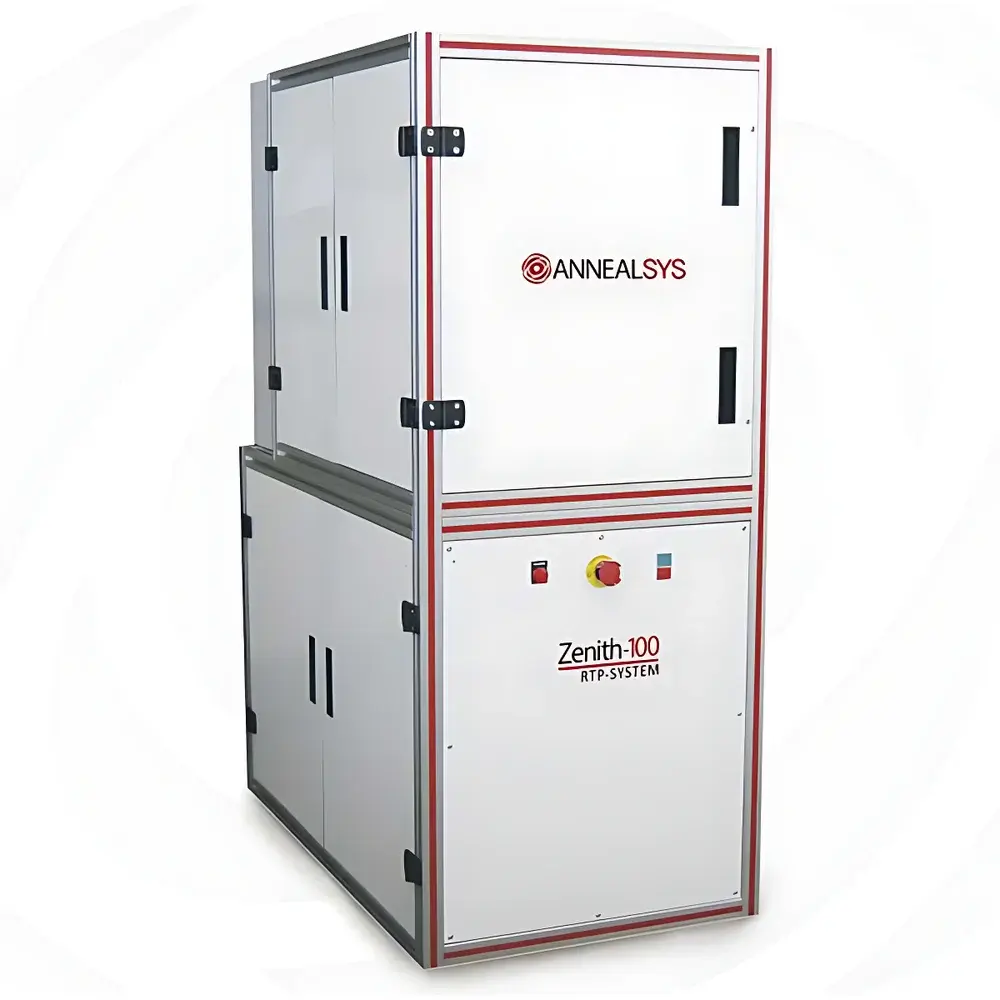
Annealsys Zenith-100 High-Vacuum Rapid Thermal Annealing Furnace
| Brand | Annealsys |
|---|---|
| Origin | France |
| Model | Zenith-100 |
| Instrument Type | High-Vacuum Rapid Thermal Annealing Furnace |
| Maximum Sample Diameter | 6-inch (150 mm) |
| Temperature Range | 0–2000 °C |
| Maximum Heating Rate | 150 °C/s |
| Maximum Cooling Rate | 200 °C/s |
| Temperature Accuracy | ±1 °C |
| Temperature Uniformity | ±1% across wafer surface |
| Chamber Construction | Stainless steel, water-cooled cold-wall design |
| Standard Atmospheres | High vacuum, inert (N₂, Ar), reducing (H₂/N₂ mix) |
| Mandatory Pumping | Turbo-molecular pump required |
| Temperature Sensors | Dual-mode — calibrated pyrometer (for >600 °C) and type C thermocouple (for full range) |
| Control System | Digital PID with real-time feedback and ramp-soak profiling |
| Compliance | Designed for GLP-compliant R&D environments |
Overview
The Annealsys Zenith-100 is a high-vacuum rapid thermal annealing (RTA) furnace engineered for precision thermal processing of semiconductor wafers and advanced materials in research and development laboratories. Operating on the principle of radiant heating via high-emissivity tungsten filament heaters, the system delivers exceptional thermal responsiveness and spatial control—critical for dopant activation, silicide formation, oxide densification, and defect engineering in Si, SiC, GaN, and 2D material systems. Its cold-wall architecture—featuring a stainless steel, water-jacketed chamber—minimizes thermal mass and eliminates cross-contamination between runs, ensuring low memory effect and high process reproducibility. Unlike conventional tube furnaces, the Zenith-100 achieves true rapid thermal processing: it heats a 6-inch (150 mm) substrate from ambient to 2000 °C in under 10 minutes, with programmable ramp rates up to 150 °C/s and controlled cooling rates up to 200 °C/s. This performance envelope supports both transient thermal budget optimization and steady-state high-temperature treatments, making it suitable for process development aligned with ITRS and IRDS thermal budget guidelines.
Key Features
- Ultra-high temperature capability: Stable operation up to 2000 °C with tungsten-based heater assembly and high-purity quartz or graphite susceptors
- Cold-wall vacuum chamber: Water-cooled stainless steel construction enabling rapid thermal cycling, minimal background contamination, and high repeatability (±1 °C accuracy, ±1% uniformity over 6-inch wafer)
- Dual-sensor temperature monitoring: Integrated type C thermocouple for full-range measurement and calibrated narrow-band pyrometer (0.8–1.1 µm) for non-contact verification above 600 °C
- High-vacuum base pressure: <1×10⁻⁶ mbar achievable with standard turbo-molecular pumping configuration (roughing pump + turbomolecular pump mandatory)
- Atmosphere flexibility: Compatible with high vacuum, inert gas (Ar, N₂), and reducing ambients (e.g., 5% H₂/95% N₂); oxidation-capable configurations require optional quartz-lined hot-wall modules
- Advanced digital control: Real-time PID algorithm with user-defined multi-step ramp-soak profiles, data logging at 100 ms intervals, and remote Ethernet interface (Modbus TCP)
Sample Compatibility & Compliance
The Zenith-100 accommodates substrates up to 150 mm (6-inch) diameter, including silicon, sapphire, SiC, GaAs, and metal-coated wafers. Susceptor options include high-density graphite and silicon carbide-coated variants—both certified for ultra-low metallic impurity outgassing (<1×10¹⁰ atoms/cm²/s for Fe, Ni, Cr). The system conforms to safety standards EN 61000-6-4 (EMC) and EN 61000-6-2 (immunity), and its vacuum and gas delivery architecture meets ISO 8573-1 Class 2 purity requirements for process gases. For regulated environments, the controller supports audit-trail-enabled operation (optional firmware upgrade) compliant with FDA 21 CFR Part 11 Annex 11 principles when integrated with validated LIMS or MES platforms. Process documentation aligns with ASTM F1937-22 (“Standard Practice for Evaluating Rapid Thermal Processing Equipment”) and supports IQ/OQ protocols per ISO/IEC 17025.
Software & Data Management
The Zenith-100 is operated via Annealsys’ proprietary RTAControl v4.x software, a Windows-based application supporting intuitive profile definition, real-time thermal mapping visualization, and synchronized acquisition of temperature, pressure, and gas flow signals. All process data—including time-stamped sensor readings, setpoint deviations, and alarm logs—are stored in .csv and HDF5 formats for post-run analysis. The software includes built-in statistical process control (SPC) tools for Cp/Cpk calculation across batch runs and export-ready reporting templates compliant with internal quality review cycles. Optional API integration (RESTful JSON endpoints) enables bidirectional communication with laboratory information management systems (LIMS) and enterprise manufacturing execution systems (MES), facilitating automated metadata tagging and electronic batch record generation.
Applications
- Dopant activation in ultra-shallow junctions (USJ) for sub-5 nm CMOS nodes
- Silicide phase formation (NiSi, CoSi₂, TiSi₂) and agglomeration studies
- Thermal stabilization of high-k dielectrics (HfO₂, Al₂O₃) and interfacial layer engineering
- Graphene and transition metal dichalcogenide (TMD) annealing for defect passivation and carrier mobility enhancement
- Recrystallization of amorphous silicon layers in TFT backplanes and photovoltaic absorbers
- Fundamental kinetic studies of solid-phase epitaxy (SPE), diffusion, and phase transformation under controlled thermal transients
FAQ
Is oxidizing atmosphere operation supported?
No—the standard Zenith-100 configuration is incompatible with O₂-rich or air ambients due to tungsten heater oxidation risk. Oxidation-capable processing requires an optional quartz-lined hot-wall chamber and MoSi₂ heater retrofit.
What vacuum pumping configuration is mandatory?
A two-stage pumping system is required: a scroll or diaphragm roughing pump (to reach ~10⁻² mbar) followed by a turbomolecular pump (minimum 300 L/s pumping speed) to achieve operational base pressure <1×10⁻⁶ mbar.
Can the system be integrated into a cluster tool environment?
Yes—the Zenith-100 features CF-100 or ISO-KF25 load-lock interface options and supports SECS/GEM protocol via optional hardware module for factory automation integration.
What is the typical maintenance interval for the heating elements?
Under standard inert/vacuum operation at ≤1800 °C, tungsten heaters exhibit service lifetimes exceeding 500 thermal cycles; annual calibration of pyrometer emissivity and thermocouple offset is recommended.
Does the system support custom susceptor geometries?
Yes—Annealsys offers bespoke susceptor design services for non-standard substrates (e.g., irregular shapes, stacked heterostructures) with thermal modeling support using COMSOL Multiphysics®-based predictive simulation.