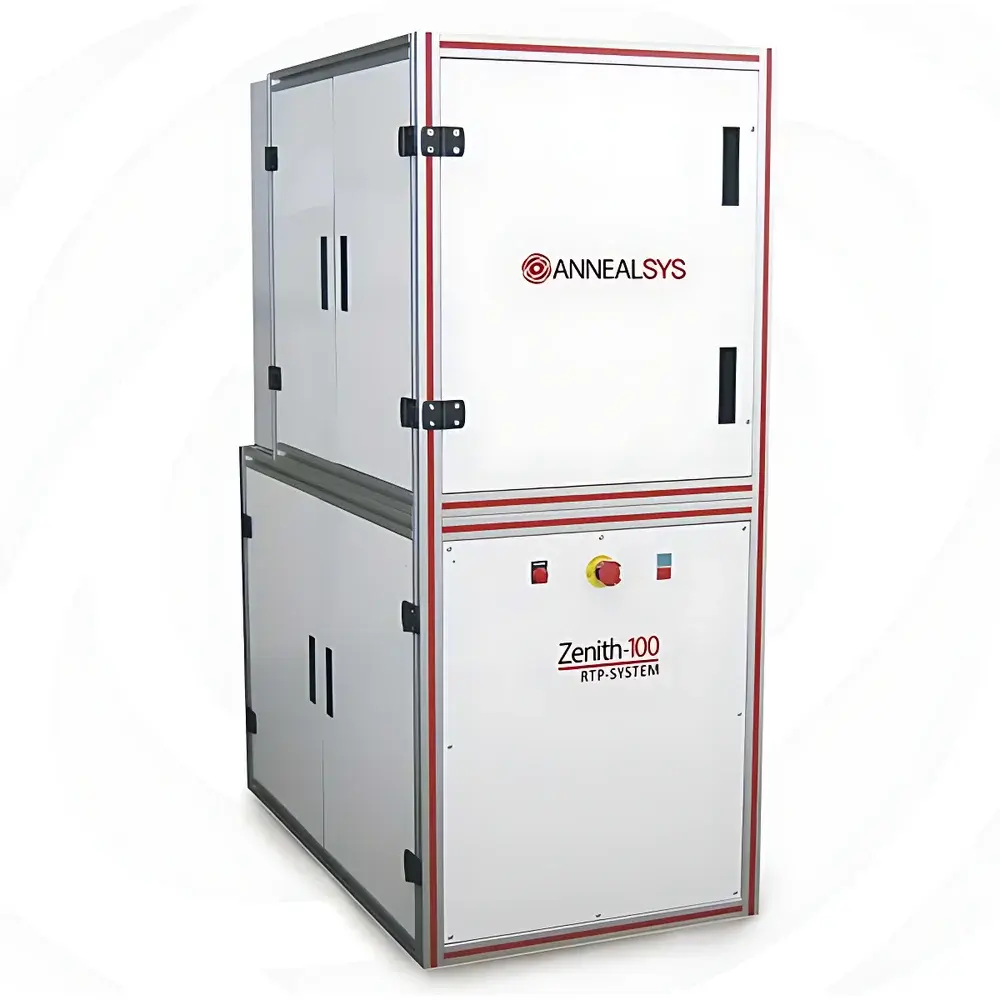
Annealsys Zenith-100 High-Vacuum Rapid Thermal Annealing Furnace
| Brand | Annealsys |
|---|---|
| Origin | France |
| Model | Zenith-100 |
| Instrument Type | High-Vacuum Rapid Thermal Annealing Furnace |
| Maximum Sample Diameter | 6-inch (150 mm) |
| Temperature Range | 0–2000 °C |
| Maximum Heating Rate | 150 °C/s |
| Maximum Cooling Rate | 200 °C/s |
| Temperature Accuracy | ±1 °C |
| Temperature Uniformity | ±1% across wafer surface |
| Chamber | Stainless steel, water-cooled, cold-wall design |
| Heating Elements | High-purity tungsten |
| Atmosphere Compatibility | Vacuum, inert (N₂, Ar), or reducing (H₂/N₂) |
| Standard Temperature Sensors | Dual-mode — calibrated pyrometer (for >600 °C) and type C thermocouple (for full range) |
| Control System | Fast-response digital PID controller with real-time thermal profile logging |
| Vacuum Requirement | Turbo-molecular pump mandatory (roughing pump included) |
| Optional Upgrades | Automated pressure control with throttle valve, SiC- or graphite-coated susceptors, CVD-compatible gas inlets |
Overview
The Annealsys Zenith-100 is a high-vacuum rapid thermal annealing (RTA) furnace engineered for precision thermal processing of semiconductor wafers and advanced materials research. Based on cold-wall, lamp-heated architecture, it employs high-intensity tungsten halogen lamps and optimized reflective cavity geometry to deliver exceptional thermal ramp fidelity and spatial uniformity. Unlike conventional tube furnaces, the Zenith-100 achieves true rapid thermal processing via direct radiant heating of the substrate—minimizing thermal mass involvement and enabling sub-second response times. Its operational envelope spans from ambient to 2000 °C, supporting critical processes such as dopant activation, silicide formation, oxide densification, and epitaxial defect recovery in Si, SiC, GaN, and 2D material systems. The system’s stainless-steel, water-jacketed chamber ensures mechanical stability under extreme thermal transients while suppressing cross-contamination through low memory effect—a key requirement for multi-material research workflows.
Key Features
- Cold-wall vacuum chamber with integrated water cooling for thermal isolation and process repeatability
- Tungsten-based high-temperature heating assembly delivering ±1 °C temperature accuracy and ±1% radial uniformity across 6-inch (150 mm) substrates
- Dual-sensor temperature monitoring: Type C thermocouple for full-range traceability and calibrated narrow-band pyrometer (≥600 °C) for non-contact surface measurement
- Ultra-fast thermal dynamics: up to 150 °C/s heating and 200 °C/s cooling rates, programmable in discrete ramp-hold-cool segments
- High-vacuum base pressure <1×10⁻⁶ mbar (with turbo-molecular pump), compatible with inert, reducing, or vacuum-only atmospheres; oxidizing environments prohibited
- Modular hardware architecture supporting optional upgrades including automated pressure regulation, CVD gas manifolds, and coated susceptors (graphite or SiC)
Sample Compatibility & Compliance
The Zenith-100 accommodates standard 6-inch (150 mm) semiconductor wafers—including silicon, sapphire, SiC, GaN-on-Si, and transition metal dichalcogenides—mounted on removable, low-outgassing susceptors. Substrate loading is facilitated by front-access horizontal load-lock configuration, minimizing exposure time and contamination risk. All wetted surfaces comply with ASTM F2784 (Standard Guide for Cleanroom-Compatible Equipment) and SEMI S2/S8 safety guidelines. The system supports GLP-compliant operation through audit-trail-enabled software (see Software & Data Management). It meets essential requirements for ISO/IEC 17025-accredited laboratories performing thermal process validation, and its temperature calibration protocol aligns with NIST-traceable standards per ISO/IEC 17025 Clause 6.4.
Software & Data Management
Control and data acquisition are managed via Annealsys’ proprietary RTAControl™ software, running on an embedded industrial PC with deterministic real-time kernel. The interface supports fully customizable thermal recipes—including multi-zone ramp profiles, dwell stabilization with dynamic feedback compensation, and synchronized gas flow sequencing. All temperature, pressure, power, and time-stamped sensor data are logged at ≥10 Hz resolution and exported in CSV or HDF5 format. The software includes built-in FDA 21 CFR Part 11 compliance modules: electronic signatures, role-based access control, immutable audit trails, and automatic backup to network storage. Raw data files retain embedded metadata (operator ID, recipe version, calibration certificate ID), ensuring full traceability for QA/QC documentation and regulatory submissions.
Applications
- Dopant activation in ultra-shallow junctions (e.g., BF₂ or As implants in Si CMOS nodes)
- Metal-silicide phase formation (NiSi, CoSi₂, TiSi₂) with controlled nucleation kinetics
- Thermal budget optimization for high-κ/metal gate stack annealing in FinFET and GAA transistor development
- Defect engineering in wide-bandgap semiconductors (e.g., vacancy annihilation in 4H-SiC)
- Graphene and MoS₂ layer healing and strain relaxation studies under controlled reducing ambients
- Pre-deposition and post-deposition annealing in ALD/CVD integration flows
FAQ
Is the Zenith-100 suitable for oxidation processes?
No. The tungsten heating elements and stainless-steel chamber are incompatible with O₂-rich or steam-containing atmospheres above 500 °C. Oxidation applications require quartz-tube furnaces with dedicated oxygen delivery systems.
What vacuum pumping configuration is required?
A turbo-molecular pump (minimum 300 L/s) is mandatory for achieving the specified base pressure and process repeatability. A two-stage rotary vane roughing pump is supplied standard.
Can the system be integrated into a cluster tool environment?
Yes—via SECS/GEM protocol support and configurable I/O ports (digital TTL, analog 0–10 V), enabling synchronization with load-lock transfer robots and metrology stations.
How is temperature uniformity verified across the wafer?
Uniformity is validated using a NIST-traceable multi-point thermocouple array mounted on a reference 6-inch dummy wafer, per Annealsys’ internal Procedure AN-ZEN-TP-003, repeated annually or after major maintenance.
Does the system support in situ optical monitoring?
Not natively—but the chamber includes two CF-63 viewports (one axial, one radial) compatible with external ellipsometers, reflectometers, or pyrometers equipped with appropriate spectral filters.