
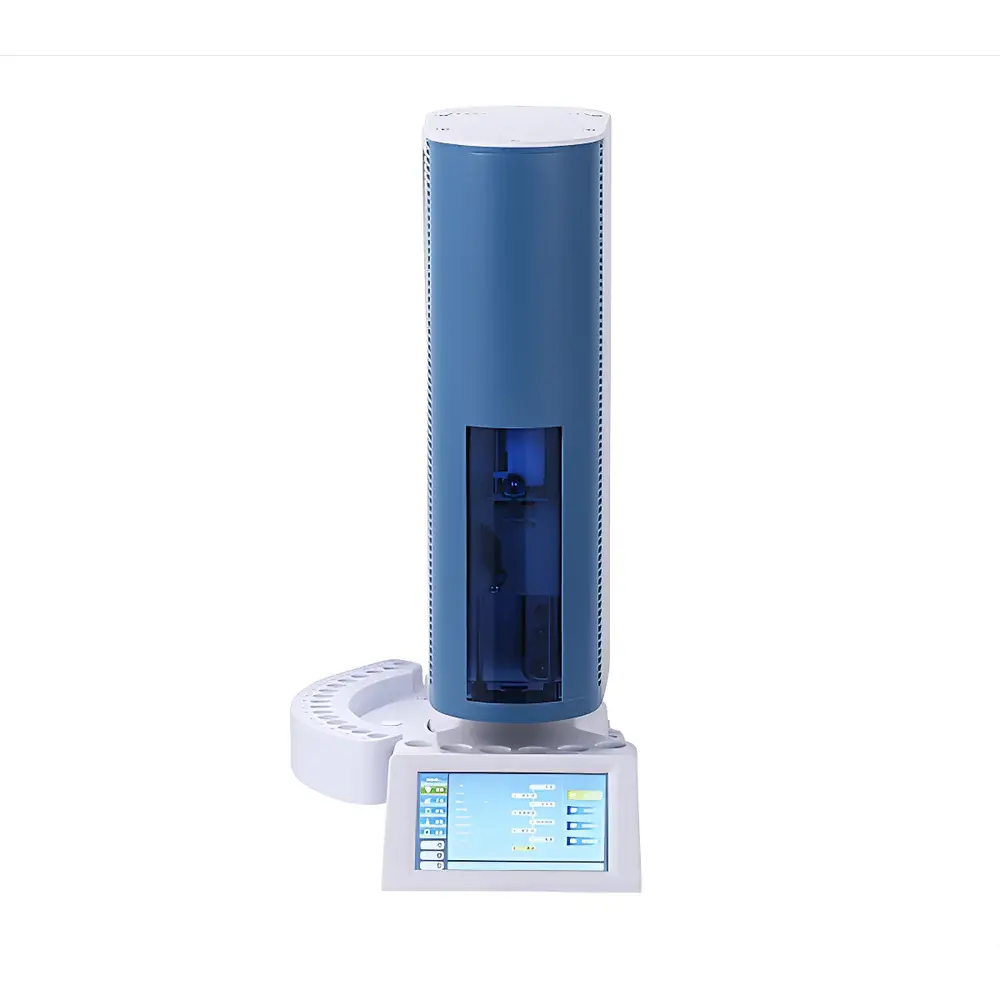
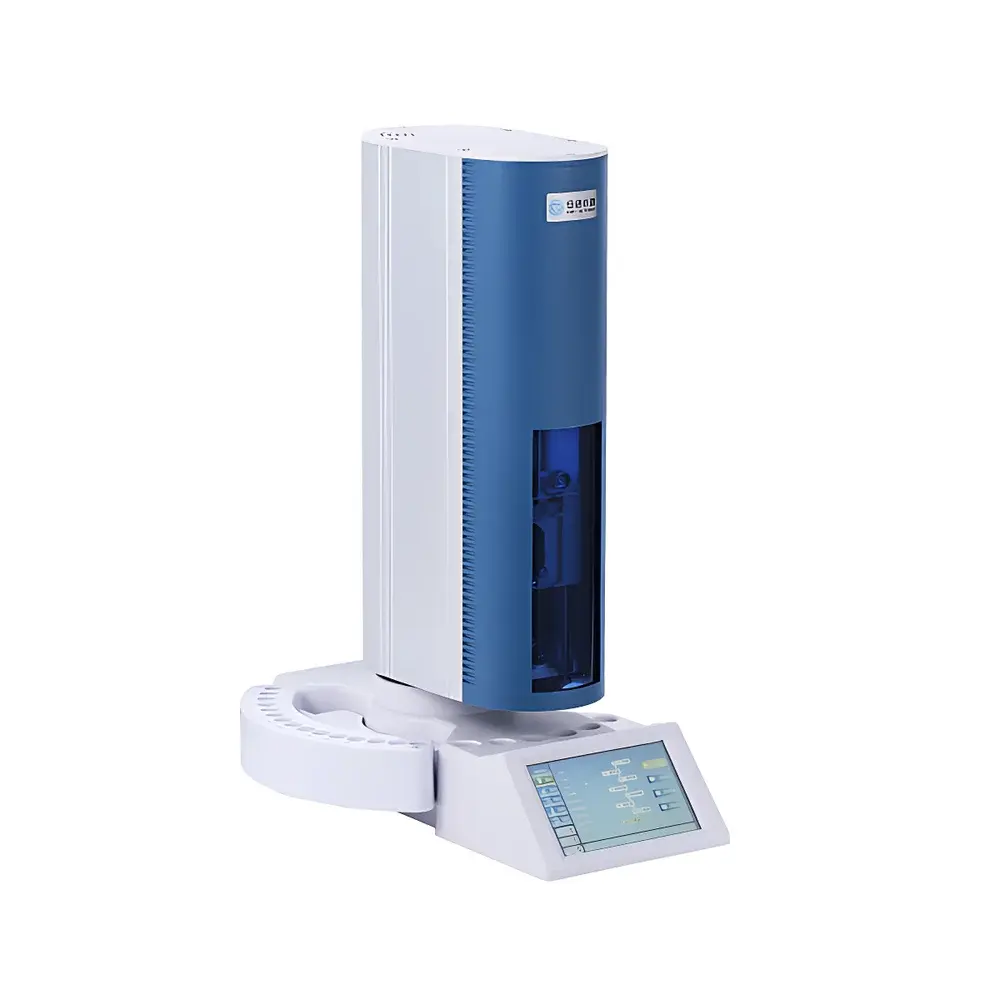
Annuo AS-3117B Multifunctional Gas Chromatography Autosampler
| Brand | Annuo |
|---|---|
| Origin | Henan, China |
| Manufacturer Type | Authorized Distributor |
| Product Category | Domestic |
| Model | AS-3117B |
| Instrument Type | GC Autosampler |
| Max Sample Capacity | 20 positions (expandable to 156) |
| Minimum Injection Volume | 0.1 µL |
| Positioning Accuracy | < 0.1 mm |
| Motion Mechanism | Turret-based |
| Needle Wash Mode | Selectable (pre- and/or post-injection) |
| Repeat Injection Count | Up to 99 cycles per sample |
Overview
The Annuo AS-3117B is a high-precision, turret-driven multifunctional autosampler engineered specifically for gas chromatography (GC) systems requiring non-intrusive, dual-inlet sampling capability. Unlike conventional autosamplers that occupy or interface directly with the GC injection port, the AS-3117B operates as a standalone peripheral—delivering samples to either of two independent GC inlets without mechanical interference or port occupancy. Its core architecture leverages closed-loop encoder feedback and microstepping stepper motor control to ensure repeatable syringe positioning and volumetric delivery down to 0.1 µL. Designed for laboratories handling limited sample volumes and demanding unattended operation, the AS-3117B supports continuous 24-hour runtime under ambient lab conditions while maintaining traceable positional fidelity (< 0.1 mm repeatability) across all sample positions.
Key Features
- Dual-inlet sampling capability: Simultaneously serves two GC injection ports without physical occupation—ideal for method development, parallel analysis, or instrument redundancy setups.
- Modular turret platform: Supports field-upgradable sample trays—from standard 15-position to 19-position or high-density 156-position configurations—installed via tool-free mechanical coupling and automatic calibration.
- Intelligent human-machine interface: 5.0-inch capacitive touchscreen with guided workflow navigation, contextual input validation, and real-time status visualization; includes included stylus for gloved operation.
- Protected syringe actuation: Buffer-damped pushrod mechanism minimizes mechanical shock during plunger advancement, significantly extending service life of expensive GC syringes (e.g., 10 µL or 50 µL fixed-volume models).
- Precision needle handling: Patented auto-homing needle mount detects syringe tip geometry and establishes zero-reference automatically—eliminating manual origin setting and ensuring zero-dead-volume aspiration and dispense cycles.
- Industrial-grade communication: Native Modbus RTU over RS-485 and USB 2.0 interfaces enable seamless integration with third-party LIMS, CDS (Chromatography Data Systems), or custom SCADA environments.
- Dual CAN bus architecture: Internal redundant Controller Area Network backbone ensures deterministic inter-module synchronization and facilitates future hardware expansion (e.g., integrated vial heater, solvent selector, or barcode reader modules).
Sample Compatibility & Compliance
The AS-3117B accommodates standard 12 × 32 mm GC vials (with optional crimp-cap or screw-cap adapters) and supports common solvent matrices including hexane, methanol, acetonitrile, and chloroform. All wetted components—including needle guide bushings, wash port seals, and syringe holder clamps—are chemically resistant to routine GC solvents and compliant with ISO 8573-1 Class 3 purity requirements for carrier gas pathways. While not certified to IEC 61000-6-2/6-4 or UL 61010-1 out-of-the-box, the unit meets CE marking requirements for EMC and low-voltage directive compliance when operated within specified environmental limits (15–30 °C, < 80% RH non-condensing). Its software logic implements input range validation, overflow prevention, and motion timeout safeguards aligned with GLP documentation principles.
Software & Data Management
The embedded firmware supports both standalone operation and host-controlled sequencing via ASCII command protocol (documented in ANSI/ISA-88.00.01-compliant syntax). All method parameters—including injection volume, wash solvent selection, dwell times, and repeat counts—are stored in non-volatile memory with timestamped version history. Audit trail functionality logs critical events (e.g., power cycle, tray insertion, error recovery) with UTC timestamps—meeting foundational requirements for FDA 21 CFR Part 11 compliance when paired with validated CDS software. Remote monitoring is enabled through USB CDC ACM virtual COM port emulation or Modbus register mapping for PLC-integrated labs.
Applications
- Environmental testing labs performing EPA Method 8260/8270 analyses on soil/water extracts where dual-column confirmation is required.
- Pharmaceutical QC facilities conducting residual solvent testing (ICH Q3C) across multiple GC instruments without cross-contamination risk.
- Academic research groups running long-duration method optimization studies with variable injection volumes and multi-point calibration sequences.
- Contract testing organizations managing heterogeneous GC fleets (Agilent, Thermo, Shimadzu, PerkinElmer) via standardized I/O abstraction layers.
- Food safety labs executing AOAC 2007.01 pesticide residue screening with automated replicate injections and integrated wash routines.
FAQ
Does the AS-3117B require modification to the GC’s injection port hardware?
No—it interfaces externally via standard GC autosampler trigger cables (TTL or relay) and does not necessitate any mechanical alteration to the GC inlet manifold.
Can the AS-3117B be integrated into a validated GxP environment?
Yes—when deployed with validated chromatography data systems and configured with audit-trail-enabling firmware settings, it satisfies key elements of ALCOA+ data integrity criteria.
What maintenance intervals are recommended for optimal performance?
Syringe seal inspection every 500 injections; needle guide cleaning after every 2,000 injections; full optical encoder recalibration annually or after mechanical impact.
Is firmware upgrade supported remotely?
Yes—USB-based firmware updates are supported using vendor-provided utility software; no hardware rework or service visit required.
How is positional accuracy verified during installation?
Using the built-in diagnostic mode, users execute a 10-point homing sequence with calibrated gauge pins; results are logged and exportable as CSV for QA records.





