
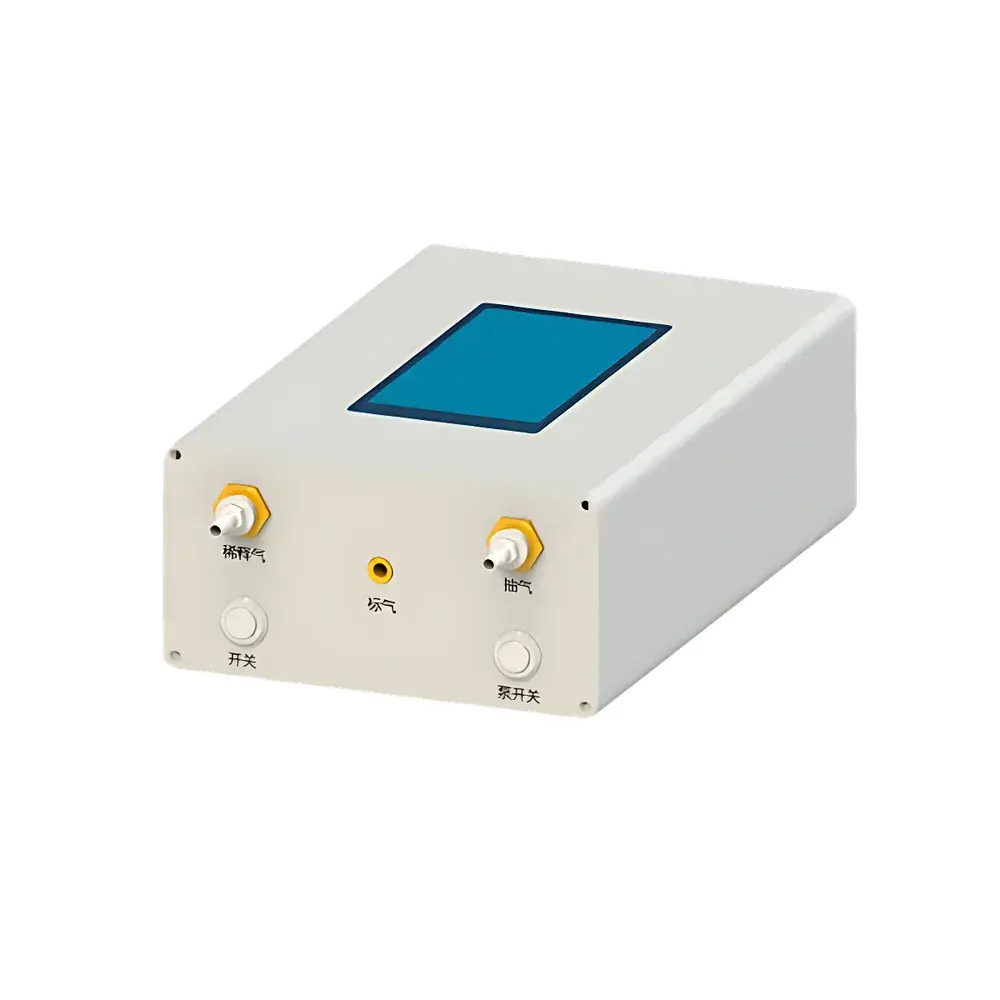
Annuo DNM-4024 Semi-Automatic Dynamic Gas Dilution System
| Brand | Annuo |
|---|---|
| Origin | Henan, China |
| Manufacturer Type | Authorized Distributor |
| Product Category | Domestic |
| Model | DNM-4024 |
| Mixing Method | Dynamic Flow-Based Dilution |
| Instrument Type | Constant-Volume Dilutor |
| Dilution Ratio Range | 1:1 to 3000:1 (configurable or custom-expandable) |
| Dilution Accuracy | ±0.5% of reading or ±0.1% of full scale |
| Equilibration Time | 2–30 minutes |
| Operating Temperature | 10–35 °C (recommended at 25 °C) |
| Operating Humidity | 10–90% RH (non-condensing) |
| Input Gas Channels | 2 (standard, expandable) |
| Output Flow Rate | 0–500 mL/min |
| Output Volume Range | 0–999 L |
| Flow Measurement Range | 0–1000 mL |
| Flow Accuracy | ±0.5% of reading or ±0.1% of full scale |
| Power Supply | 24 V DC, 1 A |
| Max Power Consumption | 20 W |
| Dimensions (W×D×H) | 260 × 160 × 90 mm |
| Weight | ~1 kg |
| Applicable Gases | CH₄, CO, CO₂, volatile halogenated hydrocarbons, BTEX, sulfur compounds (e.g., H₂S, methanethiol), NOₓ, and other VOCs |
| Diluent Gases | Clean air, N₂, He |
| Compliance Standards | GB/T 14678–1993, HJ 1078–2019 |
Overview
The Annuo DNM-4024 Semi-Automatic Dynamic Gas Dilution System is an engineered solution for precise, trace-level gas concentration adjustment in environmental monitoring, calibration laboratories, and analytical method development. It operates on the principle of continuous dynamic dilution—where a known flow of concentrated standard gas is metered into a higher, controlled flow of inert diluent gas (e.g., zero air, nitrogen, or helium), generating a stable, reproducible output stream with defined concentration and volume. Unlike static (batch) dilution methods, this flow-based architecture ensures real-time mixing, minimal memory effect, and high temporal fidelity—critical for applications requiring rapid concentration transitions or repeated calibration sequences. Designed for laboratory-grade accuracy and operational robustness, the DNM-4024 supports both manual workflow control and programmable volume-based delivery, making it suitable for use upstream of GC, GC-MS, FTIR, electrochemical sensors, and fixed-source emission analyzers.
Key Features
- 5-inch capacitive touchscreen interface with intuitive human-machine interaction (HMI) design—enabling direct setting of output flow rate (0–500 mL/min), target dilution ratio (1:1 to 3000:1), and cumulative output volume (0–999 L).
- Integrated volumetric flow measurement (0–1000 mL range) with dual-mode accuracy specification: ±0.5% of reading or ±0.1% of full scale—validated per ISO 6145-1 for gravimetric and dynamic dilution systems.
- Purge-enabled gas path architecture: user-initiated tubing flush function minimizes carryover between samples, reducing cross-contamination risk during multi-analyte or multi-concentration runs.
- Compact footprint (260 × 160 × 90 mm) and low power demand (24 V DC, ≤20 W) enable benchtop deployment in space-constrained labs or mobile calibration units.
- Modular input configuration: standard dual-gas inlet (expandable upon request) accommodates primary standard and secondary reference gases, supporting multi-component calibration blends or sequential dilution cascades.
- Thermally stabilized internal environment: optimized for operation within 10–35 °C ambient; recommended at 25 °C to maintain consistent viscosity-driven flow behavior across gas species.
Sample Compatibility & Compliance
The DNM-4024 is validated for use with a broad spectrum of volatile gaseous analytes—including methane, carbon monoxide, carbon dioxide, non-methane hydrocarbons (NMHC), benzene-toluene-ethylbenzene-xylene (BTEX), chlorinated and fluorinated VOCs (e.g., chloroform, dichloromethane), hydrogen sulfide, methanethiol, dimethyl sulfide, nitrogen oxides, and other sulfur-containing organics. Its material compatibility—featuring PTFE tubing, stainless-steel valves, and glass syringes—ensures chemical inertness and minimal adsorption for reactive or polar compounds. The system meets technical requirements outlined in GB/T 14678–1993 (determination of H₂S and sulfur organics by GC) and HJ 1078–2019 (analysis of eight sulfur compounds in stack emissions via pre-concentrated GC-MS). While not certified to ISO/IEC 17025 as a standalone calibration device, its performance parameters align with traceability frameworks used in GLP-compliant environmental testing laboratories.
Software & Data Management
The DNM-4024 operates without proprietary PC software—relying entirely on embedded firmware and local touchscreen control. All operational parameters (flow setpoints, dilution ratios, elapsed time, cumulative volume, equilibration status) are logged internally with timestamping and retained across power cycles. Audit-ready records can be exported manually via USB to CSV format for integration into LIMS or QA/QC documentation workflows. Though not natively compliant with FDA 21 CFR Part 11, the system supports manual record-keeping practices compatible with GLP and ISO 17025 documentation requirements—including operator ID entry, parameter change logs, and purge event tagging. Optional firmware upgrades may introduce Ethernet or RS-232 interfaces for remote monitoring in networked lab environments.
Applications
- Calibration of fixed and portable gas detectors (electrochemical, PID, MOS, IR) across occupational health and industrial safety programs.
- Preparation of certified reference gas mixtures for GC and GC-MS analysis of ambient air, stack emissions, and indoor air quality samples.
- Method validation and linearity assessment per EPA Method TO-15, ASTM D6420, and ISO 16017-1 for VOC analysis.
- Dynamic generation of concentration gradients for sensor response characterization and drift evaluation.
- Supporting regulatory compliance testing under China’s HJ series standards—including HJ 1078–2019 for sulfur compound speciation and HJ 732–2014 for NMHC measurement.
- Integration with automated sampling systems such as thermal desorbers, gas concentrators, and online CEMS verification protocols.
FAQ
What diluent gases are compatible with the DNM-4024?
Clean synthetic air (hydrocarbon-free), nitrogen (≥99.999%), and helium (≥99.999%) are fully supported. Moisture content must remain below dew point –20 °C to prevent condensation-induced flow instability.
Can the DNM-4024 be used for sub-ppb level dilutions?
While the nominal dilution range extends to 3000:1, achieving reliable sub-ppb outputs requires traceable parent standards, ultra-low-permeation tubing, and rigorous blank assessment—practices aligned with ISO 6142 and ISO 6145-7 for ultra-trace gas metrology.
Is the equilibration time affected by gas composition or humidity?
Yes—equilibration duration (2–30 min) scales with molecular weight, viscosity, and thermal mass of the gas mixture. High-humidity diluents (>70% RH) may prolong stabilization due to latent heat effects in flow sensors.
Does the system support automated sequence programming?
No—DNM-4024 is semi-automatic: users initiate each dilution step manually via touchscreen. Fully automated multi-step protocols require external PLC or script-based controller integration.
How often should the flow sensors be recalibrated?
Annuo recommends annual verification using NIST-traceable flow calibrators. Field checks against reference rotameters or bubble meters are advised before critical calibration campaigns.







