
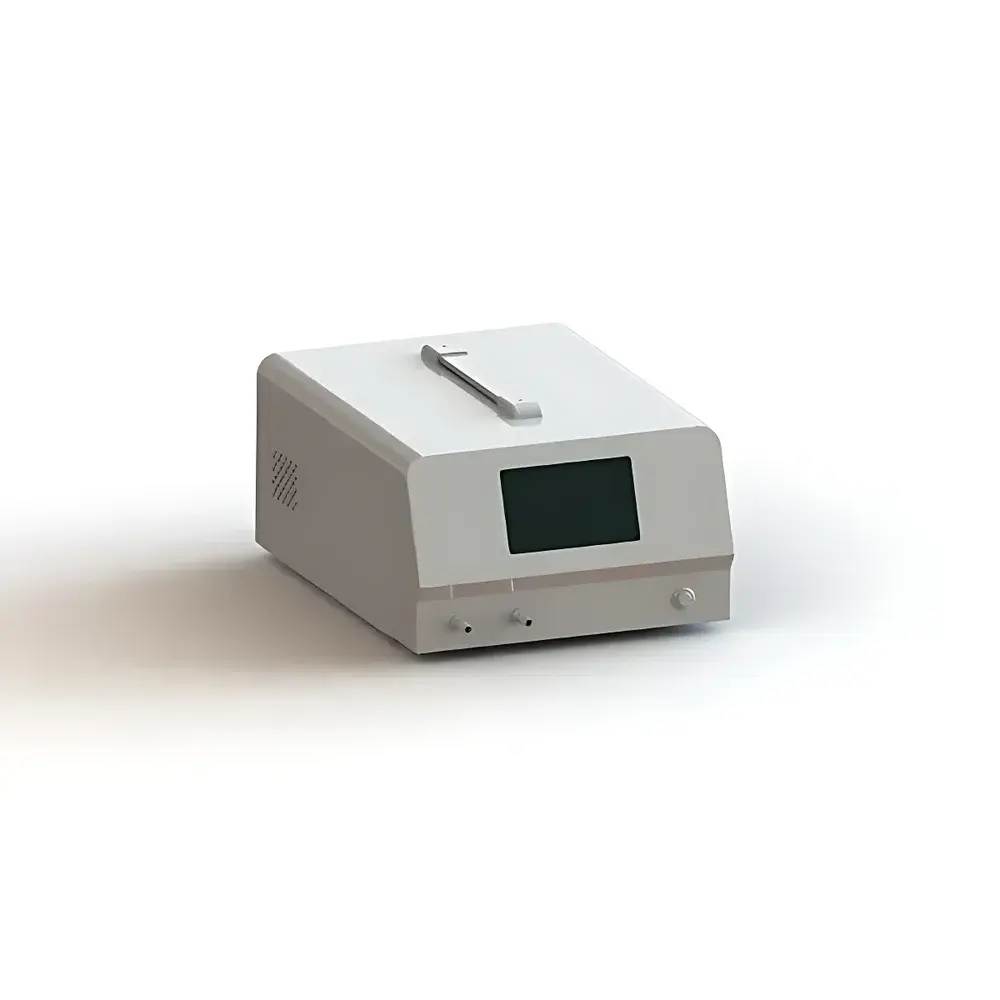
Annuo DNS-4024 Dynamic Gas Dilution System
| Brand | Annuo |
|---|---|
| Origin | Henan, China |
| Manufacturer Type | Authorized Distributor |
| Country of Origin | China |
| Model | DNS-4024 |
| Mixing Method | Dynamic Flow-Based Dilution |
| Instrument Type | Multi-Channel Dynamic Gas Dilutor |
| Dilution Ratio Range | 1:1 to 1000:1 (standard configuration |
| Dilution Accuracy | ±0.5% of reading or ±0.1% of full scale |
| Equilibration Time | 0.1–999 min |
| Input Channels | 2 (standard |
| Output Flow Rate | 0–5000 mL/min |
| Flow Accuracy | ±0.5% of reading or ±0.1% of full scale |
| Analytical Timing Range | 0.1–999 min |
| Max Power Consumption | 20 W |
| Dimensions | 320 × 260 × 150 mm |
| Power Supply | 24 V DC, 1 A |
| Weight | ~2 kg |
| Compatible Carrier Gases | Clean Air, N₂, He |
| Target Analytes | CH₄, CO, CO₂, VOCs (e.g., halogenated hydrocarbons, BTEX), H₂S, other sulfur compounds, NOₓ |
| Concentration Range Supported | 10 ppb – 10,000 ppm |
Overview
The Annuo DNS-4024 Dynamic Gas Dilution System is an engineered solution for precise, trace-level gas standard generation in environmental emission monitoring and laboratory calibration workflows. It operates on the principle of continuous mass-flow-controlled dynamic dilution—where high-purity source gas and diluent gas (e.g., zero air, nitrogen, or helium) are independently metered via calibrated thermal mass flow controllers (MFCs), mixed in real time, and delivered at a stable, programmable output concentration. This architecture eliminates static blending artifacts and ensures high reproducibility across wide dilution ranges. Designed to meet stringent regulatory method requirements—including HJ 1078–2019 (for sulfur-containing organics in stack emissions) and HJ 638–2012 (for volatile organic compounds by GC–MS)—the DNS-4024 supports traceability-critical applications such as calibration curve preparation, instrument verification, and method validation under GLP-compliant laboratory conditions.
Key Features
- Dynamic dual-channel architecture with independent thermal mass flow control for source and diluent gases, enabling true real-time concentration modulation without manual intervention.
- Standard dilution ratio range of 1:1 to 1000:1, extendable upon request to accommodate ultra-trace (sub-ppb) or high-concentration (percent-level) calibration needs.
- High-accuracy flow control: ±0.5% of reading or ±0.1% of full scale across the 0–5000 mL/min output range, verified per ISO 6145-7 (gas mixtures by dynamic volumetric methods).
- Programmable equilibration time (0.1–999 minutes), allowing optimization for slow-response analyzers or adsorptive compounds requiring extended stabilization.
- Compact, low-power design (20 W max, 24 V DC input) suitable for benchtop deployment in mobile labs, field calibration vans, or fixed ambient air monitoring stations.
- Robust aluminum alloy chassis with EMI-shielded electronics and corrosion-resistant internal gas pathways compatible with reactive sulfur species and halogenated VOCs.
Sample Compatibility & Compliance
The DNS-4024 is validated for use with a broad spectrum of gaseous analytes relevant to environmental compliance testing, including hydrogen sulfide (H₂S), carbonyl sulfide (COS), methanethiol, dimethyl sulfide, carbon monoxide, methane, carbon dioxide, nitrogen oxides (NO/NO₂), benzene, toluene, ethylbenzene, xylenes (BTEX), chloromethane, dichloromethane, and other halogenated hydrocarbons. Its gas pathway materials—electropolished stainless steel, PTFE-sealed valves, and fluoropolymer tubing—are selected to minimize adsorption, memory effects, and catalytic decomposition. The system supports method-defined carrier gases (zero air per EPA TO-14A/15, high-purity N₂ per ISO 8573-1 Class 1, or He for GC carrier applications). It aligns with QA/QC expectations outlined in ISO/IEC 17025:2017 (clause 7.7 on reference material preparation) and supports audit-ready documentation for EPA Method 205, ASTM D6159, and China’s HJ series environmental standards.
Software & Data Management
The DNS-4024 integrates with optional PC-based control software supporting USB or RS-232 communication. Users define dilution protocols—including target concentration, dwell time, ramp profiles, and channel activation sequences—via intuitive parameter tables. All operational parameters (MFC setpoints, actual flows, elapsed time, temperature drift compensation logs) are timestamped and exportable in CSV format for integration into LIMS or electronic lab notebooks (ELN). Audit trail functionality records user login events, parameter changes, and system errors—supporting compliance with FDA 21 CFR Part 11 requirements when deployed in regulated environments. Firmware updates are performed offline via secure firmware image upload, preserving configuration integrity during maintenance cycles.
Applications
- Calibration gas generation for GC-FID, GC-ECD, GC-MS, and FTIR analyzers used in stack testing and ambient air quality monitoring.
- Preparation of multi-point calibration curves for sulfur compound analysis per HJ 1078–2019, especially for challenging matrices involving methanethiol and dimethyl disulfide.
- Dynamic spiking studies to evaluate analyzer linearity, detection limits, and carryover behavior across concentration gradients.
- Verification of continuous emission monitoring systems (CEMS) per HJ 75–2017 and HJ 76–2017 performance criteria.
- Field-deployable dilution for portable gas analyzers requiring on-site standard generation without cylinder dependency.
FAQ
What carrier gases are compatible with the DNS-4024?
Clean synthetic air (hydrocarbon-free, <1 ppb THC), high-purity nitrogen (99.999%), and helium (99.999%) are fully supported. Gas purity must comply with ISO 8573-1 Class 1 for particulate and moisture content.
Can the DNS-4024 be integrated into an automated calibration station?
Yes—the system supports TTL-triggered start/stop signals and Modbus RTU over RS-485 (optional module), enabling synchronization with autosamplers, data loggers, or PLC-controlled test benches.
Is the dilution accuracy traceable to national standards?
Flow controllers are factory-calibrated against NIST-traceable primary standards; certificate of calibration (including uncertainty budget) is provided with each unit.
Does the DNS-4024 require periodic recalibration?
Annual verification against reference flow standards is recommended per ISO/IEC 17025; MFCs feature built-in zero and span checks accessible via software diagnostic mode.
How is cross-contamination prevented between different analyte standards?
The system includes automated purge sequences (programmable duration and flow rate) between runs, and all wetted parts are inert and non-catalytic—validated for sulfur compound recovery >95% after 10 ppb H₂S exposure.
Related Products







