
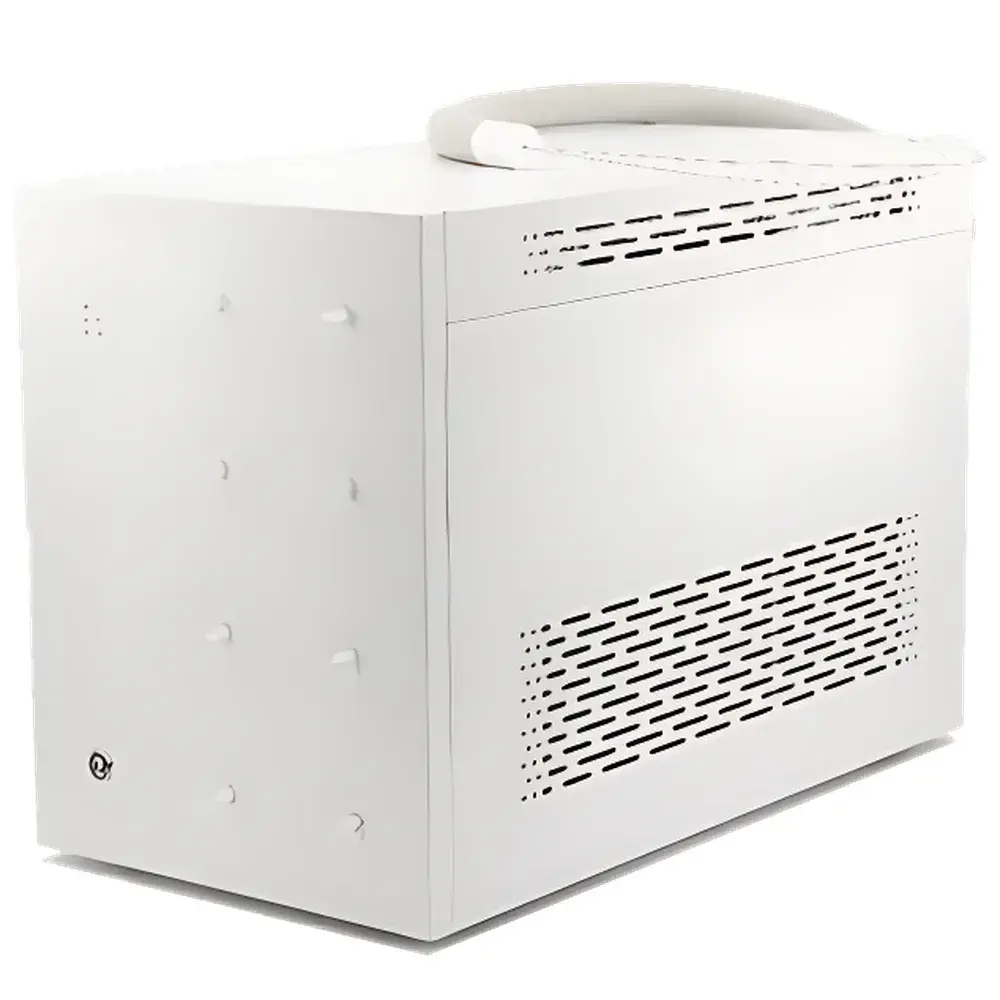
Annuo SC-4224 Automated Sulfur Compound Preconcentrator
| Brand | Annuo |
|---|---|
| Origin | Henan, China |
| Model | SC-4224 |
| Instrument Type | Automated Quantitative Gas Preconcentrator |
| Temperature Range (Valve & Tubing) | +5°C to 160°C |
| Cold Trap Temperature Range | −50°C to 300°C |
| Sample Volume Capacity | 1–2000 mL |
| Concentration Ratio | Up to 2000:1 |
| Temperature Control Accuracy | RSD ≤3% |
| Reproducibility | RSD ≤3% |
| Sample Introduction | Vacuum Pressure Sampling with MFC Flow Control |
| Cooling Method | Compressor-based |
| Dimensions (W×D×H) | 550 × 260 × 427 mm |
| Power Supply | AC 220 V, 50 Hz |
| Max Power Consumption | 1000 W |
| Weight | ~40 kg |
| Compliance | GB/T 14678–1993 |
Overview
The Annuo SC-4224 Automated Sulfur Compound Preconcentrator is a laboratory-grade gas preconcentration system engineered for trace-level analysis of volatile sulfur compounds (VSCs) in ambient air, industrial emissions, and environmental monitoring samples. It operates on the principle of cryogenic trapping followed by thermal desorption, enabling quantitative enrichment of low-concentration analytes—including hydrogen sulfide (H₂S), carbonyl sulfide (COS), methanethiol, ethanethiol, dimethyl sulfide (DMS), carbon disulfide (CS₂), methyl ethyl sulfide, thiophene, diethyl sulfide, and dimethyl disulfide—prior to separation and detection by gas chromatography (GC) or GC–mass spectrometry (GC–MS). The system integrates a precisely temperature-controlled cold trap (−50°C to 300°C), heated sample pathways (up to 160°C), and programmable valve sequencing to minimize adsorption losses and ensure high recovery (>95%) across the target compound class. Designed for compliance with GB/T 14678–1993, it delivers method-defined detection limits suitable for regulatory reporting and routine QA/QC workflows in environmental laboratories.
Key Features
- Automated preconcentration cycle including inlet line purge, cold trap conditioning, sample draw, trap focusing, and thermal desorption—all synchronized with GC start signal via hardware trigger or software command.
- Heated sample loop and transfer lines (up to 160°C) prevent condensation and wall adsorption of polar or reactive sulfur species.
- Cryogenic cold trap with compressor-based cooling achieves stable sub-ambient temperatures (−50°C) and rapid heating rates (>50°C/s) for sharp, reproducible desorption peaks.
- Independent line purging capability for each sampling path eliminates carryover between analyses; all gas pathways undergo inert surface passivation (e.g., SilcoNert® or Sulfinert® equivalent treatment).
- Semi-closed-loop valve positioning control ensures repeatable switching accuracy (<0.1° angular deviation), critical for multi-step trapping/desorption sequences.
- Modular architecture supports native integration with up to 96-position autosamplers (8 positions onboard; expandable via RS-232/Ethernet interface).
- Full I/O compatibility with major GC platforms (Agilent, Thermo Fisher, Shimadzu, PerkinElmer) via TTL, relay, and Ethernet-based GC reverse-trigger protocols.
Sample Compatibility & Compliance
The SC-4224 accommodates gaseous samples collected in evacuated canisters (SUMMA®-type or stainless-steel), Tedlar® bags, and online duct probes. Its vacuum-assisted sampling mode, regulated by mass flow controller (MFC), ensures precise volumetric intake (1–2000 mL) independent of ambient pressure or humidity fluctuations. The system meets the operational requirements of GB/T 14678–1993 for determination of odor-causing sulfur compounds in ambient air. While not certified to ISO 16000-22 or EPA TO-15/TO-11A out-of-the-box, its hardware architecture and software logging capabilities support validation per GLP/GMP frameworks when deployed with audit-trail-enabled control software and calibrated reference standards.
Software & Data Management
The SC-4224 is operated via a dedicated Windows-based host application supporting method creation, real-time status monitoring, event logging, and sequence scheduling. All instrument parameters—including trap temperature ramps, valve timing, MFC setpoints, and GC synchronization events—are stored in encrypted binary logs with timestamped metadata. Export options include CSV and XML formats compatible with LIMS integration. The software complies with FDA 21 CFR Part 11 requirements for electronic records when configured with user authentication, role-based access control, and electronic signature modules. Audit trails record operator ID, parameter changes, and run completion status—enabling full traceability during regulatory inspections.
Applications
- Environmental air quality monitoring for H₂S, DMS, and other reduced sulfur gases near wastewater treatment plants, landfills, and pulp/paper facilities.
- Odor source identification and quantification in industrial hygiene and community complaint investigations.
- Method development and validation for EPA-compliant sulfur speciation using canister-based sampling and preconcentration-GC/MS workflows.
- Calibration gas generation and standard addition studies requiring precise, reproducible dilution and concentration steps.
- Research into atmospheric sulfur chemistry, including oxidation kinetics and heterogeneous reaction pathways on particulate surfaces.
FAQ
What sulfur compounds can the SC-4224 reliably preconcentrate?
It is validated for hydrogen sulfide, carbonyl sulfide, methanethiol, ethanethiol, dimethyl sulfide, carbon disulfide, methyl ethyl sulfide, thiophene, diethyl sulfide, and dimethyl disulfide.
Does the system support unattended overnight operation?
Yes—scheduled sequences, error-recovery logic, and hardware interlocks enable continuous 24/7 operation when paired with a compatible autosampler and GC system.
Can the cold trap be regenerated in situ without manual intervention?
Yes—the built-in regeneration protocol includes bake-out cycles at elevated temperatures with continuous inert gas purge, fully automated within the method script.
Is remote diagnostics or firmware update supported?
Firmware updates are performed locally via USB; remote diagnostic access requires optional VPN-configured network deployment and IT-administered firewall permissions.
What maintenance intervals are recommended for optimal performance?
Cold trap cleaning every 200 runs; MFC calibration annually or after exposure to particulate-laden or corrosive matrices; O-ring replacement every 12 months under continuous use.
Related Products



