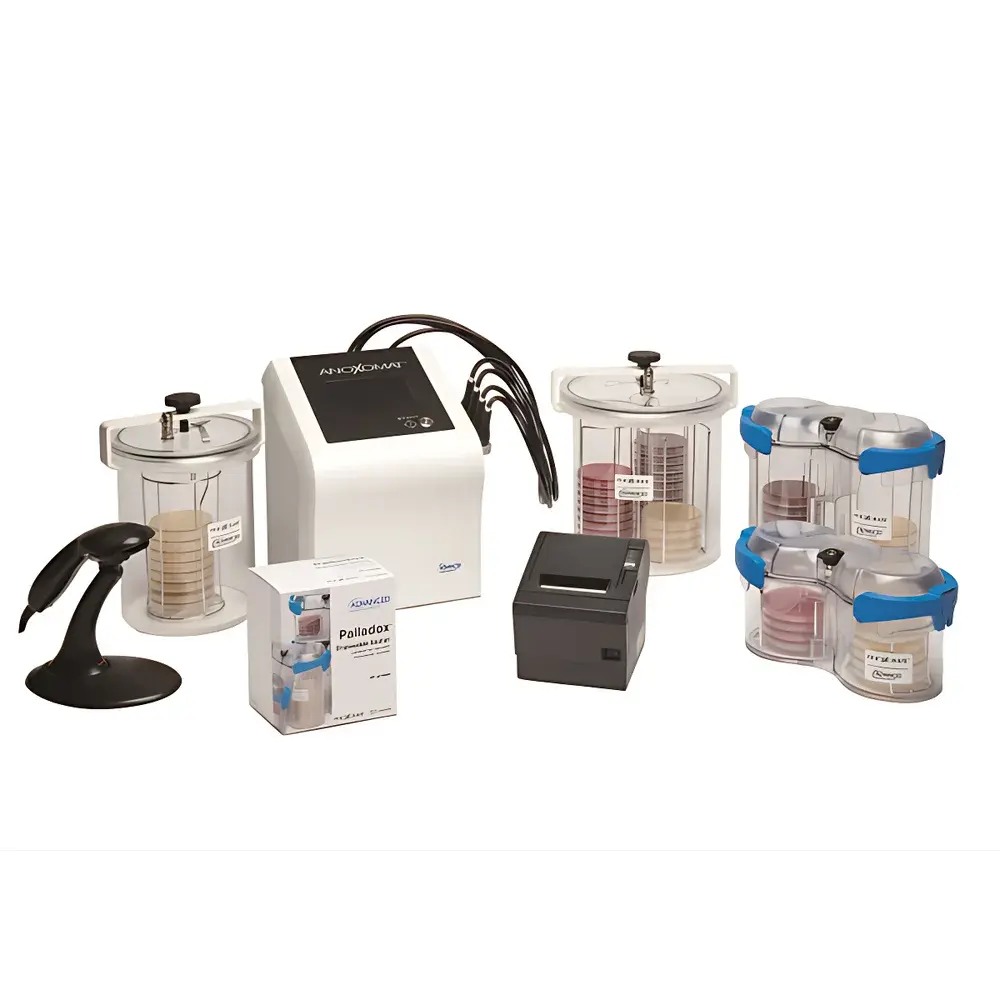
Anoxomat III Anaerobic Cultivation System
| Brand | Advanced Instruments |
|---|---|
| Origin | USA |
| Manufacturer | Advanced Instruments, Inc. |
| Type | Imported |
| Model | Anoxomat III |
| Pricing | Upon Request |
Overview
The Anoxomat III Anaerobic Cultivation System is a fully automated, benchtop gas replacement workstation engineered for precise, reproducible generation of controlled atmospheric environments—specifically anaerobic (0% O₂), microaerophilic (2–10% O₂), and capnophilic (5–10% CO₂, low O₂) conditions—for microbial culture. Unlike conventional jar-based systems requiring manual gas mixing or catalyst-dependent evacuation–replacement cycles, the Anoxomat III employs a patented dual-gas (N₂/CO₂/H₂) sequential flushing algorithm with integrated electrochemical oxygen monitoring and real-time feedback control. This ensures rapid (<15 min), consistent, and traceable atmosphere establishment across multiple culture vessels—including jars, plates, and pouches—without reliance on palladium catalysts or external vacuum pumps. Designed for compliance-critical environments, it supports GLP- and CLIA-aligned workflows in clinical diagnostics, pharmaceutical quality control, food safety testing, and academic microbiology.
Key Features
- Automated gas mixing and atmosphere validation: Integrated paramagnetic O₂ sensor (0–25% range, ±0.1% accuracy) and IR-based CO₂ sensor continuously monitor and adjust gas composition during and after cycle completion.
- Multi-vessel flexibility: Accommodates up to six standard 2.5 L anaerobic jars simultaneously—or mixed configurations including Petri dishes, blood culture bottles, and anaerobic transport pouches via optional adapters.
- Validated cycle library: Pre-programmed, user-editable protocols for common applications—including Bacteroides fragilis (anaerobic), Campylobacter jejuni (microaerophilic), and Streptococcus pneumoniae (capnophilic)—with cycle-specific dwell times, flush counts, and gas ratios.
- Traceable operation: Built-in audit trail logs all cycle parameters (start time, gas volumes, final O₂/CO₂ readings, operator ID), exportable as CSV for regulatory review per ISO 15189 and CLIA requirements.
- Robust architecture: Stainless steel chamber housing, corrosion-resistant internal manifolds, and redundant pressure-safety interlocks ensure long-term reliability in high-throughput laboratory settings.
Sample Compatibility & Compliance
The Anoxomat III is compatible with all commercially available anaerobic culture jars (e.g., GasPak™, AnaeroGen™), standard 90 mm and 150 mm Petri dishes, blood agar slants, and flexible anaerobic transport bags. It meets essential performance criteria outlined in CLSI M47-A (Methods for Antimicrobial Susceptibility Testing of Anaerobic Bacteria) and supports method validation per USP <63> and ISO 11133:2014 (Microbiology of food and animal feeding stuffs — Requirements for test media). All firmware and cycle logic are designed to facilitate 21 CFR Part 11 compliance when deployed with validated electronic signature modules and networked LIMS integration.
Software & Data Management
The system operates via an intuitive touchscreen interface with multilingual support (English, Spanish, French, German). Cycle data—including timestamps, measured O₂/CO₂ levels, gas consumption metrics, and pass/fail status—are stored locally on encrypted internal memory (16 GB) and exportable via USB or Ethernet to laboratory information management systems (LIMS). Optional Advanced Analytics Module enables trend analysis of atmospheric stability across batches, correlation of growth outcomes with environmental parameters, and automated generation of QC reports aligned with ISO/IEC 17025 documentation standards.
Applications
- Clinical microbiology: Routine isolation and cultivation of obligate anaerobes (e.g., Clostridioides difficile, Fusobacterium nucleatum) from stool, wound, and abscess specimens.
- Antimicrobial susceptibility testing (AST): Preparation of standardized inocula under defined O₂/CO₂ conditions for broth microdilution and agar dilution assays per CLSI M11-A9.
- Food and beverage safety: Enumeration of spoilage anaerobes (e.g., Clostridium perfringens, Desulfovibrio spp.) and verification of modified-atmosphere packaging integrity.
- Vaccine and biologics manufacturing: Maintenance of master cell banks and working cell stocks requiring strict O₂ control during subculturing and viability assessment.
- Research microbiology: Controlled modulation of redox potential for studying bacterial metabolism, biofilm formation, and host–pathogen interactions under physiologically relevant gas tensions.
FAQ
How does the Anoxomat III differ from traditional catalyst-based anaerobic jars?
It eliminates dependence on palladium catalysts and ambient humidity, using direct gas injection and real-time O₂ sensing to achieve validated atmospheres without risk of catalyst poisoning or inconsistent activation.
Can the system be integrated into a LIMS environment?
Yes—via Ethernet or USB, with structured data export (CSV/JSON) supporting HL7 and ASTM E1384 message formats for seamless bidirectional communication.
Is routine calibration required for the onboard sensors?
The O₂ sensor is factory-calibrated and requires only annual verification using certified zero-O₂ and span gases; CO₂ sensor drift is automatically compensated during each cycle using reference air measurements.
What maintenance is recommended for sustained performance?
Quarterly inspection of gas line fittings and filter replacement (part #ANX-FIL-01); annual preventive service includes manifold leak testing and sensor diagnostic validation.
Does the Anoxomat III support custom gas mixtures beyond standard anaerobic/microaerophilic profiles?
Yes—users may define custom gas ratios (N₂, CO₂, H₂) and timing sequences via the advanced protocol editor, subject to hardware safety limits and regulatory validation requirements.