
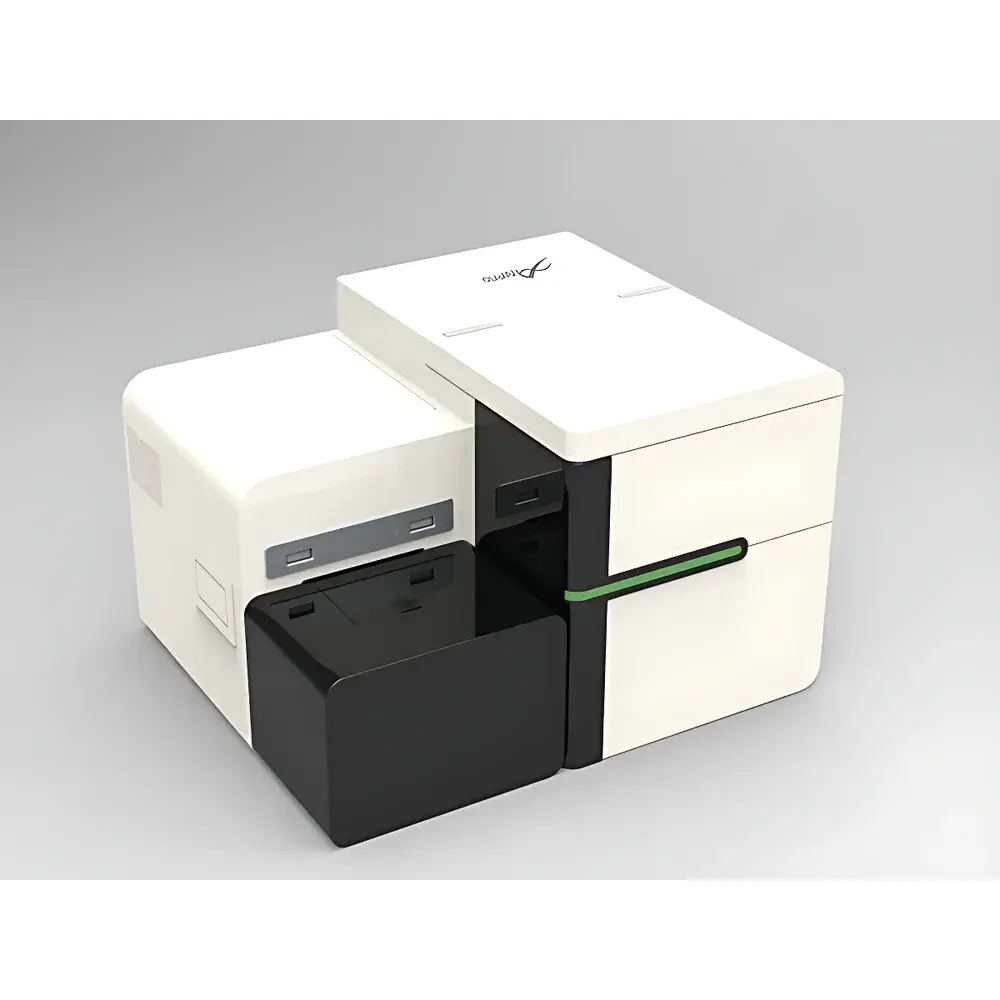
ANPRO APN-II Dual-Wavelength UV-Vis Spectrophotometer for Synthetic Colorant and Preservative Analysis
| Brand | ANPRO |
|---|---|
| Model | APN-II |
| Origin | Sichuan, China |
| Manufacturer Type | Manufacturer |
| Origin Category | Domestic |
| Wavelength Range | 185–950 nm |
| Spectral Bandwidth | 4 nm |
| Wavelength Accuracy | ±0.1 nm |
| Wavelength Repeatability | ≤±0.05 nm |
| Detector | CCD Array |
| Optical System | Dual-Wavelength Scanning with Hybrid Diffraction Grating |
| Automation Level | Fully Automatic Wavelength Selection & Sample Handling |
| Sample Throughput | Up to 12 Cuvettes (11 Simultaneous Samples + Reference) |
| Display | 10.1-inch Capacitive Touch LCD with VGA/HDMI Output |
| Computing Platform | Embedded Industrial PC (Quad-Core CPU, 4 GB RAM, Windows OS) |
| Data Storage | 500 GB SSD |
| Connectivity | Dual USB 2.0, RS232, Ethernet, Wi-Fi, VGA, Audio Out |
| Compliance | Designed for GLP-compliant food safety laboratories |
Overview
The ANPRO APN-II is a dedicated dual-wavelength ultraviolet-visible (UV-Vis) spectrophotometer engineered for the quantitative analysis of synthetic colorants (e.g., Allura Red AC, Tartrazine, Sunset Yellow FCF) and preservatives (e.g., benzoic acid, sorbic acid, sodium nitrite) in food and beverage matrices. It operates on the principle of absorbance spectroscopy—measuring sample-specific optical density at defined wavelengths where target analytes exhibit characteristic electronic transitions. Unlike general-purpose spectrophotometers, the APN-II integrates application-specific chemometric algorithms, pre-validated calibration protocols, and regulatory-aligned reporting workflows tailored to national food safety standards—including China’s GB 5009 series—and aligned with international reference methods (e.g., AOAC Official Method 2012.01 for synthetic dyes). Its hybrid diffraction grating and high-resolution CCD array enable full-spectrum acquisition (185–950 nm) in under 2 seconds, supporting both single-point quantification and multi-component spectral deconvolution without mechanical wavelength scanning.
Key Features
- Embedded industrial computing platform running Windows OS with quad-core processor and 4 GB RAM—enables real-time spectral processing, baseline correction, and derivative analysis without external PC dependency.
- Dual-wavelength measurement mode with programmable reference and analytical wavelengths—optimized for ratio-based quantitation to minimize matrix interference in turbid or colored samples (e.g., fruit juices, carbonated beverages).
- 12-position automated cuvette carousel with independent temperature-stabilized holders—supports batch analysis of up to 11 test samples plus blank/reference per cycle, reducing operator variability and increasing throughput.
- High-fidelity optical train featuring imported deuterium and tungsten-halogen lamps, precision collimating optics, and thermoelectrically stabilized CCD detector—ensures long-term photometric stability (<0.001 AU/h drift) and inter-instrument reproducibility.
- Comprehensive I/O architecture including Ethernet, Wi-Fi, RS232, and dual USB ports—facilitates integration into centralized LIMS environments and remote firmware/software updates compliant with ISO/IEC 17025 documentation requirements.
- Onboard 500 GB solid-state storage with automatic timestamped data logging, audit-trail-enabled operation history, and encrypted backup/export via USB or network share—meeting basic FDA 21 CFR Part 11 data integrity expectations for non-GMP food testing labs.
Sample Compatibility & Compliance
The APN-II is validated for direct analysis of liquid food extracts prepared per GB 5009.35–2023 (synthetic colorants) and GB 5009.28–2016 (preservatives), including clarified juice concentrates, soft drink filtrates, dairy-based beverages, and condiment supernatants. Sample introduction uses standard 10-mm pathlength quartz or high-transmission plastic cuvettes; optional micro-volume adapters support 50–500 µL analysis. Instrument design conforms to IEC 61010-1 for laboratory electrical safety and EN 61326-1 for electromagnetic compatibility. While not certified for GMP manufacturing environments, its software architecture supports GLP-aligned workflows—including user access control, electronic signature prompts for report approval, and immutable raw-data archiving—making it suitable for third-party food safety inspection agencies and QC labs operating under CNAS accreditation.
Software & Data Management
The proprietary ANPRO Analytical Suite provides intuitive touchscreen navigation with role-based interface modes (Operator, Supervisor, Administrator). Quantitative modules include fixed-wavelength absorbance, kinetic assay, multi-point calibration with linear/non-linear regression (including quadratic and cubic fits), and built-in spectral library matching. All reports export in PDF/A-1b and CSV formats with embedded metadata: instrument ID, operator ID, date/time stamp, measurement parameters, and raw absorbance spectra. Audit trail logs capture every parameter change, calibration event, and result modification—including pre- and post-edit values—with SHA-256 hashing for tamper detection. Data backups are scheduled automatically or triggered manually; restoration preserves full version history and calibration state.
Applications
- Routine screening of synthetic dyes in carbonated soft drinks, powdered beverage mixes, and flavored dairy products.
- Quantification of benzoic and sorbic acid in pH-adjusted fruit juices using differential absorbance at 225 nm and 265 nm.
- Simultaneous determination of multiple azo dyes in confectionery glazes via second-derivative spectroscopy to resolve overlapping peaks.
- Verification of label compliance for “no artificial colors” claims through limit-of-detection confirmation (LOD < 0.5 mg/kg for common dyes).
- Supporting internal method validation per ISO 17025:2017 clause 7.2.2—linearity, precision (RSD < 1.2% for n=6), recovery (92–105%), and robustness testing across analyst and day-to-day variation.
FAQ
Does the APN-II comply with ISO/IEC 17025 requirements for accredited testing laboratories?
Yes—the instrument supports traceable calibration (NIST-traceable holmium oxide and didymium filters), documented uncertainty budgets, and audit-trail functionality required for method validation and technical record retention.
Can the system be integrated with a Laboratory Information Management System (LIMS)?
Yes—via TCP/IP-based ASCII protocol over Ethernet or RS232; API documentation and sample drivers are provided for common LIMS platforms including LabWare, STARLIMS, and Thermo Fisher SampleManager.
What maintenance is required to sustain wavelength accuracy over time?
Annual verification using certified wavelength standards is recommended; the onboard self-diagnostic routine checks grating alignment, lamp intensity, and detector response daily during startup.
Is method development supported for novel analytes beyond synthetic dyes and preservatives?
Yes—the full-spectrum acquisition mode and open calibration file format allow users to define custom wavelength pairs, baseline correction regions, and regression models for emerging contaminants or natural pigment profiling.
How is data security managed for regulatory audits?
All raw spectral data, processed results, and operator actions are stored with write-once-read-many (WORM) attributes; deletion requires administrative credentials and generates an irreversible log entry with digital signature.





