
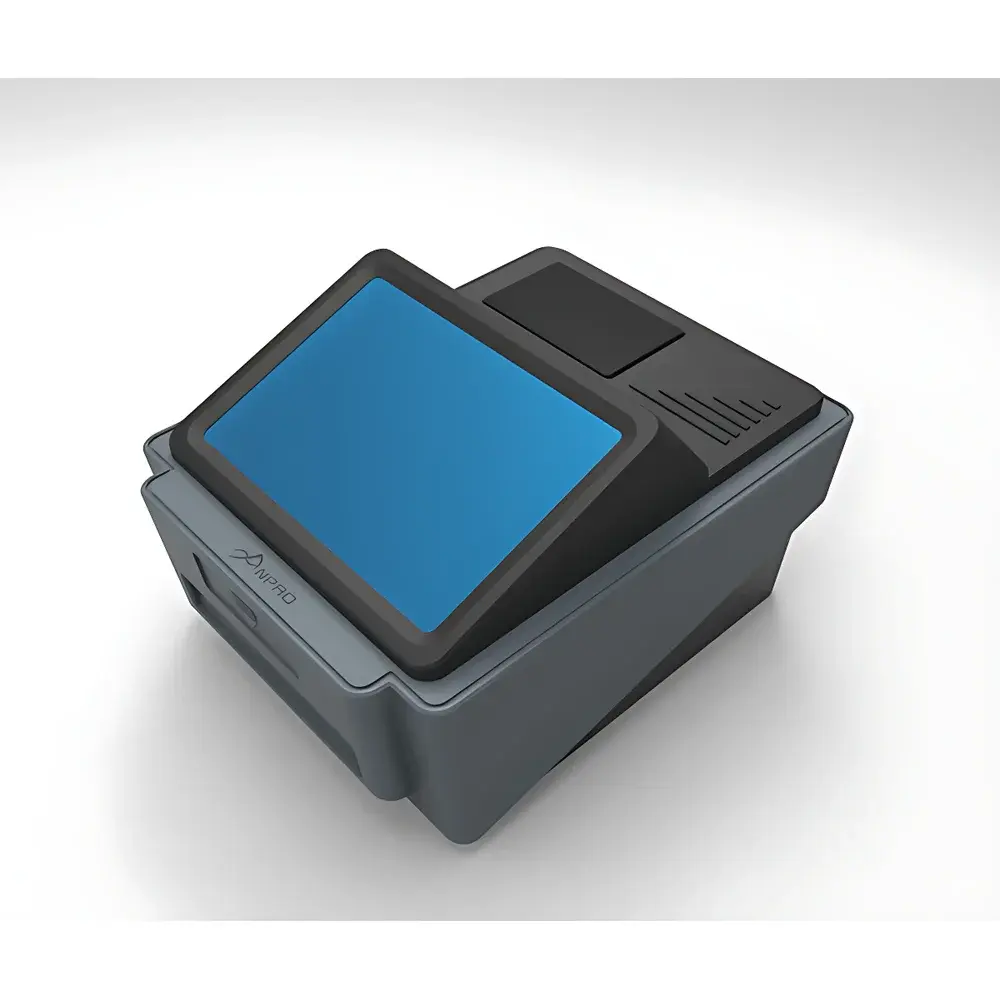
ANPRO APN-III Multi-Parameter Food Safety Analyzer
| Brand | ANPRO |
|---|---|
| Origin | Sichuan, China |
| Manufacturer Type | Manufacturer |
| Country of Origin | Domestic (China) |
| Model | APN-III |
| Price | USD 8,400 (approx.) |
| Function Type | Multi-analyte (simultaneous detection of multiple contaminants) |
| Sample Compatibility | Universal for liquid and homogenized food matrices |
| Wavelengths | 410 nm, 538 nm, 590 nm |
| Detection Time | ≤30 minutes per batch |
| Repeatability | ≤1% RSD |
| Detection Channels | 12-position automatic cuvette holder |
| Wavelength Accuracy | ±0.1 nm |
| Wavelength Repeatability | ≤±0.05 nm |
| Detector | Imported CCD sensor |
| Display | 10.1-inch high-resolution LCD |
| Interfaces | RS-232, USB 2.0, built-in thermal printer |
| Power Supply | 12 V DC (including automotive 12 V input) |
| Enclosure | Industrial-grade aluminum alloy portable case |
Overview
The ANPRO APN-III Multi-Parameter Food Safety Analyzer is a benchtop-to-field spectrophotometric platform engineered for rapid, quantitative analysis of critical food safety hazards in compliance with international screening protocols. It operates on the principle of absorbance-based colorimetric detection—leveraging fixed-wavelength photometry at 410 nm, 538 nm, and 590 nm to quantify analyte-specific chromogenic reactions. These wavelengths are selected to align with standardized enzymatic, chelation, and diazotization assays widely adopted in official methods (e.g., AOAC Official Method 2007.01 for organophosphate pesticides; GB 5009 series for heavy metals in China; ISO 15735 for nitrite). The instrument is not intended for definitive confirmation but serves as a high-throughput primary screening tool within quality control laboratories, regulatory field units, and mobile food safety inspection vehicles. Its modular optical path, thermally stabilized LED light sources, and calibrated CCD detector ensure consistent photometric performance across environmental fluctuations typical in non-climate-controlled settings.
Key Features
- 12-position automated sample carrier enabling parallel processing of up to 11 test samples plus one reagent blank per run—reducing hands-on time and operator-induced variability.
- Triple-wavelength LED illumination system with spectral stability rated for >10,000 hours, eliminating lamp replacement cycles common in halogen-based systems.
- 10.1-inch capacitive-touch LCD interface with intuitive icon-driven workflow navigation, supporting multilingual UI (English, Spanish, Arabic, and simplified Chinese preloaded).
- Built-in thermal printer for immediate hard-copy documentation compliant with GLP traceability requirements—including date/time stamp, sample ID, assay type, raw absorbance values, and calculated concentration.
- Dual power architecture: operates on standard 12 V DC input, fully compatible with vehicle auxiliary power outlets—enabling seamless integration into mobile food safety labs or roadside inspection units.
- Robust aluminum alloy chassis (IP54-rated enclosure) designed for transport resilience and long-term use in both fixed laboratories and field deployments.
Sample Compatibility & Compliance
The APN-III accommodates a broad range of pretreated food, water, and supplement matrices—including fruit/vegetable extracts, meat homogenates, dairy filtrates, grain leachates, and drinking water samples. Sample preparation follows standardized extraction and derivatization protocols outlined in national food safety standards (e.g., GB/T 5009.199–2003 for pesticide residues; GB 5009.12–2017 for lead; GB 5009.33–2016 for nitrites). While the instrument itself does not carry CE, FDA 510(k), or IVD certification, its measurement outputs are structured to support internal validation against reference methods per ISO/IEC 17025:2017. Data integrity is maintained through timestamped audit logs, user-access levels (admin/operator/guest), and non-erasable internal memory storage (≥10,000 records).
Software & Data Management
Instrument firmware supports bidirectional data exchange via RS-232 serial or USB 2.0 connection. The included PC software (Windows 10/11 compatible) provides full database management: batch import/export of calibration curves, customizable report templates (PDF/Excel), statistical summary (mean, SD, CV%, pass/fail flags), and export-ready CSV files for LIMS integration. All data transfers comply with FDA 21 CFR Part 11 principles—supporting electronic signatures, audit trails, and role-based access control. No cloud dependency: all processing occurs locally, preserving data sovereignty and minimizing cybersecurity exposure.
Applications
- Routine screening of organophosphate and carbamate pesticides in fresh produce using acetylcholinesterase inhibition assays.
- Quantification of heavy metal ions (Pb²⁺, Cd²⁺, Hg²⁺, As³⁺) via dithizone or PAR complexation chemistry.
- Detection of unauthorized food additives (e.g., Sudan dyes, rhodamine B) and adulterants (melamine, formaldehyde) in dairy, spices, and sauces.
- Monitoring preservative levels (sodium nitrite, benzoic acid, sorbic acid) and sulfite residues in processed meats and beverages.
- Field-level verification of disinfectant residuals (free chlorine, total chlorine) in food contact surface rinse water.
FAQ
Does the APN-III require external calibration standards for each assay?
Yes—each analyte module requires daily calibration using two-point or multi-point standard solutions traceable to NIST or equivalent national metrology institutes.
Can the instrument store custom calibration curves?
Yes—up to 50 user-defined curves can be saved onboard and recalled by assay name or wavelength configuration.
Is method validation support provided?
ANPRO supplies application notes aligned with GB, ISO, and AOAC guidelines, including LOD/LOQ determination protocols and inter-laboratory reproducibility data.
What maintenance is required beyond routine cleaning?
Annual optical alignment verification and LED intensity profiling are recommended; no consumable optics or lamps require replacement within the first five years of operation.
Is remote firmware update capability available?
Firmware updates are delivered via secure USB flash drive only—no internet-connected update mechanism is implemented to maintain air-gapped operational security.





