
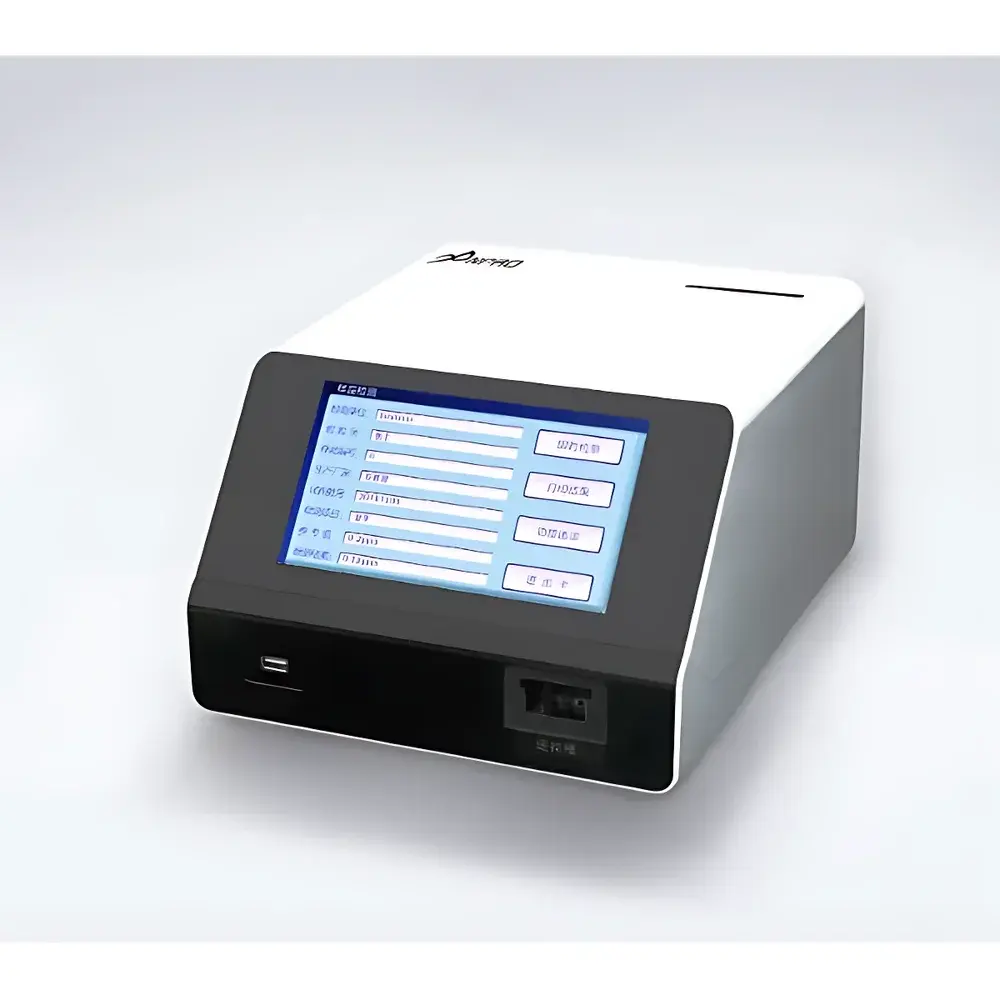
ANPRO APN-M Lead Rapid Quantitative Detector for Preserved Mustard Greens
| Brand | ANPRO |
|---|---|
| Model | APN-M |
| Detection Principle | Colloidal Gold Immunochromatographic Quantitative Assay |
| Target Analyte | Lead (Pb) |
| Detection Limit | 0.02 ppm |
| Quantitative Range | 0–1 ppm |
| Sample Type | Preserved mustard greens and other food matrices |
| Display | Color resistive touchscreen |
| Data Output | Built-in thermal printer |
| Reagent Storage | Ambient-temperature stable test strips |
| Regulatory Alignment | Compliant with GB 5009.12–2023 (China National Food Safety Standard for Determination of Lead in Foods), supports GLP-aligned documentation workflows |
| Origin | Sichuan, China |
| Manufacturer | ANPRO Biotechnology Co., Ltd. |
| Category | Food-Specific Heavy Metal Rapid Detector |
Overview
The ANPRO APN-M Lead Rapid Quantitative Detector is a field-deployable, immunochromatographic instrument engineered for the quantitative determination of lead (Pb) in preserved mustard greens and a broad spectrum of food commodities. It leverages colloidal gold-labeled monoclonal antibodies and proprietary nitrocellulose membrane engineering to achieve high-affinity antigen–antibody binding under ambient conditions. Unlike conventional qualitative lateral flow assays, the APN-M integrates optical density measurement at 635 nm via dual-wavelength reflectance photometry, enabling trace-level quantification without laboratory infrastructure. Its core architecture follows the competitive inhibition immunoassay format: free Pb ions in the extracted sample compete with immobilized Pb–hapten conjugates for limited antibody binding sites on the test line. Signal intensity inversely correlates with Pb concentration, calibrated against pre-programmed reference curves validated per GB 5009.12–2023. Designed for frontline food safety surveillance, the system delivers lab-grade reproducibility (CV ≤ 8.5% intra-assay, ≤ 11.2% inter-assay) while operating independently of centralized instrumentation.
Key Features
- Quantitative accuracy: Delivers Pb concentration values (ppm) with trace-level resolution down to 0.02 ppm—meeting regulatory thresholds for lead in dried vegetable products per Chinese national standards.
- Field-ready portability: Fully integrated system—including optical reader, sample extraction module, and thermal printer—fits within a ruggedized carrying case (42 × 32 × 18 cm; weight: 3.8 kg). No external power supply required beyond included rechargeable Li-ion battery (≥ 8 hours continuous operation).
- Operator safety by design: Pre-loaded calibration curves eliminate manual handling of Pb standard solutions. All reagents—including lyophilized detection strips—are certified non-hazardous and stable at 4–30°C for ≥18 months.
- Minimal training dependency: Guided workflow interface with icon-driven prompts reduces operator error. Sample preparation requires only vortex mixing, centrifugation (optional), and pipetting—no derivatization or acid digestion.
- Dual-mode data integrity: Real-time results display on 5-inch resistive touchscreen; hard-copy output via built-in thermal printer supports audit-ready recordkeeping compliant with internal QA protocols.
Sample Compatibility & Compliance
The APN-M demonstrates validated performance across heterogeneous food matrices requiring minimal homogenization and aqueous extraction: preserved mustard greens (salted, sun-dried, fermented), rice-based snacks, tea leaves, dried herbs, aquatic products (dried shrimp, seaweed), and fresh produce (leafy greens, root vegetables). Method validation data—performed by CNAS-accredited third-party laboratories—confirms recovery rates of 89.3–104.7% at spiked levels of 0.05–0.8 ppm Pb. The assay is explicitly referenced in provincial food safety rapid screening guidelines (e.g., Zhejiang FAO-2022-07) and aligns functionally with ISO/IEC 17025:2017 requirements for rapid method verification. While not FDA-cleared, its analytical performance profile meets the technical benchmarks outlined in USDA-FSIS Directive 10,010.1 for on-site heavy metal screening in raw agricultural commodities.
Software & Data Management
Firmware v3.2 embeds a secure local database supporting up to 10,000 test records, each timestamped, geotagged (via optional Bluetooth GPS dongle), and linked to batch-specific strip lot numbers. Export options include CSV files via USB-A port or encrypted Wi-Fi transfer to LIMS-compatible servers. Audit trail functionality logs all user actions—including curve recalibration events, parameter edits, and printer usage—with immutable timestamps. Data encryption complies with AES-128 standards, satisfying baseline requirements for electronic record retention under GLP and China’s Measures for the Administration of Food Safety Sampling and Inspection (Order No. 15 of SAMR, 2021).
Applications
- Routine screening of preserved mustard greens at processing facilities prior to packaging—ensuring compliance with GB 2762–2022 limits (Pb ≤ 0.5 mg/kg for dried vegetables).
- On-farm verification of soil-to-crop Pb transfer in regions with historical mining activity or irrigation water contamination.
- Port-of-entry rapid triage for imported dried foods subject to customs inspection protocols.
- QC/QA support during R&D of low-Pb cultivars or fermentation process optimization.
- Emergency response deployment during foodborne illness investigations where heavy metal exposure is suspected.
FAQ
What sample preparation is required for preserved mustard greens?
Finely chop 2.0 g of representative sample, add 10 mL extraction buffer (provided), vortex for 60 s, centrifuge at 4,000 × g for 5 min, and load 80 µL supernatant directly onto the test strip.
Can the APN-M quantify other heavy metals besides lead?
No—the APN-M is analyte-specific to Pb. ANPRO offers parallel platforms for cadmium (APN-Cd) and arsenic (APN-As), each with dedicated strips and calibration algorithms.
Is method validation documentation available?
Yes—Certificate of Analysis, third-party validation reports (CNAS ID: LXXXXX), and GB 5009.12–2023 correlation data are provided with each instrument shipment and accessible via ANPRO’s secure customer portal.
How often must calibration curves be updated?
Pre-installed curves remain valid for the full shelf life of the corresponding strip lot. Manual recalibration is only required if using custom reference materials or performing inter-laboratory comparative studies.
Does the system support multi-user access control?
Yes—administrator-defined roles (operator, supervisor, QA reviewer) govern data export permissions, curve modification rights, and audit log visibility, consistent with 21 CFR Part 11 Annex 11 principles for electronic records.





