
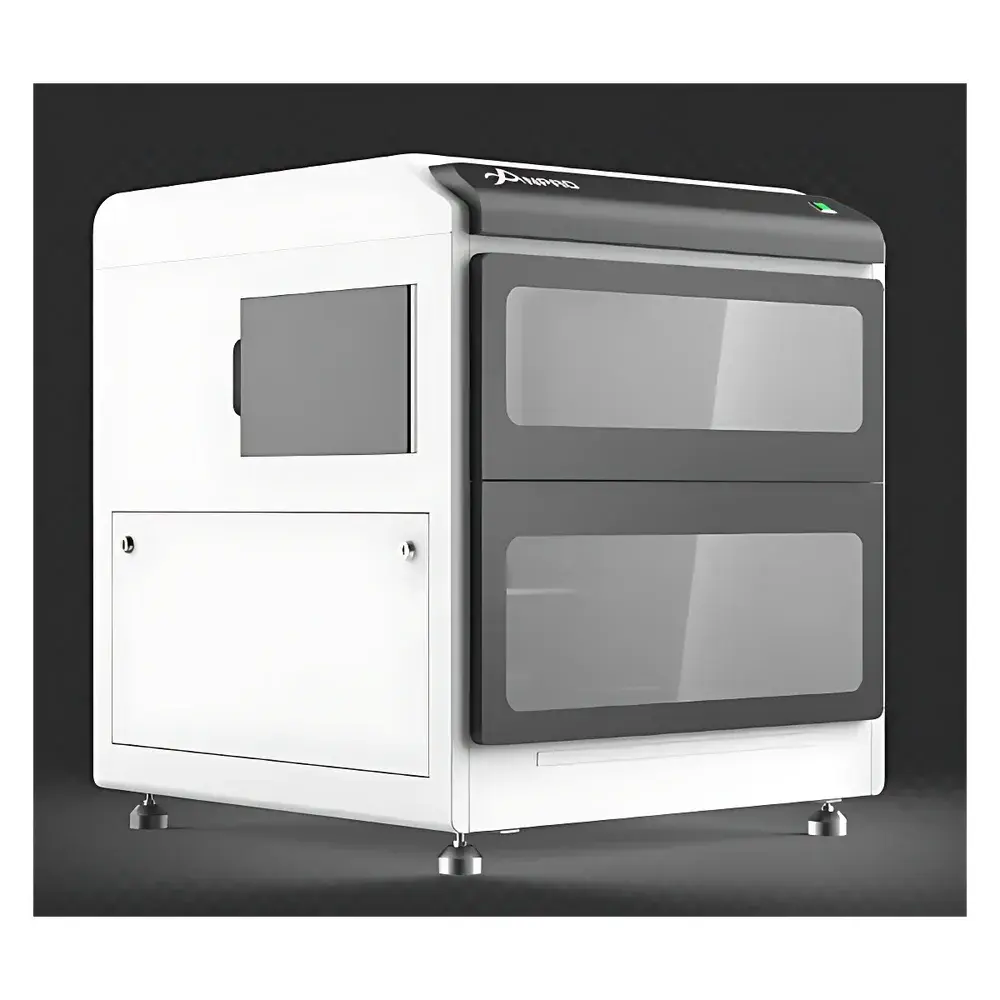
Anpro EV-X Food Safety Intelligent Analyzer
| Brand | Anpro |
|---|---|
| Origin | Sichuan, China |
| Manufacturer Type | Manufacturer |
| Regional Category | Domestic (China) |
| Model | EV-X |
| Pricing | Upon Request |
Overview
The Anpro EV-X Food Safety Intelligent Analyzer is an integrated, fully automated immunoassay-based analytical platform engineered for high-throughput screening and quantitative determination of chemical and biological contaminants in food and agricultural commodities. Utilizing a modular microfluidic architecture combined with time-resolved fluorescence (TRF) or chemiluminescent immunoassay (CLIA) detection principles—depending on configured assay cartridges—the system delivers trace-level sensitivity and robust reproducibility across diverse sample matrices. Designed to meet the operational rigor of central quality control laboratories, regulatory testing facilities, and contract research organizations (CROs), the EV-X executes end-to-end analysis without manual intervention: from sample loading and matrix-assisted extraction through thermal conditioning, immunoreaction kinetics control, signal acquisition, and digital result reporting. Its core application scope encompasses mycotoxins, heavy metals (via chelation-enhanced immunoassays), and organophosphate/carbamate/pyrethroid pesticide residues in cereals, oilseeds, dairy products, feedstuffs, and traditional Chinese medicinal materials.
Key Features
- Ultra-threaded Sample Processing Architecture: Parallelized fluidic pathways enable continuous, non-stop operation with minimal inter-sample carryover; supports true random-access, non-batch processing.
- Intelligent Sample Handling System: Integrated robotic pipetting with real-time liquid level sensing ensures volumetric accuracy ≤1% CV across all reagent and sample transfers.
- Multi-target Configurable Assay Workflow: User-defined assay panels allow concurrent detection of up to 8 analytes per sample via cartridge-based immunoassay modules—each calibrated against certified reference standards.
- Automated Matrix Extraction Module: Programmable vortex-centrifugation sequence optimizes recovery efficiency from complex, high-fat, or fibrous matrices (e.g., corn, soybean meal, ginseng powder).
- Thermal Precision Control: Independent incubation zones maintain ±0.3°C stability during antibody–antigen binding phases, critical for assay fidelity under variable ambient conditions.
- Self-Diagnostic & Fault-Resilient Operation: Onboard sensors monitor pressure, temperature, optical path integrity, and liquid presence; automatic error logging and stepwise recovery protocols minimize downtime.
Sample Compatibility & Compliance
The EV-X accommodates raw and processed samples including milled grains (wheat, maize, rice), legumes (soy, peanut), dairy powders, animal feed formulations, edible oils, and dried herbal materials. All validated methods align with national standard methodologies: GB 2761–2017 (Mycotoxins in Food), GB 2762–2022 (Contaminants in Food), and the LST series standards (LST 6111–2015 through LST 6145–2023) governing immunoassay validation for food safety testing in China. While not FDA 510(k)-cleared or CE-IVD marked, the system’s data integrity framework—including audit trail generation, electronic signature support, and user access controls—meets foundational requirements for GLP-compliant environments and internal QA/QC documentation.
Software & Data Management
The proprietary LIMXIS™ software suite provides intuitive assay setup, real-time instrument monitoring, and automated report generation compliant with ISO/IEC 17025 documentation expectations. Raw signal data, calibration curves, and QC metrics are stored in encrypted SQLite databases with timestamped metadata. Export options include CSV, PDF, and XML formats compatible with LIMS integration. Audit trails record all user actions, parameter modifications, and instrument events with immutable timestamps—supporting retrospective review during internal audits or regulatory inspections.
Applications
- Quantitative screening of aflatoxin B₁, total aflatoxins, aflatoxin M₁, deoxynivalenol (DON), zearalenone (ZEN), fumonisins, ochratoxin A, and T-2 toxin in grain procurement and storage facilities.
- Determination of Cd, Pb, Cr, and Cu in feed premixes and aquaculture ingredients using metal-chelating competitive immunoassays.
- Multi-residue pesticide analysis—including acetamiprid, emamectin benzoate, isoprocarb, carbofuran, parathion-methyl, and lambda-cyhalothrin—in rice, tea, and spice supply chains.
- Batch release testing for GMP-certified nutraceutical manufacturers requiring rapid, repeatable contaminant verification prior to packaging.
- Method transfer support for laboratories transitioning from ELISA or HPLC-MS workflows to higher-throughput immunoassay platforms.
FAQ
What sample preparation is required prior to loading?
Minimal preparation: homogenization followed by solvent extraction (e.g., 70% methanol/water) and centrifugation. The EV-X performs all subsequent steps—including filtration, dilution, and reagent addition—automatically.
Can the system be validated per ISO/IEC 17025 requirements?
Yes. Full validation documentation packages—including installation qualification (IQ), operational qualification (OQ), and performance qualification (PQ) templates—are provided. Method-specific validation reports may be generated using built-in calibration and QC routines.
Is remote monitoring supported?
Yes. LIMXIS™ includes secure HTTPS-based web interface access for real-time status viewing, alarm notifications, and historical data retrieval from any network-connected device.
What maintenance intervals are recommended?
Daily: tip waste bin and wash station inspection. Monthly: fluidic line priming and optical window cleaning. Annually: full system calibration and sensor verification by authorized service personnel.
Are assay cartridges supplied by Anpro only?
Yes. All consumables—including pre-calibrated immunoassay cartridges, reagent kits, and disposable tips—are manufactured and quality-controlled by Anpro to ensure lot-to-lot consistency and method compliance.




