
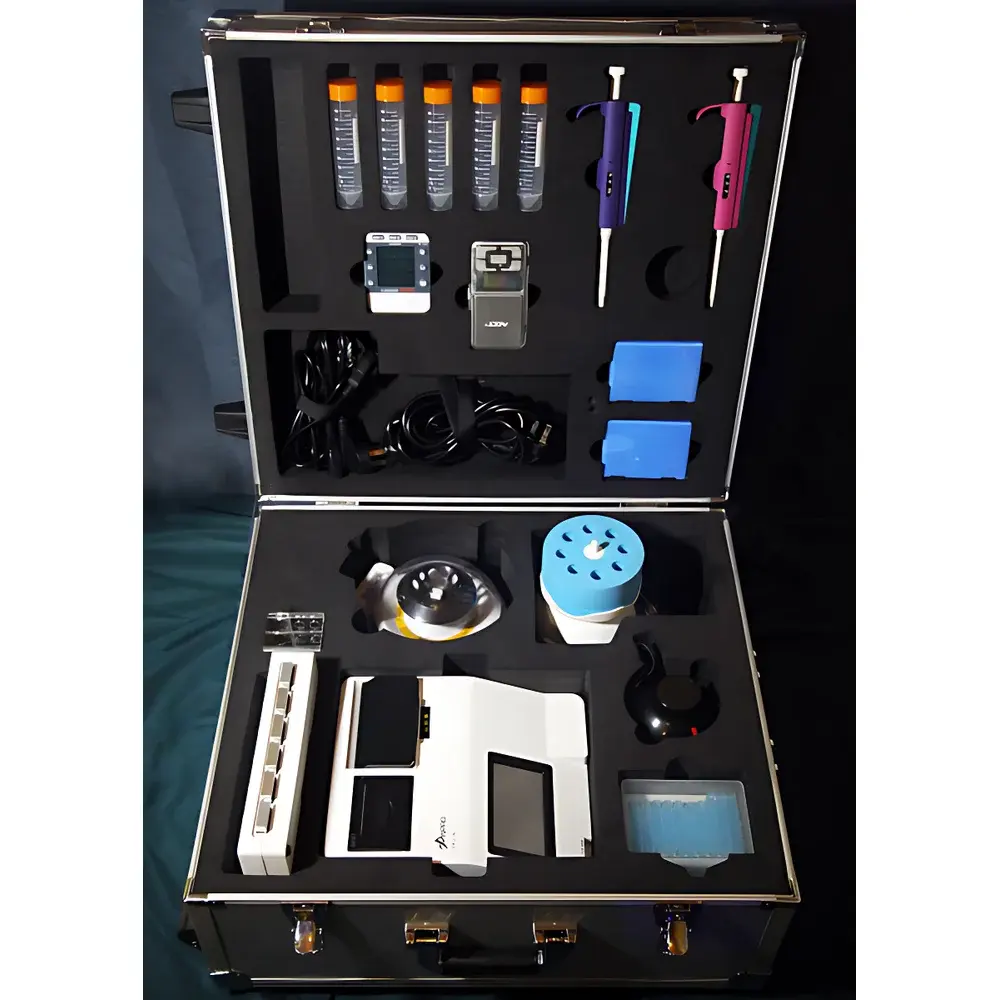
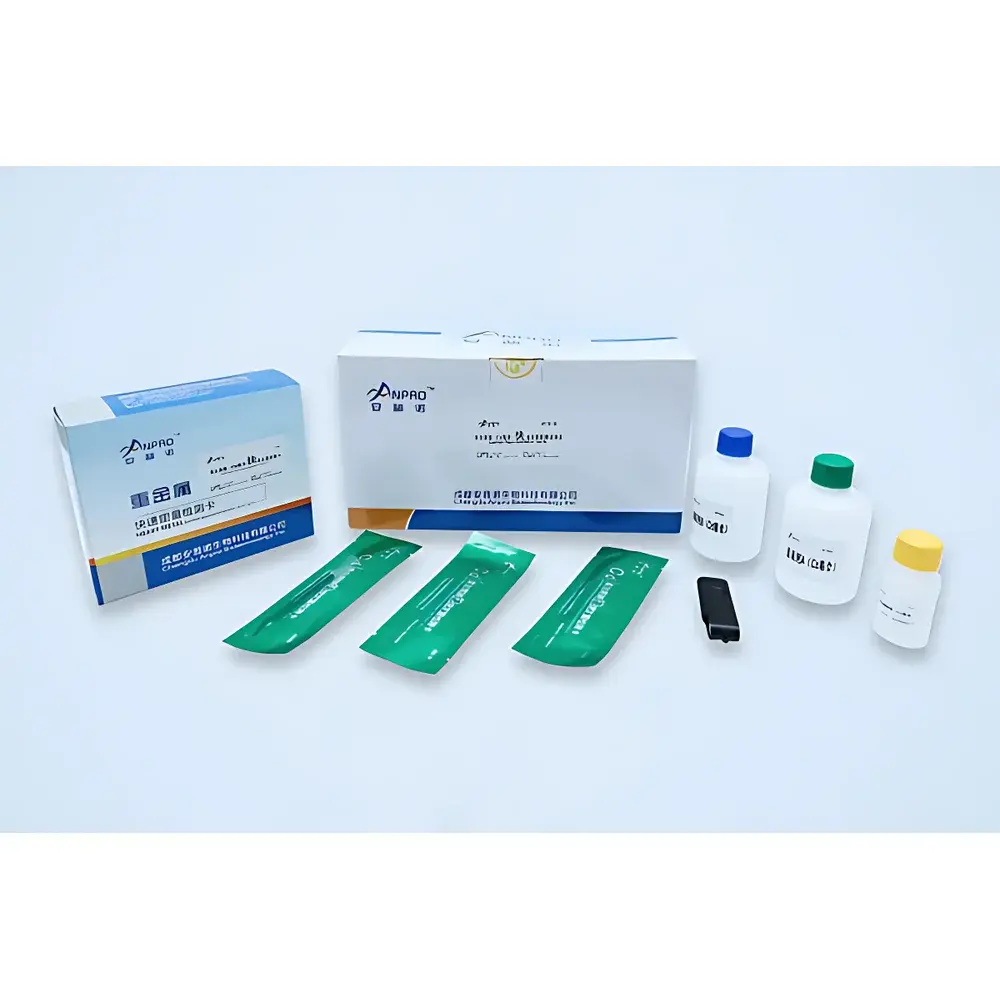
ANPRO SKJ-IA Heavy Metal Quantitative Rapid Detector (Cd, Pb, Cu, Cr)
| Brand | ANPRO |
|---|---|
| Origin | Sichuan, China |
| Manufacturer Type | Direct Manufacturer |
| Product Origin | Domestic (China) |
| Model | SKJ-IA |
| Price Range | USD 7,000 – 14,000 |
| Function Type | Multi-analyte Quantitative Detection |
| Sample Versatility | Universal for Solid & Liquid Food Matrices |
| Optical Detection Wavelength | 410 nm |
| Assay Time per Sample | ≤25 min |
| Coefficient of Variation (CV) | ≤0.2% |
| Detection Channels | 6 simultaneous independent channels |
| Detection Range (Cd & Pb) | 0–1 ppm |
| Regulatory Alignment | Designed to support ISO 17025-compliant workflows and GLP-aligned food safety testing |
Overview
The ANPRO SKJ-IA Heavy Metal Quantitative Rapid Detector is an integrated optical immunoassay platform engineered for field-deployable, quantitative analysis of cadmium (Cd), lead (Pb), copper (Cu), and chromium (Cr) in complex food matrices. It leverages colloidal gold-based lateral flow immunoassay (LFIA) technology enhanced by proprietary surface stabilization chemistry and signal amplification algorithms—enabling reproducible quantification without reliance on laboratory-grade spectrophotometers or ELISA readers. Unlike conventional qualitative strip tests, the SKJ-IA employs dual-wavelength reflectance photometry at 410 nm to measure test line intensity against a built-in reference, converting optical density into concentration values traceable to NIST-traceable calibration standards. The system is designed for operation in grain inspection stations, port quarantine labs, feed mills, and mobile food safety units where ISO/IEC 17025-compliant data integrity, audit readiness, and rapid turnaround are mission-critical.
Key Features
- Six independent optical detection channels enable parallel processing of up to six samples—reducing batch analysis time while maintaining inter-channel calibration stability.
- Pre-loaded, lot-specific calibration curves eliminate manual standard curve preparation; all calibrants are pre-dispensed in sealed, lyophilized cartridges—ensuring operator safety and minimizing exposure to heavy metal reference standards.
- Integrated 7-inch resistive touchscreen interface with on-device data visualization, real-time QC flagging (e.g., invalid control line, insufficient sample volume), and automatic CV calculation per assay run.
- Onboard thermal printer supports immediate hard-copy documentation compliant with internal QA record-keeping requirements; printed reports include timestamp, GPS coordinates (when enabled), operator ID, and instrument serial number.
- Ruggedized ABS housing with shock-absorbing rubber corners and telescopic handle meets IP54 environmental rating—suitable for transport in vibration-prone vehicles and deployment in ambient temperatures from 10 °C to 35 °C.
- Firmware architecture supports over-the-air (OTA) updates and user-defined assay protocols, enabling future expansion to mycotoxins (e.g., aflatoxin B1, deoxynivalenol) and pesticide residues (e.g., organophosphates, carbamates) via validated cartridge swaps.
Sample Compatibility & Compliance
The SKJ-IA accepts homogenized extracts from diverse food and agricultural materials—including cereals, milled grains, dried seaweed (kelp, wakame), dried fruit (e.g., plum/ume), herbal medicines, aquaculture feed, and fresh produce—following standardized extraction procedures aligned with GB 5009.12–2023 (China National Standard for Pb in Foods) and GB 5009.15–2014 (for Cd). Each assay cartridge includes matrix-matched controls to compensate for extract interference. Instrument output complies with data integrity principles outlined in FDA 21 CFR Part 11 (electronic records/signatures) when paired with ANPRO’s optional cloud-based LIMS connector. All reagent kits carry CE-IVD marking for in vitro diagnostic use in food safety screening applications.
Software & Data Management
The embedded operating system runs ANPRO’s TraceLink™ firmware v3.2, which logs every assay event—including raw reflectance values, calculated concentrations, operator inputs, environmental sensor readings (temperature/humidity), and GPS metadata (if enabled). Data export options include CSV via USB-C, Bluetooth 5.0 pairing with Android/iOS tablets, and secure HTTPS push to ANPRO Cloud or customer-hosted servers. Audit trails retain full history of user logins, method changes, and calibration events—supporting GLP/GMP inspections and third-party accreditation audits. Role-based access control allows lab supervisors to configure operator permissions (e.g., view-only vs. result-editing rights).
Applications
- Regulatory screening of imported dried seaweed at customs checkpoints for Cd/Pb compliance with EU Commission Regulation (EC) No 1881/2006.
- In-line quality assurance for herbal medicine processors verifying Cr levels in Prunus mume (Japanese apricot/ume) extracts prior to tablet formulation.
- Field verification of feed contamination incidents involving Cu accumulation in poultry layer rations—per AAFCO guidelines.
- Surveillance testing of rice and wheat flour in municipal food safety programs targeting Pb thresholds specified in China’s GB 2762–2022.
- Contract laboratory support for AOAC PTM (Performance Tested Method) validation studies requiring ≥95% recovery accuracy across 0.1–1.0 ppm Pb/Cd ranges.
FAQ
What regulatory standards does the SKJ-IA support for reporting?
The instrument generates reports compatible with ISO/IEC 17025 documentation requirements, including uncertainty estimation per ISO/IEC Guide 98-3, and supports 21 CFR Part 11 electronic signature workflows when used with ANPRO Cloud.
Can the SKJ-IA quantify beyond Cd and Pb?
Yes—Cu and Cr assays are fully validated and included in the base configuration; additional analytes (e.g., As, Hg) require cartridge revalidation and are available under custom development agreements.
Is method validation documentation provided?
Each shipment includes a Certificate of Conformance, analytical performance summary (LOD, LOQ, precision, accuracy per AOAC 2012.01), and a copy of the Grain Inspection Service (GIS) evaluation report for Cd/Pb assays.
How is instrument calibration maintained between uses?
The system performs automatic optical self-check at startup using an internal reference tile; full recalibration is required only after firmware updates or every 90 days—verified via supplied calibration verification kit (Cat. No. CAL-SKJ-IA-01).
What sample preparation equipment is needed?
None beyond standard lab tools: vortex mixer, centrifuge (≥3,000 × g), and pipettes. Extraction buffers and solid-phase cleanup columns are supplied with each assay kit.





