
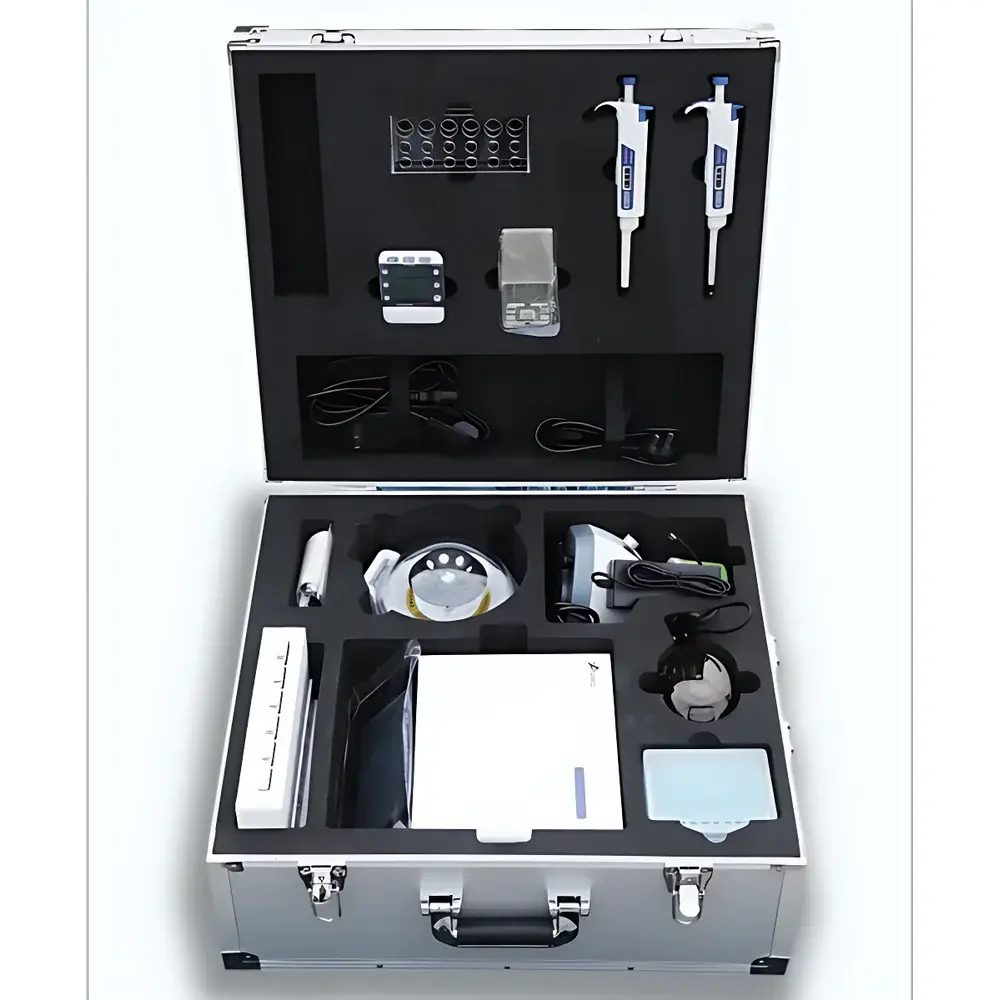
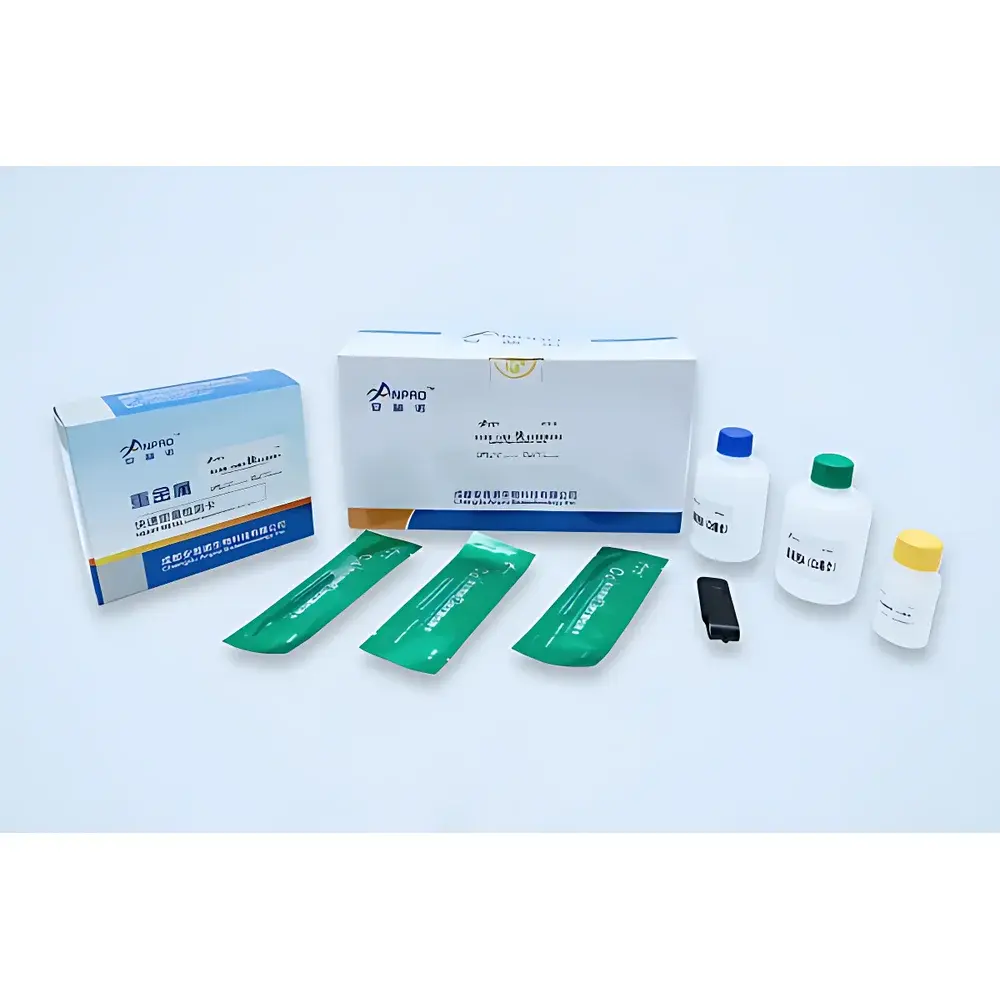
ANPRO SKJ-IA-C Tea Heavy Metal Rapid Quantitative Analyzer (Pb, Cd, Cu, Cr)
| Brand | ANPRO |
|---|---|
| Origin | Sichuan, China |
| Manufacturer Type | Direct Manufacturer |
| Region Classification | Domestic (China) |
| Model | SKJ-IA-C |
| Price | USD 7,000 (approx.) |
Overview
The ANPRO SKJ-IA-C Tea Heavy Metal Rapid Quantitative Analyzer is a field-deployable, lateral-flow immunoassay-based instrument engineered for the quantitative detection of lead (Pb), cadmium (Cd), copper (Cu), and chromium (Cr) in tea matrices—including black tea, green tea, oolong, and fresh leaf samples. Unlike conventional qualitative rapid tests, this system integrates colloidal gold immunochromatographic technology with on-board optical densitometry and pre-calibrated algorithmic curve fitting to deliver trace-level quantification without laboratory infrastructure. It operates on the principle of competitive inhibition immunoassay: target metal ions in extracted samples compete with immobilized metal–hapten conjugates for binding sites on anti-metal monoclonal antibodies labeled with colloidal gold nanoparticles. Signal intensity at the test line—measured via high-sensitivity RGB photometric sensor—is inversely proportional to analyte concentration and converted into quantitative results using embedded calibration curves validated against reference standards traceable to NIST SRMs. Designed specifically for food safety surveillance in tea production, procurement, and regulatory inspection contexts, the analyzer meets functional requirements aligned with ISO/IEC 17025-compliant method validation frameworks and supports data integrity practices consistent with GLP and FDA 21 CFR Part 11 principles (audit trail, user authentication, electronic signature readiness).
Key Features
- Quantitative multi-analyte capability: Simultaneous determination of Pb, Cd, Cu, and Cr in a single run, with result output in ppm (mg/kg)
- Pre-loaded calibration curves: Eliminates need for operator handling of certified reference standards; ensures analyst safety and measurement consistency
- Integrated sample processing workflow: Includes extraction buffer vials, centrifuge-compatible tubes, and pipette tips—fully contained within the portable instrument case
- Rugged field design: Pull-handle aluminum alloy chassis, IP54-rated enclosure, and 6-hour rechargeable Li-ion battery support mobile deployment in warehouses, farms, border checkpoints, and third-party labs
- Touch-enabled interface: 7-inch resistive color touchscreen with intuitive icon-driven navigation and multilingual OS (English, Spanish, Vietnamese, Arabic available)
- On-device thermal printing: Built-in micro-printer generates tamper-evident hardcopy reports including sample ID, timestamp, GPS coordinates (optional), and QC flag status
Sample Compatibility & Compliance
The SKJ-IA-C is validated for use with ground or powdered tea samples (≤200 µm particle size), requiring only 2 g of homogenized material per test. Sample preparation follows AOAC Official Method 2018.02–based acid leaching (0.1 M HNO₃, 60°C, 30 min), followed by centrifugation and supernatant dilution. Detection limits meet Chinese GB 2762-2022 and EU Commission Regulation (EC) No 1881/2006 thresholds for Pb (0.5–10 ppm) and Cd (0.2–5 ppm); Cu and Cr ranges align with national tea quality standards (GB/T 14456.1–2017). All assay strips carry CNAS-accredited verification reports from SGS Shanghai and China National Institute of Metrology (NIM). Device firmware complies with IEC 61326-1 for EMC and IEC 61010-1 for electrical safety.
Software & Data Management
Embedded firmware supports local storage of ≥5,000 test records with time/date stamp, operator ID, GPS metadata (via optional external Bluetooth GNSS module), and raw optical density values. Data export options include USB mass storage mode (CSV), Bluetooth 5.0 (to Android/iOS companion app), and Wi-Fi upload to ANPRO Cloud Platform—compatible with LIMS integration via RESTful API. Audit trail logs capture all user actions (e.g., calibration reset, curve update, report deletion) with immutable timestamps. Software architecture enables role-based access control (admin/operator/auditor) and supports periodic backup to encrypted SD card.
Applications
- Tea estate QC: In-field screening of harvested leaves prior to processing to prevent contaminated batches from entering production
- Import/export compliance: Rapid verification against destination-market heavy metal limits (e.g., Japan MHLW Notification No. 370, US FDA Import Alert 22-02)
- Regulatory surveillance: Mobile deployment by provincial food and drug administrations during seasonal tea harvest inspections
- Third-party certification labs: As a prescreening tool to prioritize samples for confirmatory ICP-MS analysis, reducing lab turnaround time by >60%
- Supply chain transparency: Integration with blockchain-enabled traceability systems to link test results to specific plantation lots and processing dates
FAQ
What sample preparation is required before testing?
A standardized acid leaching step (0.1 M HNO₃, 60°C, 30 min) followed by centrifugation and 1:5 dilution is mandatory. Full SOPs are included in the instrument’s onboard help library.
Is method validation documentation available?
Yes—CNAS-accredited performance evaluation reports (precision, accuracy, LOD/LOQ, matrix interference) are provided with each unit and updated annually per ISO/IEC 17025 requirements.
Can the device be used for other food matrices besides tea?
While optimized for tea, the platform has demonstrated cross-reactivity feasibility for dried herbs and spices; however, matrix-specific validation is required per AOAC guidelines prior to routine use.
How often does the optical sensor require recalibration?
Factory calibration remains stable for ≥12 months under normal use; annual verification using supplied reference strip set is recommended and logged automatically.
Does the system support multi-language reporting for international users?
Yes—English, Spanish, Vietnamese, Arabic, and Russian language packs are pre-installed and selectable via settings menu; printed reports reflect the active UI language.






