
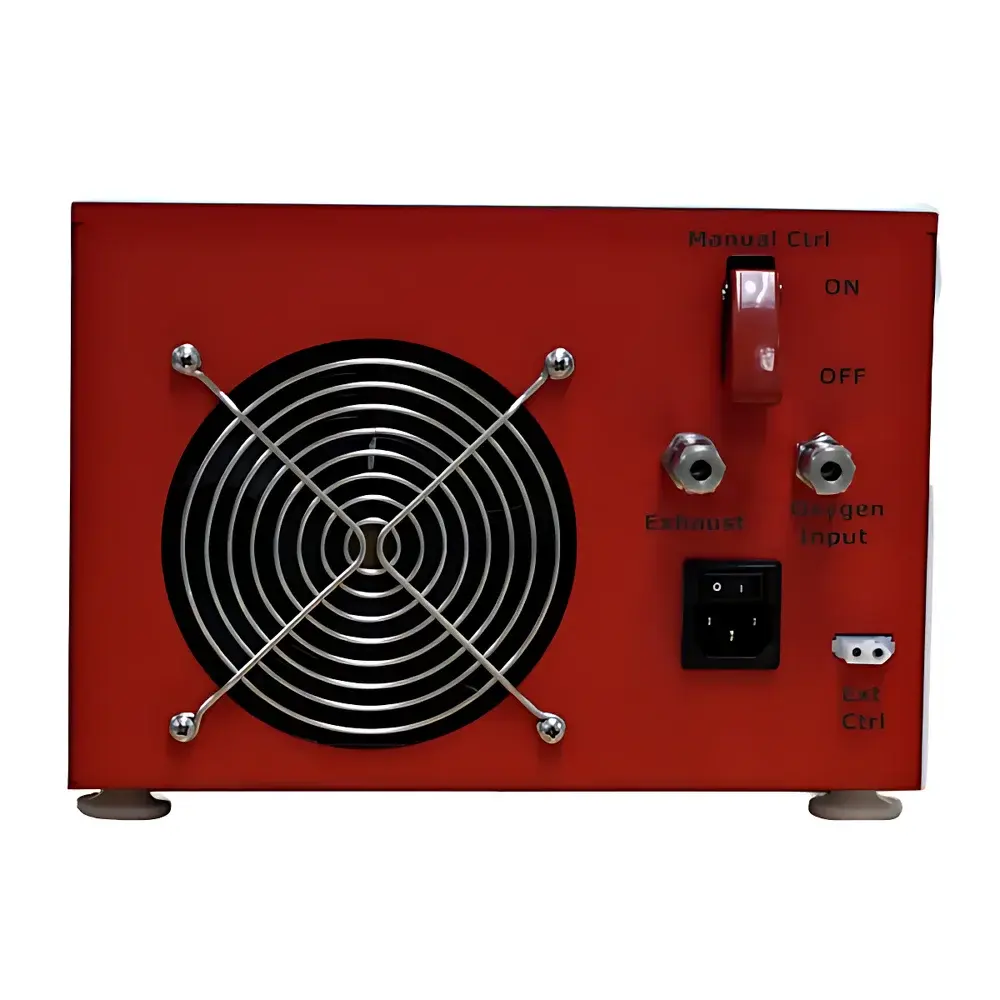
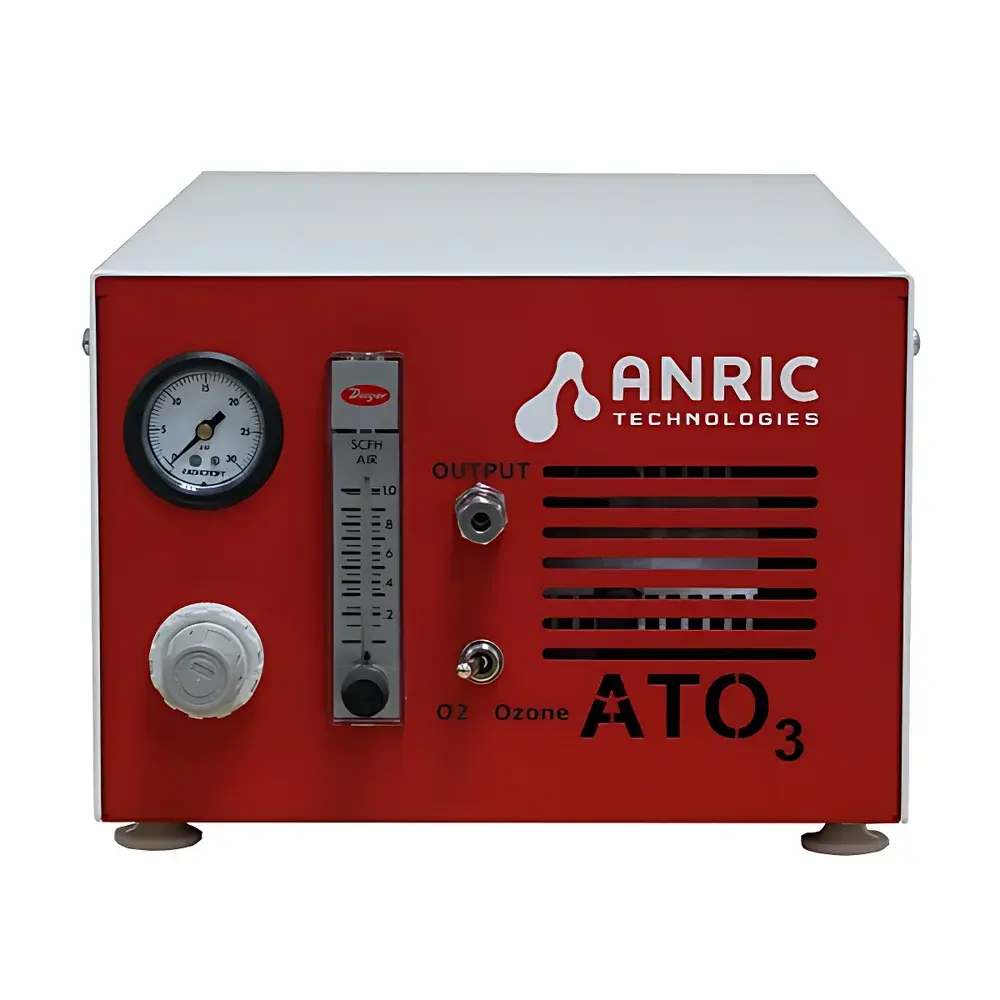
ANRIC AT Ozone Generator
| Brand | ANRIC |
|---|---|
| Origin | USA |
| Manufacturer Type | Authorized Distributor |
| Product Origin | Imported |
| Model | AT |
| Pricing | Upon Request |
| Ozone Output Range | 12% w/w at 250 sccm, 6% w/w at 2500 sccm |
| Oxygen Flow Control | 25–2500 sccm (panel-integrated mass flow control) |
| O₂ Regulator Range | 3–29 psi |
| Corona Cell | Aluminum electrode with ceramic dielectric |
| Operating Frequency | 5–30 kHz |
| Input Power | 110–220 VAC, 50/60 Hz, 2 A |
| Dimensions | 10.3" W × 7.5" H × 20" D |
| Weight | 15 lbs |
| Cooling | Forced-air (integrated high-speed fan) |
| Control Interface | 3–24 VDC analog input for automated ozone modulation |
| Manual Override | Front-panel O₃/O₂ toggle switch + rear-panel mechanical override switch |
| Output Port | 1/4" Swagelok compression fitting (ozone delivery) |
| Inlet Port | 1/4" Swagelok compression fitting (O₂ supply, ≥90% purity recommended) |
| Exhaust Port | 1/4" Swagelok compression fitting (0.5 SCFH O₂-rated venting capacity) |
| Optional Safety Monitor | Real-time ambient O₃ detection (0–5000 ppb), LED status indicators (green/yellow/red), temperature & humidity sensing, LCD display, wall-mount bracket, dry-contact relay output for interlocked shutdown |
Overview
The ANRIC AT Ozone Generator is a compact, laboratory-grade corona discharge ozone source engineered for precision gas-phase oxidation, surface functionalization, and process integration in controlled environments—particularly atomic layer deposition (ALD), plasma-assisted thin-film synthesis, and advanced material surface treatment. It operates on the principle of silent electrical discharge (corona discharge) across a ceramic-dielectric barrier, where high-frequency alternating current (5–30 kHz) ionizes feed oxygen (O₂) to generate ozone (O₃) via triatomic molecular recombination. Unlike water-cooled industrial systems, the AT employs an optimized forced-air thermal management architecture—featuring a high-efficiency axial fan and thermally conductive aluminum corona cell housing—to maintain stable plasma discharge conditions during continuous operation up to 2500 sccm. Its design prioritizes safety, reproducibility, and compatibility with vacuum-integrated workflows while eliminating reliance on external chillers or complex coolant infrastructure.
Key Features
- High-concentration ozone output: 12% w/w at low-flow conditions (250 sccm), scalable down to 6% w/w at maximum rated flow (2500 sccm)
- Integrated mass flow-controlled oxygen delivery system with front-panel adjustable flowmeter (25–2500 sccm range) and precision pressure regulator (3–29 psi)
- Ceramic-dielectric barrier corona cell constructed from aerospace-grade aluminum for thermal stability, corrosion resistance, and long-term discharge uniformity
- Modular analog control interface: 3–24 VDC input signal enables seamless integration with programmable logic controllers (PLCs), data acquisition systems, or ALD tool sequencers for closed-loop ozone dosing
- Dual-mode operation: Front-panel O₂/O₃ selector switch supports manual bypass; rear-panel mechanical override switch provides fail-safe local activation independent of control signals
- Onboard high-capacity catalytic ozone destruct unit rated for non-recirculating effluent streams—critical for compliance with indoor air quality (IAQ) standards and OSHA PEL (0.1 ppm TWA)
- Compact footprint (10.3″ × 7.5″ × 20″) and lightweight construction (15 lbs) facilitate benchtop deployment, cleanroom integration, or mobile lab configurations
Sample Compatibility & Compliance
The AT Ozone Generator is designed exclusively for use with high-purity oxygen feed gas (≥90% O₂, recommended ≥98% for optimal yield and electrode longevity). It is incompatible with compressed air, nitrogen, or hydrocarbon-containing gases due to risk of nitric oxide formation, carbon deposition, or dielectric breakdown. All wetted materials—including Swagelok 1/4″ compression fittings, internal stainless-steel manifolds, and alumina-ceramic barriers—meet ASTM F800-21 specifications for oxygen service cleanliness and are certified for Class E (flammability-sensitive) environments. The system complies with UL 61010-1 (Safety Requirements for Electrical Equipment for Measurement, Control, and Laboratory Use) and incorporates intrinsic safety features including overtemperature cutoff, open-circuit detection, and interlock-ready relay outputs. When paired with the optional ATOzone Safety Monitor, it supports GLP/GMP-aligned environmental monitoring per ISO 14644-1 (cleanroom air quality) and OSHA 29 CFR 1910.1000 (hazardous substance exposure limits).
Software & Data Management
The AT operates as a hardware-level gas delivery module without embedded firmware or proprietary software. Its 3–24 VDC analog control input is compatible with standard industrial I/O protocols (e.g., 0–10 V, 4–20 mA via signal conditioner) and integrates natively into LabVIEW, MATLAB, Python-based automation frameworks (e.g., PyVISA), or vendor-specific ALD platform controllers. All operational parameters—including inlet pressure, flow rate, discharge voltage, and thermal status—are accessible via calibrated analog feedback channels (optional add-on). The optional ATOzone Safety Monitor includes onboard data logging (timestamped O₃, temperature, humidity), USB export capability, and configurable alarm thresholds aligned with FDA 21 CFR Part 11 requirements for audit-trail generation when deployed in regulated pharmaceutical or medical device manufacturing settings.
Applications
- Atomic layer deposition (ALD) of metal oxides (e.g., Al₂O₃, HfO₂, TiO₂) requiring precise, low-carbon, high-purity oxidant delivery
- In-situ surface oxidation and hydroxylation of silicon, graphene, and 2D materials prior to functionalization or heterostructure assembly
- Low-temperature plasma-enhanced chemical vapor deposition (PECVD) processes demanding stable, tunable O₃ concentration profiles
- Calibration and validation of ozone analyzers (UV photometry, electrochemical sensors) per EPA Method IO-3 and ISO 13964
- Controlled oxidative etching of photoresists and organic contaminants in semiconductor metrology and failure analysis labs
- Research-scale atmospheric chemistry simulation involving trace O₃ kinetics under laminar flow conditions
FAQ
What oxygen purity is required for optimal performance and warranty validity?
ANRIC specifies a minimum oxygen purity of 90% (v/v); however, ≥98% purity is strongly recommended to maximize ozone yield, minimize NOₓ byproduct formation, and ensure full warranty coverage. Use of lower-purity gases may accelerate electrode erosion and void the 24-month limited warranty.
Can the AT be operated under vacuum or connected directly to a vacuum chamber?
No. The AT must operate under positive-pressure oxygen flow. Connecting it to a vacuum system—or allowing backflow into the corona cell—will cause irreversible damage to the ceramic dielectric and immediately void the warranty. Always maintain ≥3 psi gauge pressure at the O₂ inlet during operation.
Is the integrated ozone destruct unit sufficient for room exhaust?
No. The destruct unit is intended only for non-recirculating process effluent. All exhaust lines—including the 1/4″ Swagelok vent port—must be plumbed to an externally exhausted fume hood, rooftop stack, or dedicated ozone abatement system meeting local environmental regulations (e.g., EPA 40 CFR Part 63, Subpart SS).
How does ambient temperature affect ozone output stability?
The forced-air cooling system maintains corona cell temperature within ±3°C of setpoint across ambient conditions from 15–35°C. Output concentration drift remains ≤±0.5% w/w over 8-hour continuous operation at 2500 sccm when ambient temperature is stabilized within this range.
What certifications does the AT hold for international laboratory use?
The AT carries CE marking (EMC Directive 2014/30/EU and LVD Directive 2014/35/EU), RoHS 2011/65/EU compliance, and UL 61010-1 certification. Documentation packages include Declaration of Conformity, RoHS Statement, and UL Component Recognition File E491252 for global procurement and audit readiness.



