
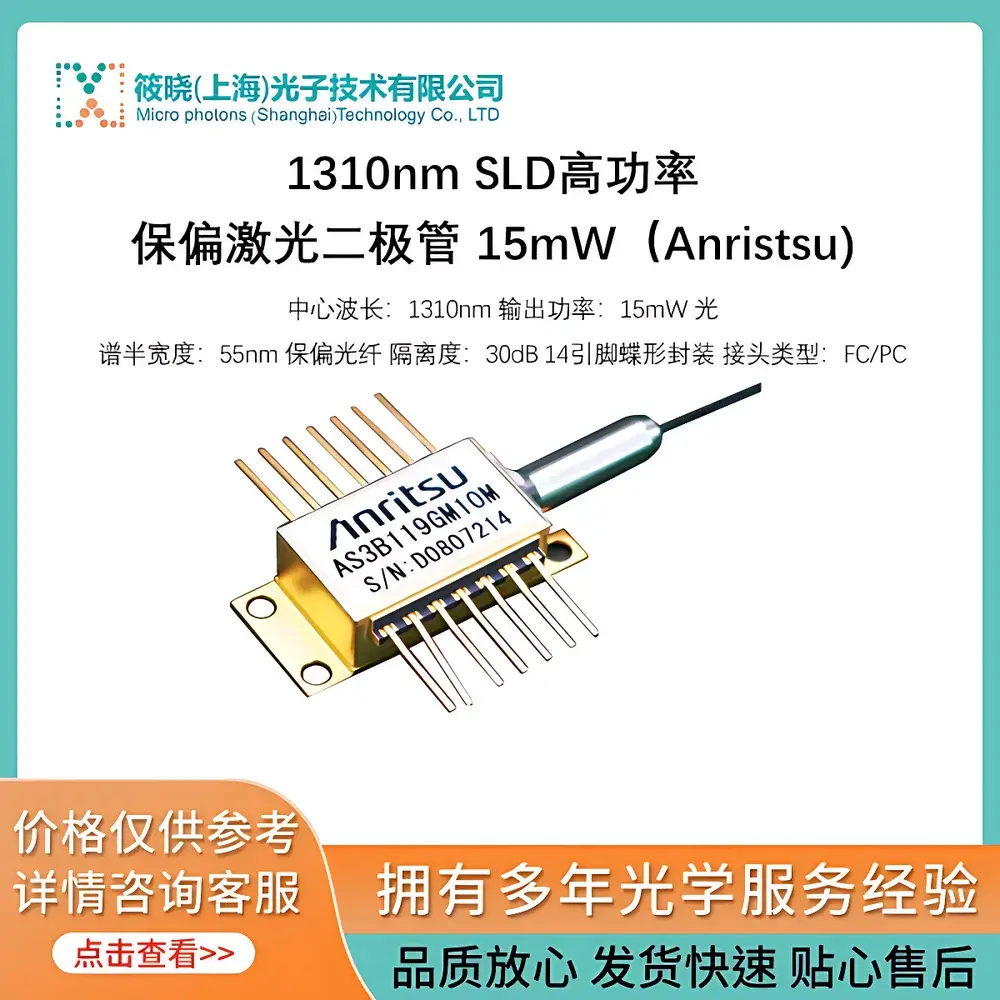
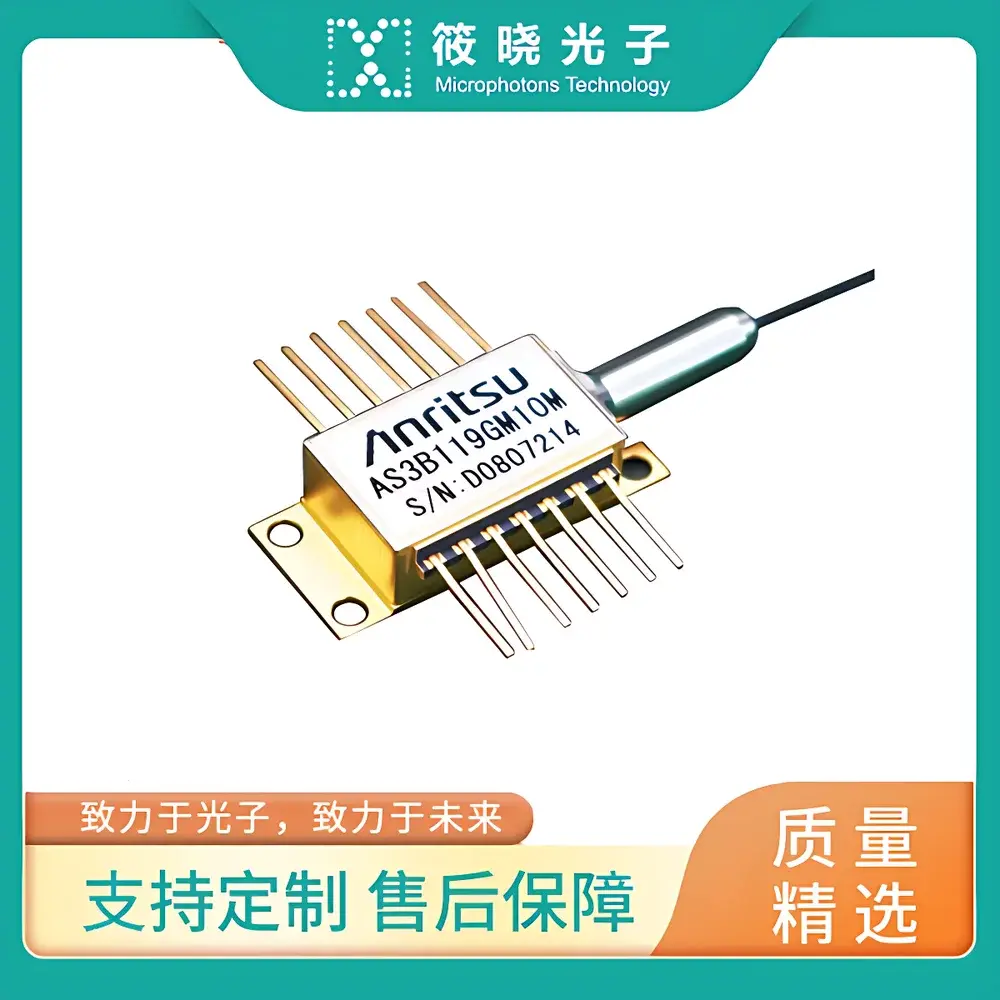
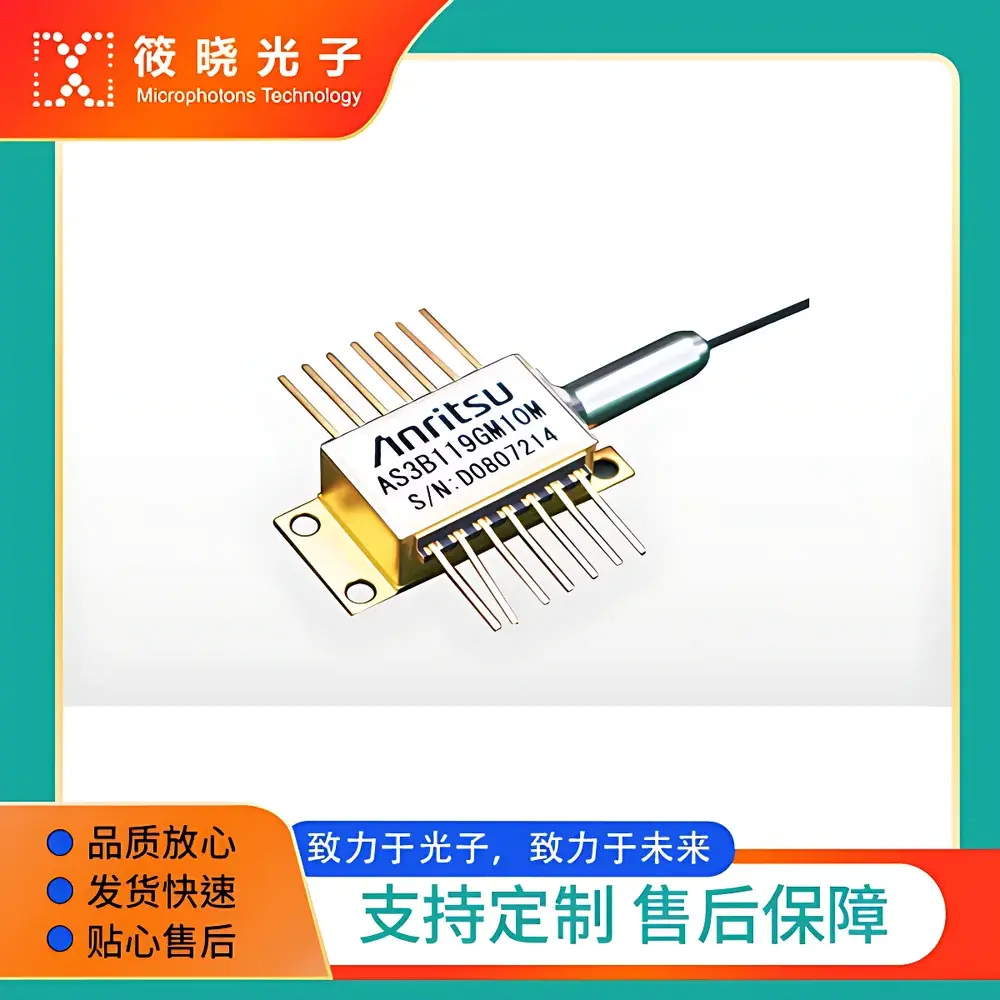
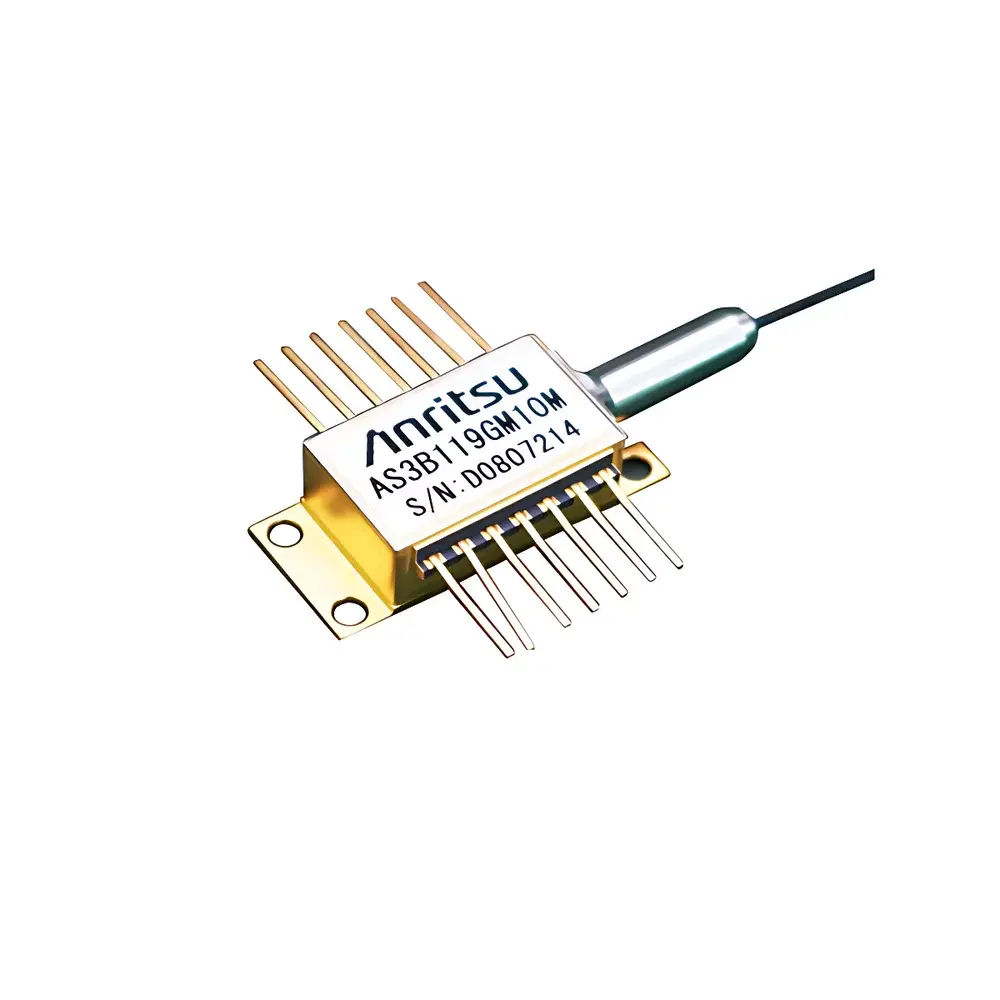
Anritsu AS3B119GM10M 1310 nm High-Power Polarization-Maintaining SLD Source
| Brand | Anritsu |
|---|---|
| Origin | Japan |
| Model | AS3B119GM10M |
| Output Power | 15 mW (typ.) |
| Central Wavelength | 1310 nm |
| Spectral Bandwidth (FWHM) | ~45 nm (typ., standard for SLDs) |
| Polarization Extinction Ratio | ≥20 dB |
| Fiber Pigtail | PMF (Panda-type), FC/APC connector |
| Operating Temperature | 15–35 °C |
| Input Power | +5 V DC, ≤300 mA |
| Lifetime (MTTF) | >50,000 hours |
Overview
The Anritsu AS3B119GM10M is a high-stability, polarization-maintaining superluminescent diode (SLD) source engineered for precision optical coherence tomography (OCT), fiber-optic gyroscopes (FOGs), interferometric sensing, and polarization-sensitive metrology applications. Operating at a center wavelength of 1310 nm—within the low-dispersion, low-loss window of standard single-mode fiber—the device delivers a nominal output power of 15 mW with broad spectral bandwidth (~45 nm FWHM) and high spatial coherence. Unlike laser diodes, SLDs emit amplified spontaneous emission (ASE) with low temporal coherence, eliminating speckle noise and enabling high axial resolution in time-domain and swept-source OCT systems. Its integrated polarization-maintaining (PM) fiber pigtail—typically Panda-type PMF with FC/APC termination—ensures stable linear polarization output (PER ≥20 dB), critical for maintaining signal fidelity in interferometric configurations where polarization drift introduces phase error and measurement uncertainty.
Key Features
- Stable 1310 nm broadband ASE emission optimized for OCT and fiber sensing
- Polarization-maintaining output via integrated Panda-type PM fiber pigtail (FC/APC)
- High output power of 15 mW (typical), supporting long-path interferometry and low-signal detection
- Thermally stabilized TO-can package with integrated thermistor and TEC for wavelength and power stability
- Low relative intensity noise (RIN) < −130 dB/Hz (typ.), essential for high-dynamic-range interferometric measurements
- Compliant with IEC 60825-1:2014 Class 1 laser safety requirements when properly enclosed
- Designed for continuous-wave (CW) operation with robust current and temperature control interface
Sample Compatibility & Compliance
The AS3B119GM10M is compatible with standard SMF-28 and PM1550 fibers and integrates seamlessly into OEM modules requiring 1310 nm broadband illumination. It meets RoHS Directive 2011/65/EU and REACH Regulation (EC) No. 1907/2006 for hazardous substance restrictions. For system-level integration, the device supports compliance with IEC 61300-2-4 (fiber optic connector durability) and IEC 61300-2-1 (vibration testing). When embedded in medical or industrial instrumentation, it contributes to overall system conformity with ISO 13485 (medical devices) and IEC 61000-6-3 (EMC emissions) under appropriate host-level shielding and filtering. Note: Final system-level regulatory certification (e.g., FDA 510(k), CE marking) remains the responsibility of the end-equipment manufacturer.
Software & Data Management
While the AS3B119GM10M operates as a standalone analog-controlled light source, its drive electronics are compatible with industry-standard current and temperature controllers (e.g., Thorlabs LDCxx, ILX Lightwave LDX-3620) offering RS-232, USB, or analog voltage interfaces. Anritsu provides detailed electrical and thermal operating specifications—including bias current vs. output power curves, TEC drive requirements, and thermal derating profiles—in its official datasheet (Rev. D, 2022). For traceable calibration and quality assurance, the device supports GLP-compliant documentation workflows: each unit ships with a factory test report listing measured PER, center wavelength, spectral width, and output power at defined drive conditions. Full audit trails for production batch records and material declarations are available upon request for GMP-regulated integrators.
Applications
- OCT systems: Enables axial resolution of ~15 µm in air (≈11 µm in tissue) for ophthalmic, dermatological, and intravascular imaging
- Fiber-optic gyroscopes: Provides broadband, polarized seed light for minimizing Kerr-effect-induced bias drift in closed-loop FOGs
- Optical component characterization: Used in insertion loss, polarization-dependent loss (PDL), and return loss testing of PM couplers, isolators, and circulators
- Interferometric strain and temperature sensors: Serves as stable broadband source in Michelson, Mach-Zehnder, and Sagnac configurations
- Calibration of spectrometers and wavemeters: Offers known center wavelength and spectral shape traceable to NIST-traceable reference standards
FAQ
What is the typical spectral bandwidth (FWHM) of this SLD?
The AS3B119GM10M exhibits a full-width-at-half-maximum bandwidth of approximately 45 nm centered at 1310 nm, consistent with high-power 1310 nm SLD designs for OCT-grade resolution.
Is the output polarization state guaranteed over temperature and lifetime?
Yes—the integrated Panda PM fiber ensures polarization extinction ratio ≥20 dB across the specified operating temperature range (15–35 °C); long-term PER stability is maintained via hermetic TO-can packaging and controlled drive conditions.
Can this SLD be modulated?
It is designed for CW operation; direct high-speed modulation is not supported due to gain dynamics of the SLD active region. External AOM or EOM modulation is recommended for pulsed or gated applications.
Does Anritsu provide spectral characterization data for individual units?
Yes—each shipped unit includes a factory-measured spectral plot and key parameters (λ₀, Δλ, Pout, PER) in its test report; custom spectral scanning (e.g., via OSA) is available under NDA for volume OEM customers.
What is the recommended drive current and thermal setpoint for rated output?
Typical operating conditions are 180–220 mA forward current and 25 ±0.1 °C TEC setpoint; exact values are unit-specific and provided in the calibration sheet accompanying each device.





