
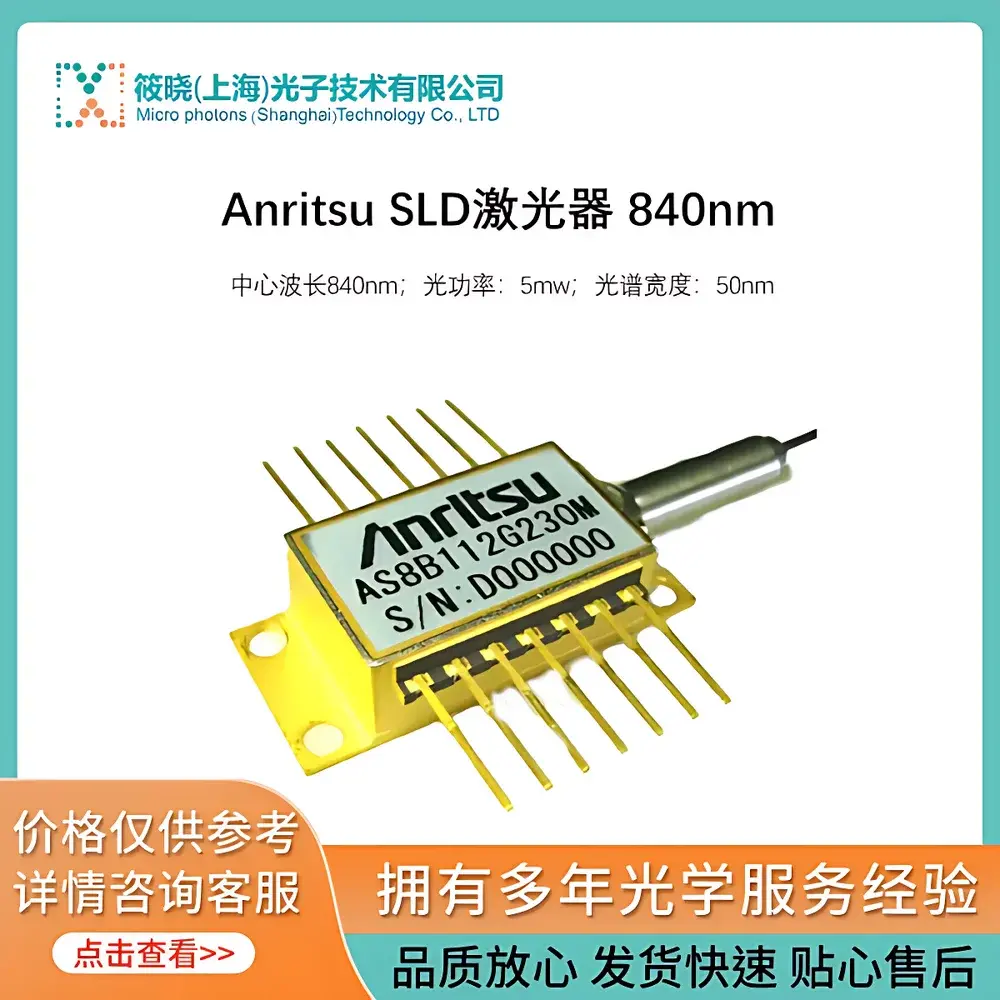
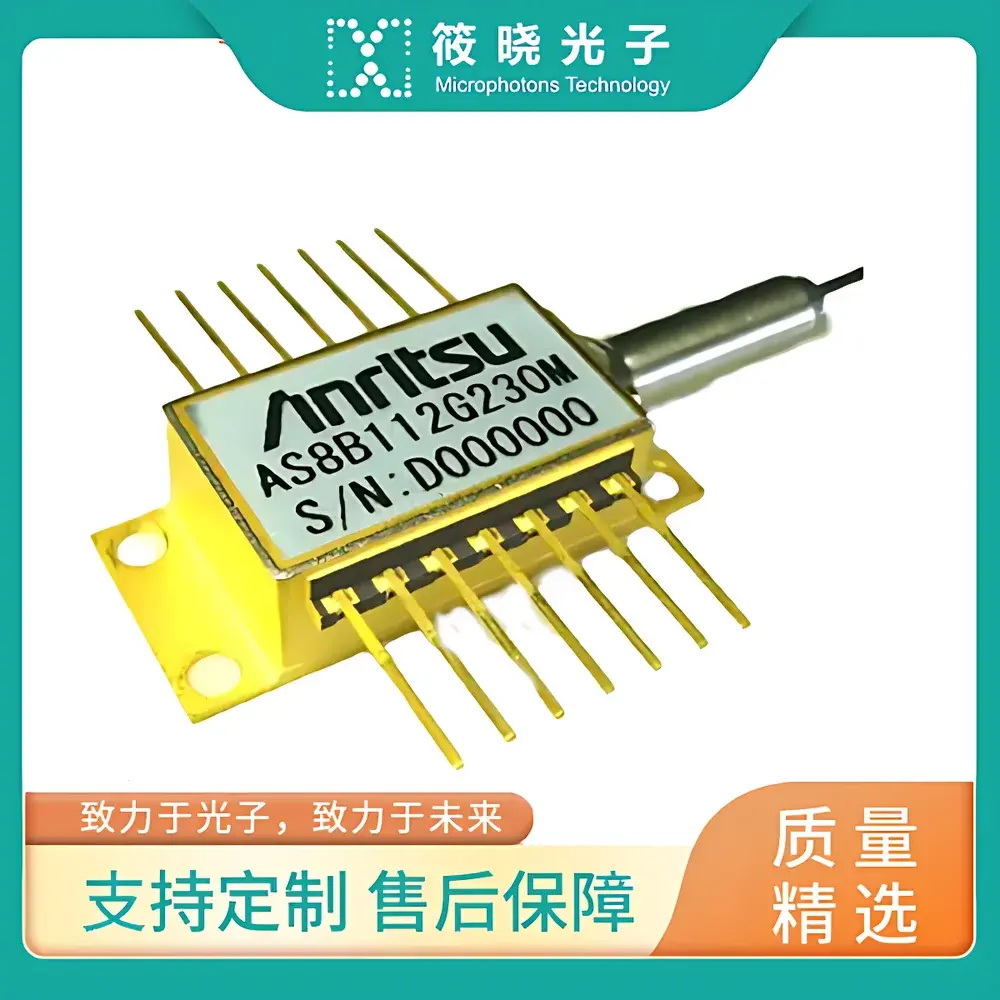
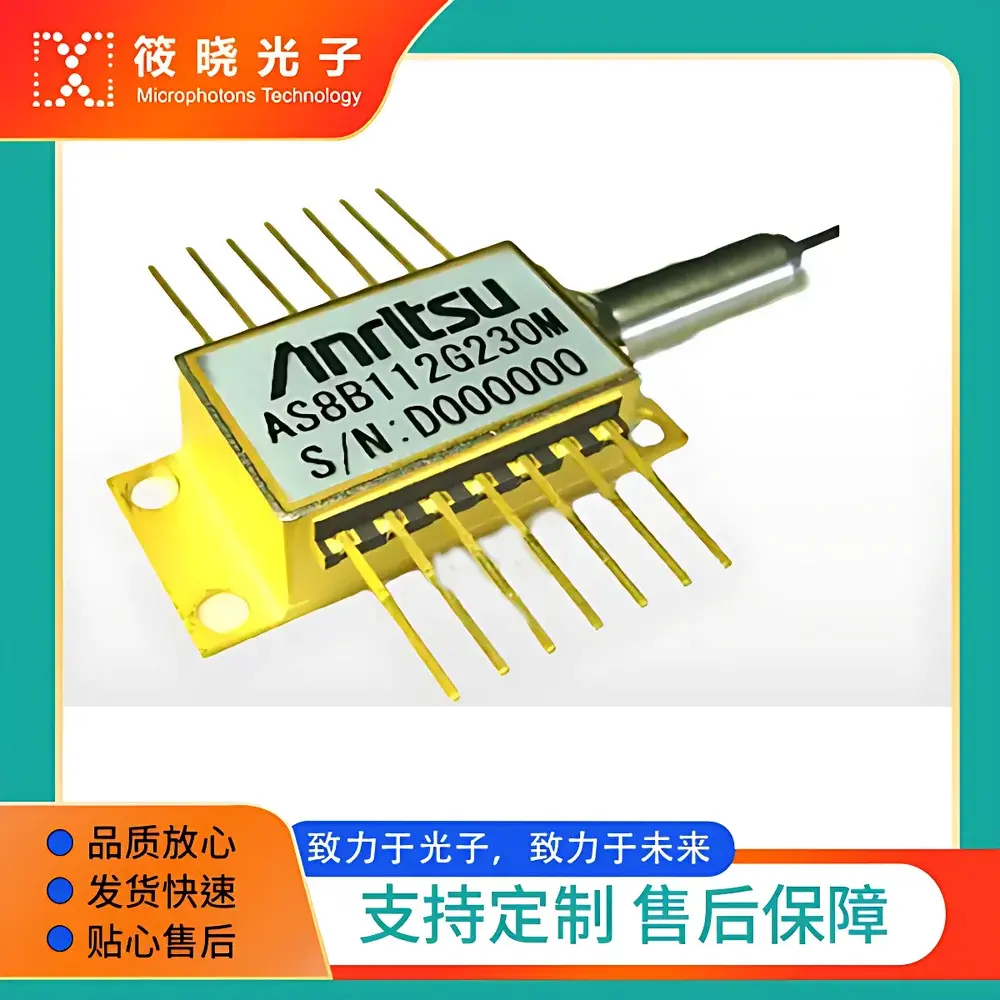
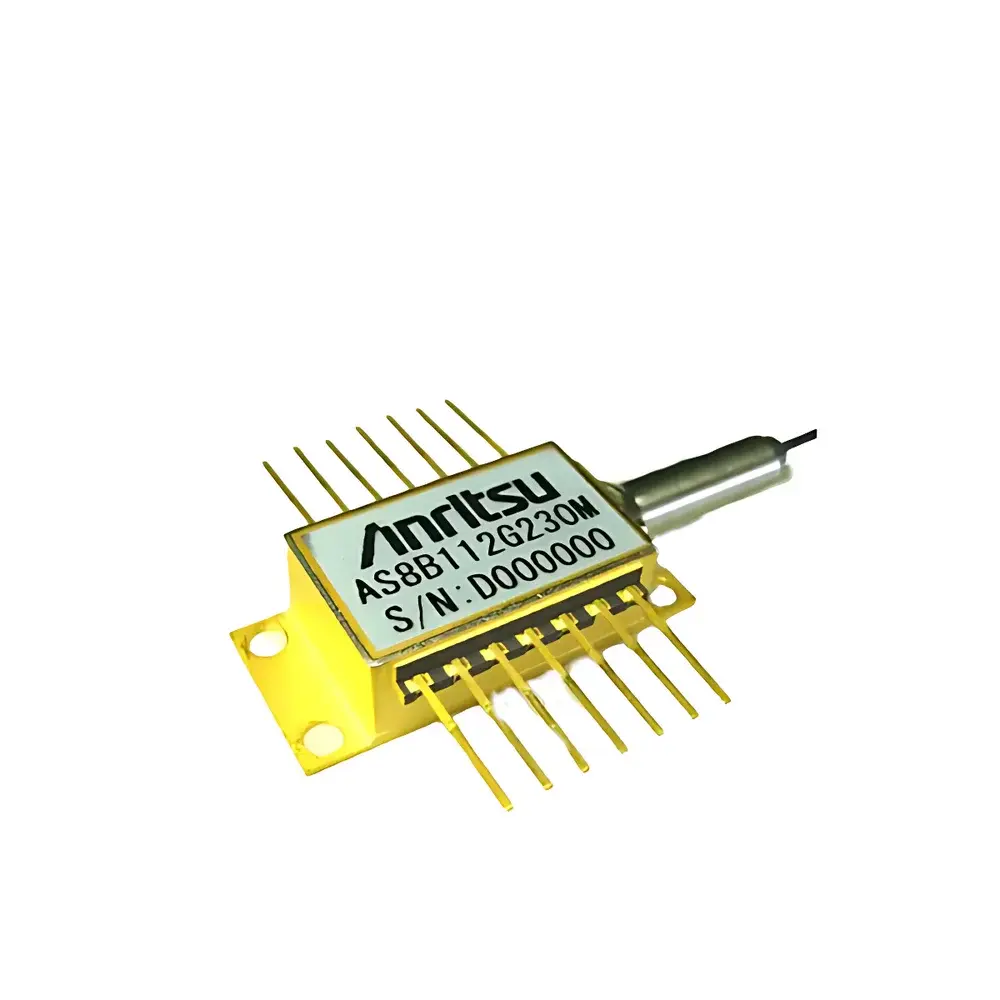
Anritsu AS8B115L240M Superluminescent Diode (SLD) Light Source at 840 nm
| Brand | Anritsu |
|---|---|
| Origin | Japan |
| Model | AS8B115L240M |
| Light Source Type | Superluminescent Diode (SLD) |
| Central Wavelength | 840 nm |
| Output Power | Typical ≥1.5 mW (fiber-coupled, SMF-28) |
| Spectral Bandwidth (FWHM) | ~25 nm |
| Polarization Extinction Ratio | >20 dB |
| Operating Temperature Range | 15–35 °C |
| Warm-up Time | <5 minutes to stable output |
| Fiber Pigtail | SMF-28, FC/PC connector |
| Compliance | CE, RoHS, ISO 9001 manufacturing environment |
Overview
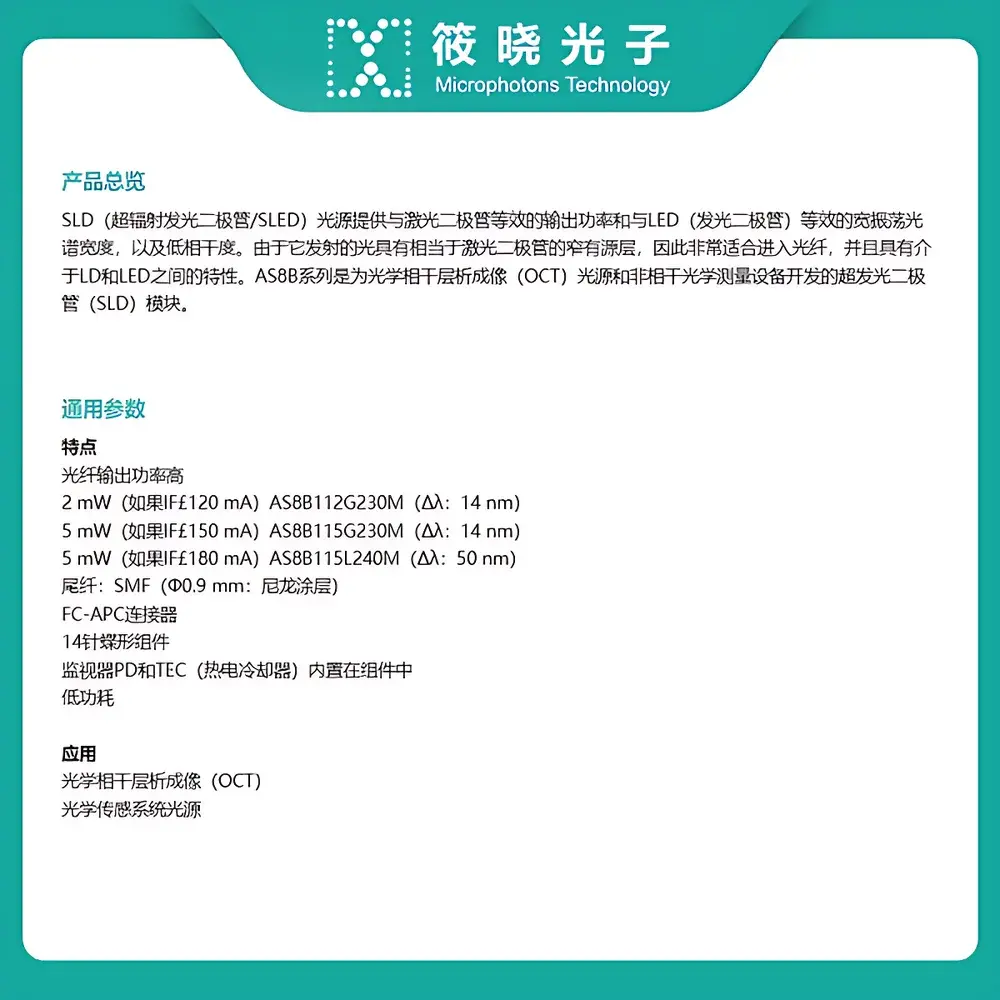
The Anritsu AS8B115L240M is a high-stability, fiber-coupled superluminescent diode (SLD) light source engineered for precision optical coherence tomography (OCT), low-coherence interferometry (LCI), and optical component characterization in research and industrial metrology laboratories. Operating at a center wavelength of 840 nm, this SLD leverages broadband amplified spontaneous emission (ASE) physics—distinct from laser diodes (coherent) and LEDs (incoherent)—to deliver high spatial coherence with low temporal coherence. Its typical spectral bandwidth of 25 nm (FWHM) enables axial resolution better than 15 µm in free-space OCT systems, while maintaining excellent power stability (<±0.5% over 8 hours) and low polarization-dependent loss. Designed and manufactured in Japan under Anritsu’s ISO 9001-certified production processes, the AS8B115L240M integrates a thermoelectric cooler (TEC) and integrated monitor photodiode for closed-loop power regulation, ensuring reproducible performance across variable ambient conditions.
Key Features
- Fiber-pigtailed output with FC/PC connector and SMF-28 single-mode fiber for seamless integration into interferometric and spectral-domain setups
- Integrated TEC and feedback-controlled driver enabling ±0.05 °C temperature stability and <0.2% RMS power fluctuation over 24-hour operation
- High polarization extinction ratio (>20 dB) minimizes polarization-induced signal fading in polarization-sensitive measurements
- Low relative intensity noise (RIN) < −120 dB/Hz (10 kHz–10 MHz), critical for high-dynamic-range OCT signal acquisition
- Compliant with IEC 60825-1:2014 Class 1 laser safety requirements when used with specified fiber termination
- Compact OEM module form factor (70 × 50 × 20 mm) suitable for embedded instrumentation and portable diagnostic platforms
Sample Compatibility & Compliance
The AS8B115L240M is compatible with standard single-mode optical components including circulators, couplers, collimators, and fiber Bragg gratings optimized for the 750–850 nm window. It meets international regulatory standards including CE marking per EU Directive 2014/30/EU (EMC) and 2011/65/EU (RoHS), and conforms to JIS C 61000-6-3 for radiated emissions. While not classified as a medical device under FDA 21 CFR Part 820, its performance specifications align with ISO 13485-aligned quality controls applied during final test and burn-in. The unit supports GLP-compliant calibration traceability via optional factory-issued test report (NIST-traceable power meter verification included upon request).
Software & Data Management
The AS8B115L240M operates as a standalone analog-controlled source but supports digital integration via optional RS-232 or USB-to-TTL interface modules (sold separately). Anritsu provides a Windows-based configuration utility for setting output power level (0–100% full scale), monitoring real-time TEC temperature and photodiode current, and logging operational parameters with timestamped CSV export. All firmware updates and driver packages are distributed through Anritsu’s secure customer portal and comply with data integrity requirements outlined in FDA 21 CFR Part 11 for audit trail generation, electronic signatures, and change control documentation.
Applications
- Ophthalmic and dermatological OCT systems requiring high-resolution, motion-artifact-resistant imaging at 840 nm
- Fiber-optic gyroscopes (FOGs) and interferometric sensor development where low-coherence, high-brightness illumination is essential
- Calibration of spectrometers, wavemeters, and optical spectrum analyzers within the visible-NIR transition band
- Characterization of thin-film interference coatings, MEMS mirrors, and micro-optical elements using white-light interferometry
- Research in quantum optics involving photon-pair generation via spontaneous parametric down-conversion (SPDC) pump sources
FAQ
Is the AS8B115L240M suitable for use in FDA-regulated medical devices?
Yes—while the SLD itself is not an FDA-listed device, its design, manufacturing controls, and test documentation support inclusion in Class II medical imaging systems compliant with IEC 62304 and ISO 14971 risk management frameworks.
What is the expected lifetime under continuous operation?
Rated for >20,000 hours MTBF at 25 °C case temperature and 70% nominal drive current, per Anritsu’s accelerated life testing protocol (JESD22-A108F).
Can the output be modulated externally?
Yes—the bias current input accepts 0–5 V analog modulation signals up to 100 kHz bandwidth; digital TTL modulation is supported via optional interface board.
Does Anritsu provide calibration certificates with NIST traceability?
Standard shipment includes a factory test report; NIST-traceable calibration with uncertainty budget is available as an add-on service (lead time +5 business days).
Is electrostatic discharge (ESD) protection built into the module?
The device incorporates on-board ESD suppression circuits rated to IEC 61000-4-2 Level 4 (±8 kV contact, ±15 kV air), and must remain in original antistatic packaging until installation.




