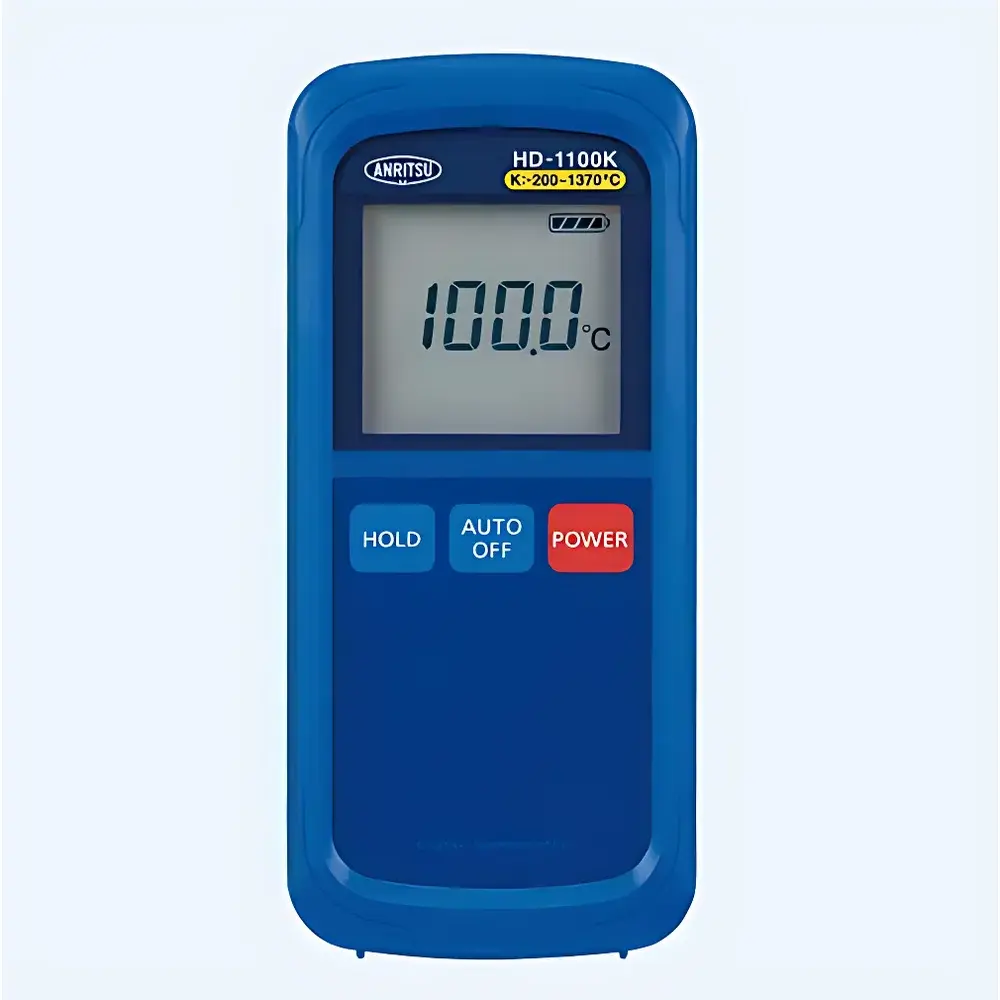
Anritsu Meter HD-1100E / HD-1100K Handheld Thermometer
| Brand | Anritsu Meter |
|---|---|
| Origin | Japan |
| Model | HD-1100E / HD-1100K |
| Measurement Range | E-type: −200 to +800°C |
| K-type | −200 to +1370°C |
| Accuracy | ±(0.05% of reading + 0.2°C) at 0°C (0.1°C resolution range) |
| Resolution | 0.1°C (−104.9 to +504.9°C for both E & K), otherwise 1°C |
| Waterproof Rating | IPX5 |
| Display | Large LCD |
| Power | 4 × AA alkaline batteries (300 h typical life) |
| Data Logging | Up to 9999 records, 9 programmable intervals, manual trigger, playback & PC transfer via AMS-100 software |
| Compliance | CE, RoHS |
| Operating Environment | 0–40°C, 0–80% RH (non-condensing) |
| Dimensions | 76 × 167 × 36 mm (W×H×D) |
| Weight | ~350 g (incl. batteries) |
| Input | Single-channel thermocouple (E or K type), integrated cold-junction compensation, max input resistance 500 Ω |
| Sampling Rate | ~300 ms |
| Linearization | Digital, compliant with IEC 60584-1:2013 |
Overview
The Anritsu Meter HD-1100E / HD-1100K is a precision-engineered handheld thermometer designed for field-deployable and laboratory-adjacent temperature measurement applications requiring traceable accuracy, environmental robustness, and operational flexibility. Based on thermoelectric voltage measurement principles per the Seebeck effect, the instrument supports two industry-standard thermocouple types—E (chromel–constantan) and K (chromel–alumel)—with full digital linearization conforming to IEC 60584-1:2013. Its architecture integrates a high-stability reference junction compensator and uses thermocouple-grade materials in all input terminals to minimize thermal EMF errors at connection points. The device delivers ±(0.05% of reading + 0.2°C) accuracy within its primary 0.1°C resolution range (−104.9°C to +504.9°C), making it suitable for calibration verification, process validation, and quality control tasks where metrological integrity is critical.
Key Features
- Precision thermocouple measurement with automatic cold-junction compensation (CJC) referenced to 25°C ±10°C, achieving ±0.2°C CJC accuracy
- IPX5-rated enclosure for protection against water jets from any direction—validated for use in humid industrial environments, outdoor maintenance, and HVAC commissioning
- Large, high-contrast LCD display with backlight-independent visibility under ambient lighting conditions
- Intelligent resolution management: automatically switches between 0.1°C and 1°C resolution based on measured temperature to maintain optimal signal-to-noise ratio and readability
- Low-power design enabling up to 300 hours of continuous operation on four standard AA alkaline cells
- Dedicated HOLD key for freezing real-time readings during transient measurements or inaccessible probe placements
- Auto-power-off after 5 minutes of inactivity (configurable disable option not available; default safety feature)
- Compact ergonomic form factor (76 × 167 × 36 mm) and lightweight construction (~350 g with batteries) for extended handheld use
Sample Compatibility & Compliance
The HD-1100E/K accepts only standardized E- and K-type thermocouples via its single-channel input connector. Probe compatibility is maintained through adherence to ASTM E230/E230M and IEC 60584-1 specifications for thermocouple EMF output characteristics. No internal RTD or thermistor inputs are supported. The instrument complies with EU directives for electromagnetic compatibility (2014/30/EU) and low-voltage safety (2014/35/EU), evidenced by CE marking and RoHS 2011/65/EU conformity. While not certified to ISO/IEC 17025 or accredited for calibration lab use, it ships with a factory-issued test report traceable to JCSS (Japan Calibration Service System) standards—supporting GLP-aligned documentation requirements in manufacturing and R&D settings. It is not intended for intrinsically safe or hazardous-area deployment.
Software & Data Management
Data acquisition and archival are managed via the optional AMS-100 PC application (Windows-compatible), which enables bidirectional communication over USB-to-serial interface (cable sold separately). The built-in memory stores up to 9999 timestamped records, with user-selectable logging intervals across nine preset options (1 s to 24 h). Manual sampling is supported via front-panel trigger. Stored datasets include temperature value, unit, thermocouple type, timestamp, and measurement status flags. AMS-100 provides CSV export, basic trend visualization, and audit-ready session logs. The system does not implement FDA 21 CFR Part 11 electronic signature or audit trail functionality; therefore, it is classified as a non-GxP data capture tool unless validated in-house per organizational SOPs.
Applications
- Preventive maintenance of motors, bearings, and electrical enclosures in industrial plants
- Validation of sterilization cycles, autoclave chamber uniformity, and oven temperature profiles
- Thermal mapping of HVAC ductwork, refrigeration units, and cleanroom perimeter monitoring
- Field verification of sensor outputs prior to installation or after repair
- Education and vocational training in instrumentation and process control curricula
- Environmental monitoring during equipment commissioning and energy audits
FAQ
What thermocouple types does the HD-1100E/K support?
It supports only E-type (−200°C to +800°C) and K-type (−200°C to +1370°C) thermocouples. No other types (e.g., J, T, S, or N) are compatible.
Is the device suitable for use in wet or outdoor environments?
Yes—the IPX5 rating confirms protection against low-pressure water jets from any angle, making it appropriate for rain-exposed outdoor inspections and damp indoor locations such as boiler rooms or food processing areas.
Does the HD-1100E/K include calibration certification?
Each unit ships with a factory test report showing as-delivered performance at key points across its range, traceable to JCSS-accredited references. Full ISO/IEC 17025 calibration certificates require third-party service.
Can measurement data be exported in machine-readable format?
Yes—AMS-100 software exports logged data as UTF-8 encoded CSV files, compatible with Excel, MATLAB, Python pandas, and LIMS platforms.
What is the effective sampling rate during continuous measurement?
The instrument performs a complete measurement cycle approximately every 300 ms, including cold-junction compensation, linearization, and display update—sufficient for monitoring slow-to-moderate thermal transients.