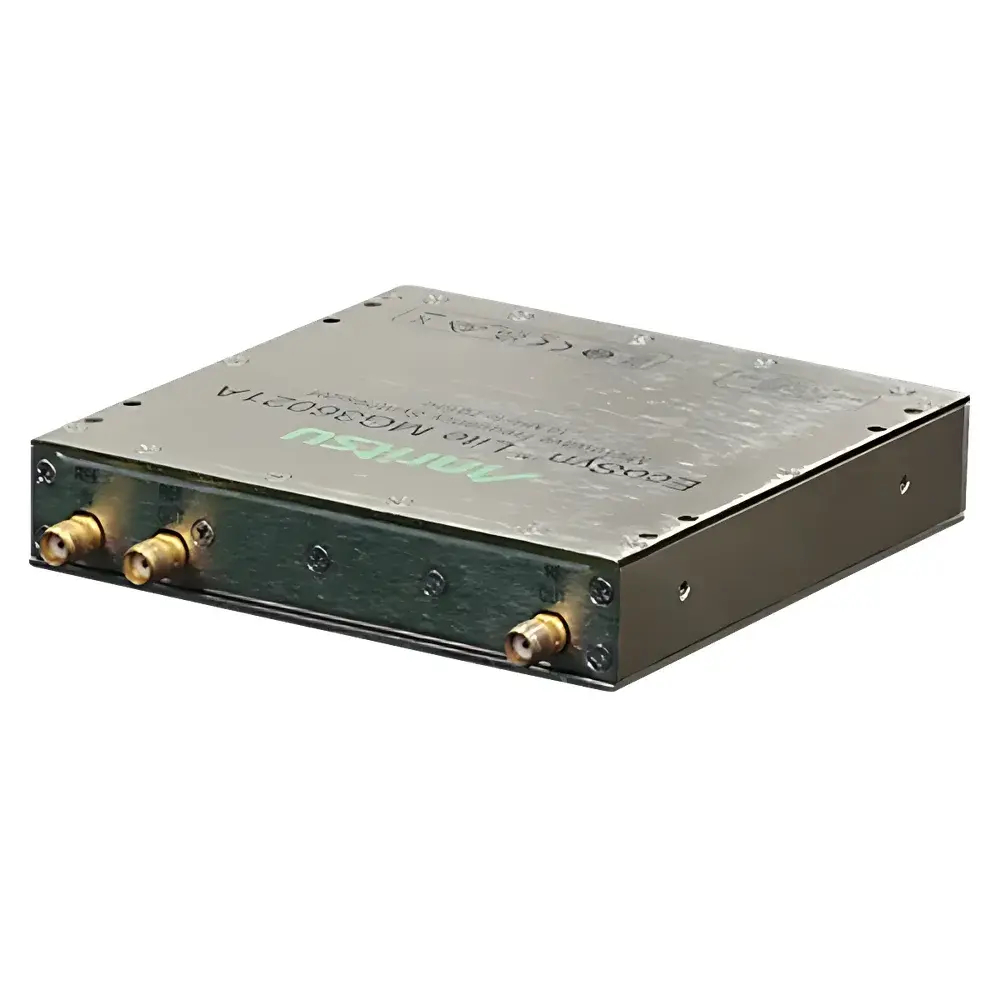
Anritsu MG36021A EcoSyn™ Lite RF/Microwave Frequency Synthesizer Module
| Brand | Anritsu |
|---|---|
| Origin | Japan |
| Model | MG36021A |
| Frequency Range | 10 MHz to 20 GHz |
| Frequency Resolution | 0.001 Hz |
| Phase Noise (typ.) | –126 dBc/Hz at 10 GHz, 10 kHz offset |
| Harmonic Suppression | –10 dBc (nom.) |
| Non-Harmonic Spurious | –60 dBc |
| Frequency Switching Time (list mode) | <50 µs |
| Max Output Power | +18 dBm @ 20 GHz |
| Power Level Accuracy | ±1.5 dB |
| Reference Input/Output | 10 MHz |
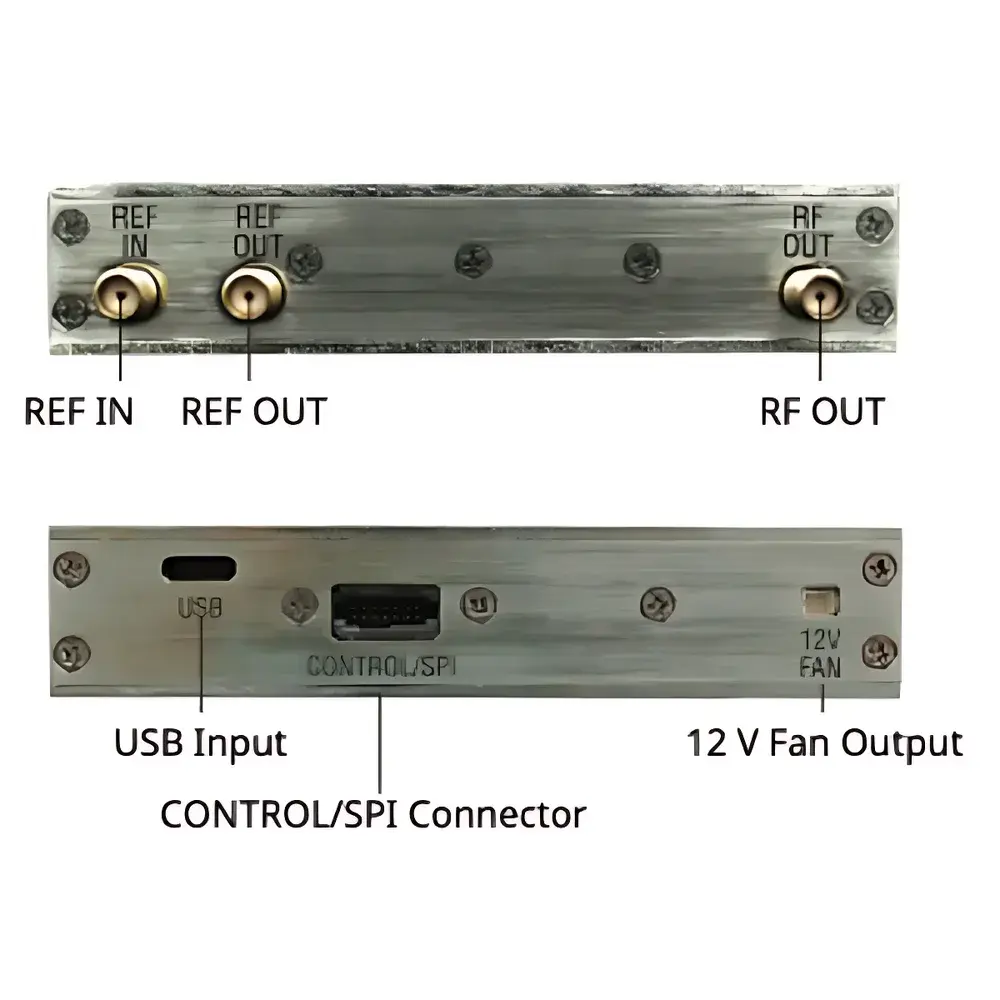
| Supply Voltage | +12 V DC |
| Dimensions | 4 in × 4 in × 0.8 in (101.6 mm × 101.6 mm × 20.3 mm) |
| Control Interfaces | USB 3.0 Type-C, SPI (via CONTROL/SPI connector) |
| RF & Reference Connectors | SMA (REF IN, REF OUT, RF OUT) |
| Thermal Management | Optional external heatsink kit available |
Overview
The Anritsu MG36021A EcoSyn™ Lite RF/Microwave Frequency Synthesizer Module is a compact, high-performance signal generation solution engineered for precision applications in R&D, production test, and embedded system integration. Operating across a continuous frequency range of 10 MHz to 20 GHz, the module implements direct digital synthesis (DDS) augmented by analog PLL-based multiplication and filtering architectures to achieve low-phase-noise CW output with exceptional spectral purity. Its design prioritizes metrological-grade stability, fast reconfiguration, and deterministic timing behavior—making it suitable not only as a standalone stimulus source but also as a core local oscillator (LO) or clock reference within microwave transceivers, ADC/DAC characterization setups, and optical coherent receiver test benches.
Key Features
- Ultra-low phase noise performance: –126 dBc/Hz typical at 10 GHz with 10 kHz offset, meeting stringent requirements for high-order modulation analysis and narrowband receiver testing.
- Sub-50 µs frequency switching in list mode—enabling rapid multi-tone or swept-frequency measurements without compromising measurement throughput.
- Stable output power over full band: +18 dBm maximum at 20 GHz with ±1.5 dB amplitude accuracy, traceable to NIST-calibrated standards via Anritsu’s factory calibration process.
- Compact 4″ × 4″ × 0.8″ form factor compliant with industry-standard Eurocard and modular instrumentation footprints; designed for integration into PXIe, VXI, or custom rack-mounted test systems.
- Flexible control architecture supporting both USB 3.0 (Type-C) and SPI interfaces, enabling seamless integration with LabVIEW, Python-based automation frameworks, and FPGA-hosted control logic.
- Full support for linear, logarithmic, and step-sweep modes—including programmable dwell time, trigger synchronization (TTL/CMOS), and user-defined frequency lists stored in non-volatile memory.
Sample Compatibility & Compliance
The MG36021A is compatible with standard 50 Ω RF environments and supports common laboratory reference signals (10 MHz sine or CMOS-level inputs). It complies with CE, FCC Part 15 Subpart B, and RoHS directives. Its phase noise, spurious, and harmonic specifications align with IEEE Std 1139–2008 definitions for frequency synthesizer performance characterization. For regulated environments—including ISO/IEC 17025-accredited calibration labs—the module supports optional factory calibration certificates with uncertainty budgets traceable to JCSS (Japan Calibration Service System). While not inherently 21 CFR Part 11 compliant as a standalone hardware unit, its USB/SPI interface enables integration into validated software platforms that implement electronic signatures, audit trails, and data integrity controls per GxP requirements.
Software & Data Management
Anritsu provides the free PC-based Synthesizer Control Utility (SCU) for Windows, offering intuitive GUI-based configuration, real-time spectrum monitoring, and script export capabilities (CSV, SCPI command logs). The device natively supports industry-standard SCPI commands (IEEE 488.2), ensuring compatibility with Keysight PathWave, MATLAB Instrument Control Toolbox, and Python libraries such as PyVISA. All internal settings—including sweep parameters, output states, and calibration offsets—are retained in EEPROM and survive power cycling. Firmware updates are delivered via signed binary packages through Anritsu’s secure customer portal, with version rollback capability and SHA-256 hash verification.
Applications
- Production-line testing of RF front-end modules (FEMs), power amplifiers, and mixer assemblies requiring fast, repeatable stimulus generation.
- Portable field diagnostics for satellite communication terminals and radar subsystems where size, weight, and power (SWaP) constraints preclude bench-top instruments.
- LO substitution in vector signal analyzers (VSAs) and vector signal generators (VSGs) to extend dynamic range and reduce phase error in EVM-critical measurements.
- Low-jitter clock injection for gigasample-per-second ADCs, high-speed SerDes PHY validation, and photonic integrated circuit (PIC) testing.
- Multi-channel phase-coherent stimulus generation when deployed in synchronized arrays using external 10 MHz reference distribution and trigger fan-out.
FAQ
Is the MG36021A suitable for use as a local oscillator in millimeter-wave upconversion systems?
Yes—its phase noise floor and harmonic suppression meet LO requirements for Q-band (33–50 GHz) and V-band (50–75 GHz) systems when paired with passive multipliers and appropriate filtering.
Does the module support external amplitude modulation or pulse modulation?
No—the MG36021A is a CW-only synthesizer. Modulation functionality requires external I/Q modulators or dedicated signal generators.
Can multiple units be phase-synchronized?
Yes—using a common 10 MHz reference input and precise trigger alignment, sub-degree phase coherence can be achieved across up to eight synchronized modules.
What thermal management options are recommended for continuous operation at maximum output power?
For sustained +18 dBm output above 15 GHz, Anritsu recommends the optional 2000-2180-R heatsink kit mounted directly to the module’s aluminum baseplate with thermally conductive interface material.
Is factory recalibration required annually?
While not mandated, Anritsu recommends annual verification against traceable standards in mission-critical applications; calibration intervals may be extended based on usage history and environmental conditions per ISO/IEC 17025 Clause 6.5.