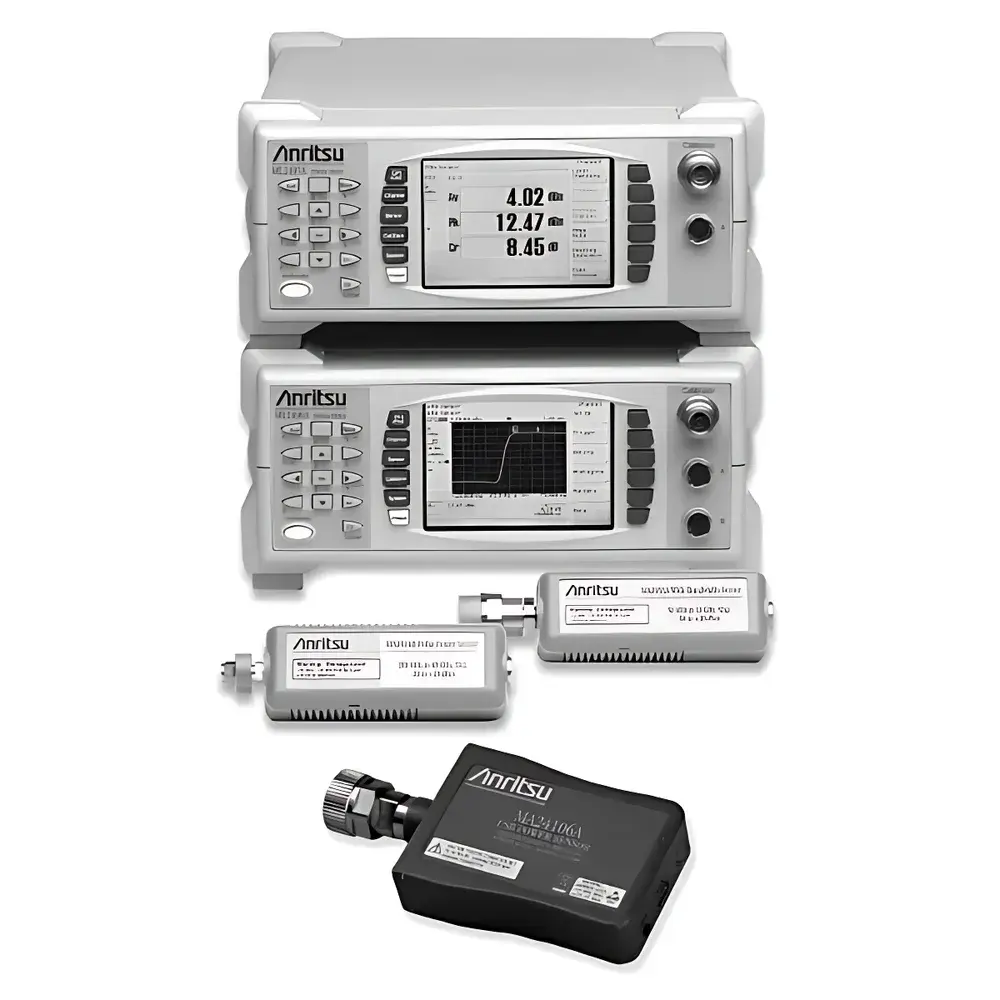
Anritsu ML2490A / ML2480B / ML2430A RF & Microwave Power Meter System
| Brand | Anritsu |
|---|---|
| Origin | Japan |
| Model | ML2490A / ML2480B / ML2430A |
| Frequency Range | Up to 50 GHz |
| Dynamic Range | Up to 90 dB |
| Sensor Modes | CW, Pulsed, Modulated |
| Compatible Software | PowerMax™ (ML2480B/ML2490A), PowerSuite (ML243xA) |
| Interface | Ethernet (PowerMax™), GPIB/RS-232 (PowerSuite) |
| OS Support | Windows XP SP2+ (PowerMax™), Windows 95+ (PowerSuite) |
Overview
The Anritsu ML2490A, ML2480B, and ML2430A series represent a modular, high-performance RF and microwave power measurement system engineered for precision amplitude characterization across diverse signal types. These benchtop power meters operate on the principle of thermoelectric or diode-based RF power detection—calibrated traceably to NIST standards—enabling absolute average power measurement with high linearity, low drift, and excellent temperature stability. Unlike scalar network analyzers or spectrum analyzers, these instruments deliver true RMS-averaged power values without requiring complex signal reconstruction, making them essential for calibration labs, production test environments, and R&D facilities where repeatability and metrological integrity are mandated. The ML2490A series is optimized for fast-rise-time pulsed RF signals (e.g., radar, pulsed amplifiers), supporting rise times down to <10 ns with high temporal resolution. The ML2480B series targets wideband modulated signals—including W-CDMA, LTE, WLAN (802.11ac/ax), and WiMAX—by integrating digital signal processing (DSP) algorithms that compute time-gated and burst-mode power with statistical confidence. The ML2430A series delivers cost-effective, high-speed CW power measurement with sub-millisecond sampling, ideal for amplifier gain flatness verification, oscillator stability monitoring, and basic RF source calibration.
Key Features
- Three-tier architecture: ML2490A (pulse-optimized), ML2480B (wideband modulated), ML2430A (CW-optimized) — enabling application-specific instrument selection without over-specification
- Support for up to seven interchangeable power sensor families, covering DC to 50 GHz with selectable dynamic range (–70 dBm to +20 dBm)
- Real-time pulse profiling capability on ML2490A: peak power, pulse width, duty cycle, and PRF calculation with timestamped waveform capture
- Multi-sensor concurrent measurement support via optional dual-channel firmware upgrade (ML2480B/ML2490A)
- Traceable calibration certificates available per ISO/IEC 17025-accredited laboratories; factory calibration intervals recommended every 12 months
- Rugged industrial-grade chassis with fan-cooled thermal management for extended operation under ambient temperatures up to 40 °C
- Front-panel USB host port for direct data export to flash storage (CSV, TXT, or native .pwr format)
Sample Compatibility & Compliance
The system accommodates a broad range of RF sources and DUTs—from low-noise oscillators and GaN power amplifiers to 5G NR base station transceivers and satellite communication payloads. All sensors comply with IEC 61000-4-3 (radiated immunity) and IEC 61326-1 (EMC for measurement equipment). For regulated industries, the ML2480B and ML2490A models support audit-ready operation when used with PowerMax™ software configured for 21 CFR Part 11 compliance (electronic signatures, user access levels, and immutable audit trails). Calibration documentation satisfies GLP and GMP requirements for pharmaceutical RF heating validation and medical device EMC pre-compliance testing. Sensor interchangeability ensures seamless migration between frequency bands without recalibration overhead, provided the selected sensor’s specified operating envelope matches the DUT’s spectral and modulation characteristics.
Software & Data Management
Two dedicated software suites ensure full functional coverage across the product family. PowerMax™, supplied at no cost with ML2480B and ML2490A units, runs on Windows XP SP2 or later and requires Ethernet connectivity. It provides real-time graphical display of power vs. time, multi-cursor marker analysis, pass/fail limit testing with configurable thresholds, and automated report generation (PDF/CSV). All measurement sessions include embedded metadata (sensor SN, date/time stamp, firmware revision, and calibration due date) for full traceability. PowerSuite, bundled with ML2430A systems, operates via GPIB or RS-232 and supports legacy Windows platforms (95 through 10). It enables live trace visualization, batch data logging, and script-driven automation using SCPI command sets compliant with IEEE 488.2. Both applications support third-party integration via COM/ActiveX interfaces and offer API documentation for LabVIEW, MATLAB, and Python (PyVISA) development.
Applications
- Radar subsystem validation: pulse-to-pulse power consistency, peak envelope power (PEP), and duty-cycle-dependent thermal derating
- 5G FR1/FR2 transceiver testing: ACLR, EVM-correlated power stability, and burst-power timing alignment
- RF component characterization: insertion loss of filters, return loss of antennas, and compression point (P1dB) mapping
- Manufacturing test: go/no-go power screening of MMICs, LNAs, and PA modules in high-throughput ATE environments
- Standards laboratory use: reference-level power transfer between primary standards (thermistor mounts) and working standards (diode sensors)
- Education and training: hands-on demonstration of modulation depth impact on measured average power, crest factor effects, and sensor bandwidth limitations
FAQ
What is the maximum supported sensor frequency for the ML2490A system?
The ML2490A host supports all Anritsu MA24xxx-series sensors rated up to 50 GHz, including the MA24108A (10 MHz–50 GHz) and MA24118A (10 MHz–40 GHz) thermocouple-based sensors.
Can the ML2480B measure OFDM signals with high PAPR?
Yes—the ML2480B employs adaptive averaging and digital crest factor compensation to maintain ±0.15 dB accuracy for signals with PAPR up to 12 dB, as verified per IEEE 1451.4 Annex C procedures.
Is remote programming supported for automated test sequences?
All models support full SCPI command sets over Ethernet (ML2480B/ML2490A) or GPIB/RS-232 (ML2430A), with documented syntax and error-handling protocols aligned with IVI-3.3 specifications.
How often must the power sensors be recalibrated?
Anritsu recommends annual calibration against national standards; however, interval adjustments may be justified per ISO/IEC 17025 Clause 7.7 based on usage intensity, environmental conditions, and internal quality control data.
Does PowerMax™ support multi-user role-based access control?
Yes—when deployed in domain environments with Windows Active Directory integration, PowerMax™ enforces configurable permission tiers (Operator, Technician, Administrator) with session logging and password-protected configuration locks.