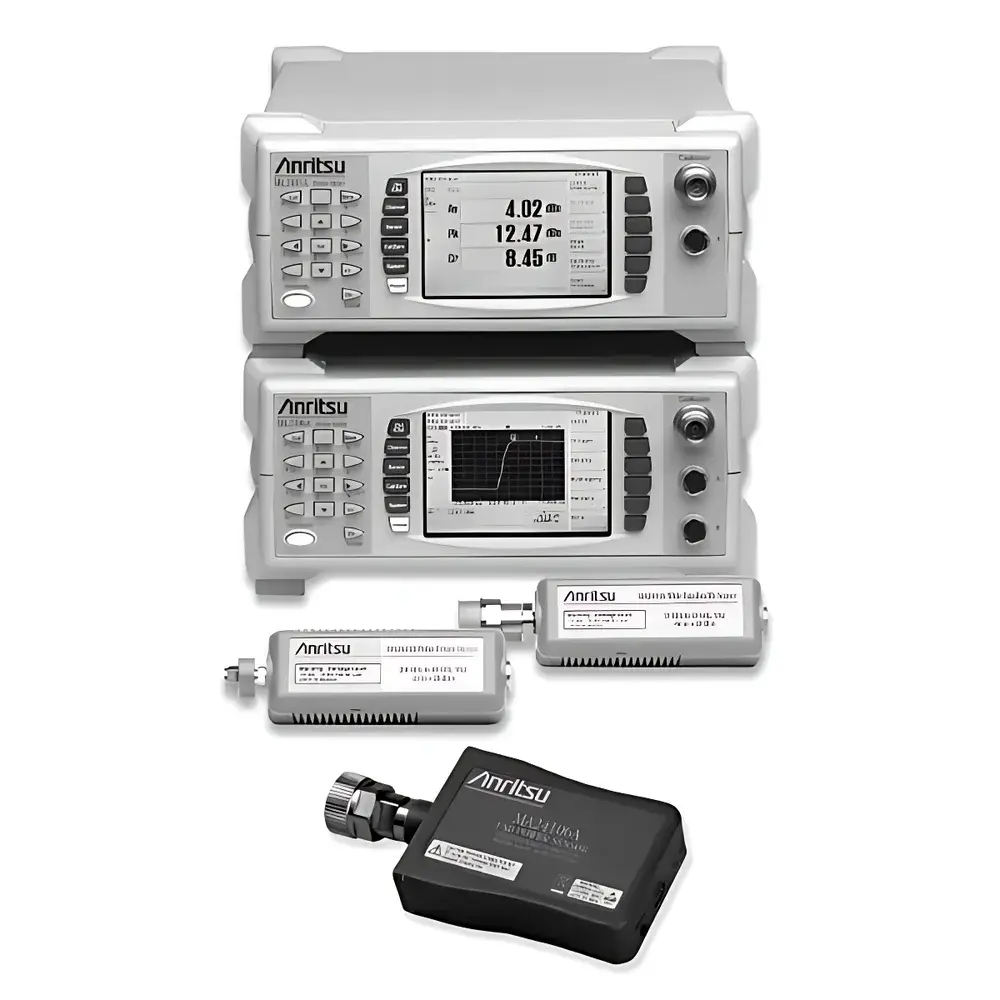
Anritsu ML2490A/ML2480B/ML2430A Series RF & Microwave Power Meters
| Brand | Anritsu |
|---|---|
| Origin | Japan |
| Model | ML2490A (Pulse-Optimized), ML2480B (Broadband Modulated), ML2430A (CW-Optimized) |
| Frequency Range | Up to 50 GHz |
| Dynamic Range | Up to 90 dB |
| Sensor Modes | CW, Pulsed, and Modulated Signal Support |
| Included Software | PowerMax™ (ML2480B/ML2490A), PowerSuite (ML243xA) |
| Interface | Ethernet (ML2480B/ML2490A), GPIB/RS-232 (ML243xA) |
| Compliance | Designed for ISO/IEC 17025 traceable calibration workflows, compatible with GLP/GMP data integrity requirements via audit-trail-capable software logging |
Overview
Anritsu’s ML2490A, ML2480B, and ML2430A series RF & microwave power meters constitute a modular, application-optimized measurement platform engineered for precision RF power quantification across diverse signal types—continuous wave (CW), pulsed radar envelopes, and complex digitally modulated waveforms. These instruments operate on the thermoelectric and diode-based sensor principles, where incident RF energy is converted into a proportional DC voltage or thermal EMF, enabling high-fidelity, wide-dynamic-range power detection without signal distortion. The system architecture separates sensor head and meter unit to minimize thermal drift and electromagnetic interference—critical for metrology-grade repeatability in R&D labs, production test benches, and compliance validation environments. With frequency coverage extending to 50 GHz and dynamic range spanning 90 dB, the platform supports both narrowband pulse profiling (e.g., airborne radar, EW systems) and broadband statistical power analysis (e.g., LTE-Advanced, 5G NR, Wi-Fi 6E).
Key Features
- Three-tier sensor/meter architecture: ML2490A optimized for sub-100 ns rise time pulse power analysis; ML2480B supporting RMS-averaged power measurement of OFDM, CDMA, and QAM-modulated signals; ML2430A delivering cost-effective, high-stability CW measurements.
- Interchangeable sensor heads covering DC–50 GHz, including waveguide, coaxial, and USB-powered variants—each calibrated per ISO/IEC 17025-accredited procedures with NIST-traceable certificates available.
- Dual-mode operation: All ML2480B and ML2490A sensors support simultaneous CW and pulsed mode selection; real-time switching enables comparative analysis of peak, average, and duty-cycle-corrected power within a single acquisition.
- Low-noise analog front-end with 16-bit ADC resolution and programmable integration time (10 µs to 10 s), minimizing quantization error in low-power (12 dB) scenarios.
- Ruggedized industrial enclosure rated IP20, fanless thermal design, and operating temperature range of 0–50 °C—validated for continuous 24/7 deployment in automated test systems.
Sample Compatibility & Compliance
The ML24xx platform accommodates standard 1.0 mm, 1.85 mm, 2.4 mm, 2.92 mm, and N-type coaxial connectors, as well as WR-19 through WR-22 waveguide interfaces—enabling direct coupling to antenna feeds, power amplifiers, circulators, and MMIC modules without external attenuators or couplers in most cases. Sensors are characterized for VSWR <1.25 up to 40 GHz, ensuring minimal mismatch uncertainty (< ±0.05 dB) in impedance-matched systems. For regulatory testing, the platform meets essential requirements of IEC 61000-4-3 (radiated immunity) and CISPR 16-1-1 (EMI receiver compatibility). When used with documented calibration intervals and version-controlled firmware, the system supports audit-ready documentation for ISO 9001, ISO/IEC 17025, and FDA 21 CFR Part 11-compliant environments—particularly when PowerMax™ or PowerSuite log files include timestamped operator ID, instrument serial number, sensor calibration date, and measurement configuration metadata.
Software & Data Management
PowerMax™ (v4.3+) provides native Ethernet-based control of ML2480B and ML2490A units, featuring real-time waveform visualization, marker-based threshold analysis, and programmable trigger logic for gated pulse capture. It supports SCPI command scripting, MATLAB® and LabVIEW® driver integration, and CSV/TDMS export with embedded metadata tags—including sensor model, calibration expiration, and environmental temperature reading from internal thermistor. PowerSuite (v2.8+) serves ML243xA series via GPIB or RS-232, offering time-domain trace logging, statistical histogram generation (for crest factor and PAPR evaluation), and batch file archiving compliant with IEEE 1584-2022 data exchange standards. Both applications enforce user-level access controls, automatic backup of configuration profiles, and tamper-evident log file hashing—meeting ALCOA+ (Attributable, Legible, Contemporaneous, Original, Accurate, Complete, Consistent, Enduring, Available) data integrity criteria.
Applications
- Radar subsystem validation: Pulse width, PRF, and peak-to-average power ratio (PAPR) measurement of L/S/C/X-band T/R modules.
- 5G base station conformance: ACLR, EVM-correlated power stability assessment under 100 MHz OFDMA channel bandwidths.
- Satcom payload testing: High-linearity CW power monitoring of TWTA and SSPA output stages over extended thermal cycles.
- EMC pre-compliance: Radiated emission source characterization using calibrated biconical/log-periodic antennas with known gain factors.
- Component qualification: Insertion loss and return loss verification of isolators, filters, and phase shifters using dual-sensor differential measurement mode.
FAQ
What is the minimum detectable power level for the ML2490A with a MA24108A sensor?
The typical noise floor is –70 dBm (100 pW) at 10 Hz measurement bandwidth, referenced to a 50 Ω system.
Can the ML2480B measure true RMS power of a 256-QAM 5G NR signal with 100 MHz bandwidth?
Yes—when paired with an MA24118B broadband sensor and configured for 100 kHz video bandwidth and 10 ms averaging, it achieves ±0.25 dB RMS accuracy per IEEE 145-2013 Annex C.
Is PowerMax™ validated for 21 CFR Part 11 electronic records?
PowerMax™ v4.3+ includes optional 21 CFR Part 11 module with electronic signatures, audit trail export, and role-based permissions—requires separate validation protocol execution by end-user.
How often must sensors be recalibrated to maintain traceability?
Anritsu recommends annual recalibration against NIST-traceable standards; interval may be extended to 2 years under controlled lab conditions with documented intermediate verification checks.
Do ML2430A meters support external triggering for synchronized multi-instrument setups?
No—ML2430A operates in free-run mode only; synchronization requires external gating via ML2480B/ML2490A models with TTL/CMOS trigger input and output ports.