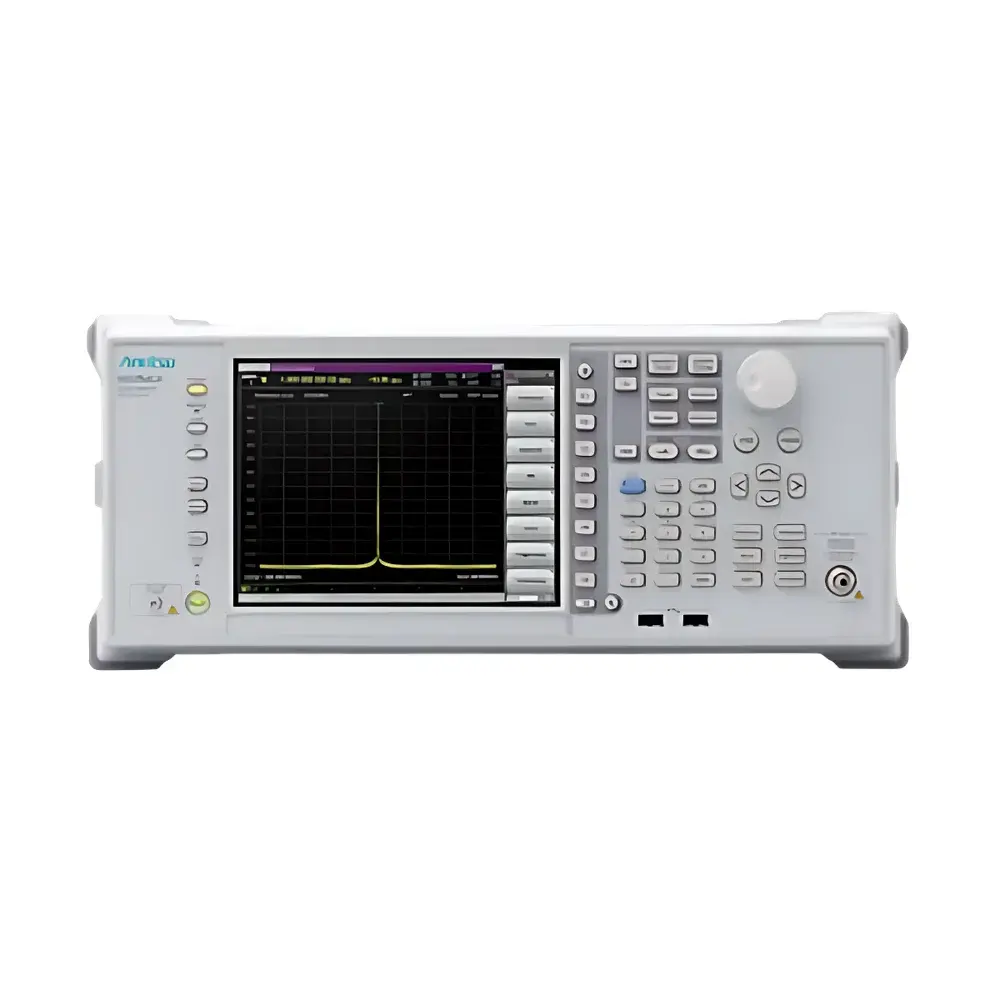
Anritsu MS2840A-041 Spectrum & Signal Analyzer
| Brand | Anritsu |
|---|---|
| Origin | Japan |
| Model | MS2840A-041 |
| Frequency Range | 9 kHz to 6 GHz |
| Phase Noise (1 GHz, 1 kHz offset) | –117 dBc/Hz (nom.) |
| DANL (1 GHz, Preamp OFF) | –153 dBm/Hz |
| RBW | 1 Hz to 31.25 MHz |
| Analysis Bandwidth | Up to 125 MHz (with options) |
| Input Impedance | 50 Ω (N-type female) |
| Operating Temperature | 0°C to +50°C |
| Weight | ≤14.5 kg |
| Power Supply | 100–240 VAC, 50/60 Hz |
Overview
The Anritsu MS2840A-041 is a high-performance benchtop spectrum and signal analyzer engineered for precision RF and microwave measurement in R&D, manufacturing test, and regulatory compliance laboratories. It operates on superheterodyne architecture with dual-mode capability—functioning simultaneously as a real-time spectrum analyzer (RTSA) and a wideband signal analyzer—enabling both spectral occupancy assessment and time-domain modulation analysis. Its 9 kHz to 6 GHz frequency coverage supports characterization of cellular (LTE, 5G NR), Wi-Fi (802.11ac/ax), Bluetooth, IoT, radar, and aerospace communication signals. The instrument employs digital IF processing with 16-bit ADC resolution (≤31.25 MHz bandwidth) and supports optional analysis bandwidths up to 125 MHz—critical for wideband modulation analysis including OFDM, DPD, and pulsed RF. All specifications are validated under traceable calibration conditions: 30-minute warm-up, ambient temperature 18–28°C, and post-CAL verification per Anritsu’s internal metrology protocol.
Key Features
- Integrated dual-mode architecture: seamless switching between spectrum analysis (zero-span, swept, FFT-based) and signal analysis (time-frequency mapping, CCDF, spectrogram, phase vs. time)
- Ultra-low phase noise performance: –117 dBc/Hz at 1 kHz offset from 1 GHz carrier (nominal); enhanced to –122 dBc/Hz with optional MS2840A-066 low-noise local oscillator
- High dynamic range: third-order intercept point (TOI) ≥+16 dBm (300 MHz–4 GHz), enabling accurate intermodulation and spurious emission measurements
- Flexible resolution bandwidth (RBW) selection: 1 Hz–31.25 MHz in standard 1–3–10 sequence; supports CISPR-compliant RBWs (e.g., 200 Hz, 9 kHz, 120 kHz) via MS2840A-016 EMI pre-compliance option
- Low-displayed average noise level (DANL): –153 dBm/Hz at 1 GHz (Preamp OFF); improves to –166 dBm/Hz with optional MS2840A-008 100 kHz–6 GHz preamplifier
- Robust RF front-end: N-type 50 Ω input with VSWR ≤1.5 (4–6 GHz), ±0.5 dB amplitude accuracy (300 kHz–4 GHz), and >100 dB spurious-free dynamic range
- Modular expandability: supports vector signal generation (MS2840A-020/021), rubidium reference clock (MS2840A-001), and extended analysis bandwidths (62.5 MHz / 125 MHz with MS2840A-077/078)
Sample Compatibility & Compliance
The MS2840A-041 is designed for direct connection to 50 Ω RF sources including antennas, amplifiers, filters, mixers, and transceivers. Its input protection circuitry accommodates peak voltages up to ±10 Vdc and average power up to +30 dBm (with ≥10 dB attenuation). The analyzer complies with IEC 61000-4-3 (radiated immunity) and IEC 61326-1 (EMC for laboratory equipment). Optional MS2840A-016 enables CISPR 16-1-1 compliant EMI pre-scan per EN 55032, FCC Part 15, and MIL-STD-461G. For regulated environments, the instrument supports audit-ready operation when paired with Anritsu’s MA89100A software suite—fully compatible with FDA 21 CFR Part 11 requirements for electronic records and signatures, including user access control, electronic signatures, and immutable audit trails.
Software & Data Management
The MS2840A-041 runs on Anritsu’s proprietary Windows Embedded Standard OS and ships with MA89100A Measurement Application Software. This platform provides intuitive GUI-driven workflows for ACP, OBW, SEM, burst power, and channel power measurements—with automated pass/fail reporting against user-defined limits. Raw I/Q data (up to 125 MHz bandwidth) is exportable in .mat, .csv, or .tsv formats for MATLAB®, Python (NumPy), or LabVIEW® post-processing. Remote operation is supported via SCPI over LAN (10/100/1000Base-T), GPIB (IEEE 488.2), or USB 2.0; all interfaces support full command set compatibility with IVI-C and IVI-COM drivers. Firmware updates and configuration backups are managed through secure HTTPS web interface or USB storage—ensuring GLP/GMP traceability and version-controlled instrument setup.
Applications
- 5G NR FR1 transmitter testing: ACLR, EVM, spectrum emission mask validation at 600 MHz–3.8 GHz
- Wi-Fi 6E/7 device development: 160 MHz and 320 MHz channel analysis with real-time spectrogram and occupied bandwidth tracking
- Radar pulse characterization: rise/fall time, PRI, PW, and Doppler shift analysis using zero-span time-domain mode
- EMI pre-compliance screening: CISPR peak/average/RMS detection with auto-limit line overlay and margin reporting
- RF component validation: filter insertion loss, amplifier gain compression (P1dB), and mixer conversion loss
- IoT module certification: conducted spurious emissions testing per ETSI EN 300 328 and FCC §15.247
- Academic and defense research: wideband signal interception, modulation classification, and spectral coexistence studies
FAQ
What is the minimum detectable signal level at 2.4 GHz?
At 2.4 GHz, the displayed average noise level (DANL) is –151 dBm/Hz (Preamp OFF, 0 dB attenuation); with MS2840A-008 preamplifier enabled, sensitivity improves to –164 dBm/Hz.
Does the MS2840A-041 support real-time spectrum analysis?
Yes—it offers real-time FFT processing with 100% probability of intercept (POI) for signals ≥3.8 µs duration when configured with ≥25 MHz analysis bandwidth.
Can it perform EMI measurements without external accessories?
With the optional MS2840A-016 EMI pre-compliance package, it delivers CISPR-compliant detector modes (peak, quasi-peak, average), standardized RBWs, and limit line templates—no external LISN or antennas required for preliminary scans.
Is remote programming supported for automated test systems?
Yes—full SCPI command support over LAN, GPIB, and USB ensures seamless integration into ATE platforms using Python, C#, or LabVIEW.
How is calibration traceability maintained?
All factory calibrations are performed against NIST-traceable standards; users receive a Certificate of Calibration with uncertainty budgets per ISO/IEC 17025 guidelines.