
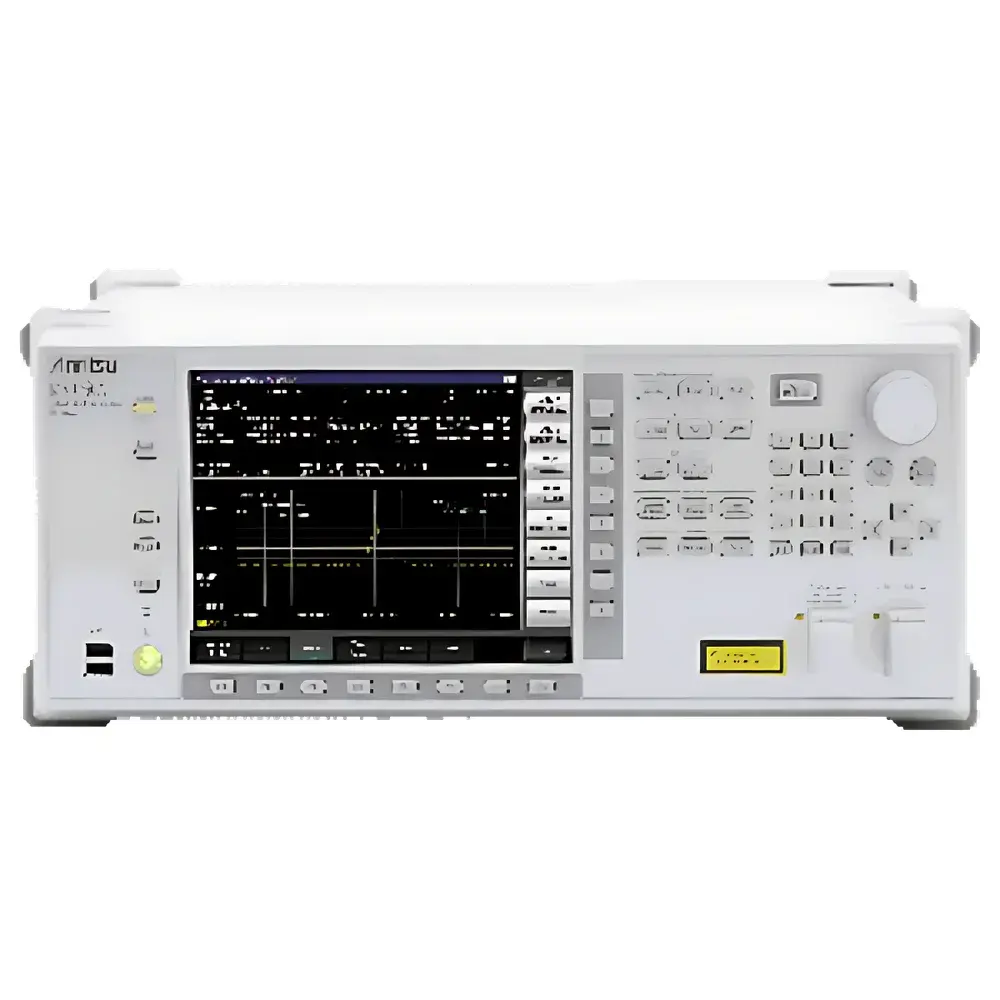
Anritsu MS9740B Fiber Optic Spectrometer
| Brand | Anritsu |
|---|---|
| Origin | Japan |
| Model | MS9740B |
| Wavelength Range | 600–1750 nm |
| Wavelength Accuracy | ±20 pm (1520–1620 nm, RBW 0.03–0.2 nm) / ±100 pm (1520–1620 nm, RBW 0.5/1.0 nm) |
| Wavelength Resolution (RBW) | 0.03 / 0.05 / 0.07 / 0.1 / 0.2 / 0.5 / 1.0 nm (3 dB bandwidth) |
| Dynamic Range | ≥60 dB at 0.4 nm offset from peak |
| Minimum RBW | 30 pm |
| Scan Speed | ≤0.2 s for 5 nm span (RBW 0.1 nm, VBW 10 kHz) |
| Max Input Power | +23 dBm (with optical attenuator enabled) |
| Fiber Compatibility | SMF-28 (9/125 µm, ITU-T G.652), 50/125 µm GI fiber |
| Connector Options | Interchangeable FC, SC, ST, DIN, LC |
| Storage Capacity | Up to 1,000 files or 10,000 spectra |
| Interfaces | Ethernet (standard), GPIB (optional) |
| Dimensions | 426 × 177 × 350 mm (W×H×D, excluding protrusions) |
| Weight | ≤15.0 kg (excluding options) |
| Power Consumption | ≤75 VA |
Overview
The Anritsu MS9740B Fiber Optic Spectrometer is a high-performance, benchtop optical spectrum analyzer engineered for precision characterization of both active and passive photonic components across telecommunications, datacom, and R&D environments. Operating on the principle of diffraction grating-based monochromation with optimized optical path design and thermally stabilized detector arrays, the MS9740B delivers laboratory-grade spectral resolution and repeatability in an industrial-grade platform. Its core architecture supports full-spectrum acquisition from 600 nm to 1750 nm—covering visible, O-, E-, S-, C-, L-, and U-bands—enabling comprehensive analysis of laser diodes, LEDs, EDFAs, WDM filters, arrayed waveguide gratings (AWGs), and tunable transceivers. Designed for integration into automated test systems and production line validation workflows, the instrument meets the stringent demands of optical component qualification under ISO/IEC 17025-accredited laboratories and manufacturing facilities aligned with IEC 61280 and Telcordia GR-468-CORE compliance frameworks.
Key Features
- Ultra-fast spectral acquisition: ≤0.2 seconds for 5 nm span (RBW = 0.1 nm, VBW = 10 kHz), enabling high-throughput device screening and real-time monitoring of transient emission events.
- High-resolution capability: Selectable resolution bandwidths down to 0.03 nm (30 pm), with calibrated accuracy of ±20 pm in the C-band (1520–1620 nm) under optimal RBW settings.
- Extended dynamic range: ≥60 dB suppression at 0.4 nm offset from peak wavelength—critical for accurately resolving side-mode suppression ratio (SMSR) in DFB lasers and evaluating out-of-band rejection in dense WDM filters.
- Flexible fiber interface: Supports interchangeable physical connectors (FC, SC, ST, DIN, LC) and dual-fiber compatibility—single-mode (9/125 µm, ITU-T G.652) and multimode (50/125 µm graded-index)—without recalibration.
- Low operational footprint: Power consumption limited to 75 VA; total mass ≤15.0 kg—optimized for space-constrained lab benches and portable field deployment scenarios.
- Robust data management: Internal memory accommodates up to 1,000 saved measurement files or 10,000 individual spectral traces, with timestamping and metadata tagging per acquisition.
Sample Compatibility & Compliance
The MS9740B is validated for use with standard telecommunication-grade optical fibers and devices operating within Class 1 laser safety limits (IEC 60825-1). It supports direct coupling to TO-can packages, butterfly modules, and pigtailed components via adjustable fiber alignment stages (not included). All spectral calibrations are traceable to NMI-Japan (National Metrology Institute of Japan) reference sources. The instrument conforms to electromagnetic compatibility requirements per CISPR 11 Group 1, Class A, and safety standards IEC 61010-1 for electrical equipment used in measurement, control, and laboratory applications. When operated with optional GPIB or Ethernet interfaces, it supports audit-ready data logging compliant with FDA 21 CFR Part 11 when integrated with validated third-party software platforms.
Software & Data Management
Bundled Anritsu OSASoft application provides dedicated measurement modes—including laser SMSR analysis, EDFA gain/ripple profiling, WDM channel power uniformity, and pulse spectrum deconvolution for modulated sources. Raw spectral data exports in CSV, SPC, and XML formats support interoperability with MATLAB, Python (NumPy/Pandas), and LabVIEW-based automation frameworks. Remote control via SCPI commands over TCP/IP or GPIB enables seamless integration into manufacturing execution systems (MES) and statistical process control (SPC) dashboards. Firmware updates are delivered through secure HTTPS channels, with version history and cryptographic signature verification embedded in the update protocol.
Applications
- Characterization of DFB, FP, and VCSEL lasers: threshold current, lasing wavelength, linewidth estimation (via RBW sweep), and mode stability under temperature/voltage sweep.
- Passive component testing: insertion loss, return loss, and passband shape of isolators, circulators, couplers, and thin-film filters.
- WDM system validation: channel spacing verification, adjacent/non-adjacent crosstalk, and composite signal spectral flatness across multi-channel transmitters.
- EDFA and Raman amplifier evaluation: small-signal gain, noise figure (via source-substitution method), and gain tilt compensation assessment.
- Pulsed and modulated source analysis: time-averaged spectral envelope measurement of directly modulated lasers (DMLs) and externally modulated signals (e.g., QPSK, 16-QAM).
FAQ
What fiber types and connectors are supported?
The MS9740B accepts single-mode (ITU-T G.652, 9/125 µm) and multimode (50/125 µm GI) fibers via user-replaceable adapters for FC, SC, ST, DIN, and LC connectors.
Is wavelength calibration traceable to national standards?
Yes—factory calibration is traceable to NMI-Japan reference lasers, and users may perform field recalibration using certified wavelength references (e.g., gas absorption cells or stabilized Fabry–Pérot etalons).
Can the MS9740B measure optical signal-to-noise ratio (OSNR)?
While not a dedicated OSNR meter, the instrument’s high dynamic range and fine RBW settings enable accurate in-band noise floor estimation for C-band signals when combined with appropriate averaging and noise-bandwidth correction algorithms.
Does the unit support remote programming in automated test environments?
Yes—full SCPI command set is available over Ethernet (TCP/IP port 5025) and optional GPIB, supporting integration with Keysight PathWave, National Instruments TestStand, and custom Python-based test sequencers.
What environmental conditions are required for specified performance?
Optimal wavelength accuracy and dynamic range are guaranteed at 20–30 °C ambient temperature with <±1 °C/hour drift; operation outside this range requires thermal stabilization or periodic recalibration.





