
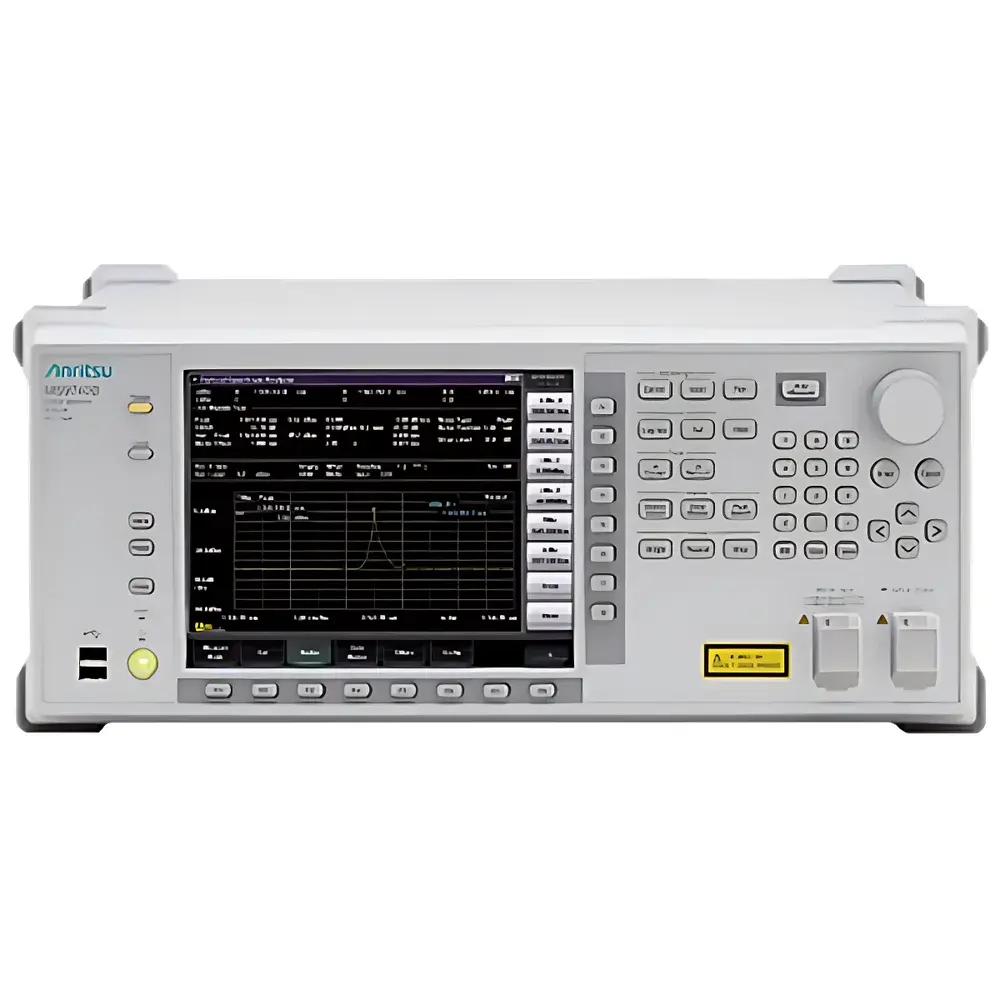
Anritsu MS9740B High-Performance Optical Spectrum Analyzer
| Brand | Anritsu |
|---|---|
| Model | MS9740B |
| Wavelength Range | 600 nm – 1750 nm |
| Wavelength Accuracy | ±20 pm (C/L-band, with calibration source) |
| Resolution Bandwidth | 0.03 nm – 1.0 nm (selectable) |
| Dynamic Range | >58 dB (at ±0.4 nm from peak, 0.05 nm RBW) |
| Sensitivity | –90 dBm |
| Minimum Resolution | 30 pm |
| SMSR Measurement Limit | ≥45 dB |
| SMSR Reproducibility | ±1.4 dB |
| Scan Speed | ≤0.2 s (5 nm span, 0.1 nm RBW) |
| Input Fiber Compatibility | SMF, MMF (50/125 µm, 62.5/125 µm) |
| Connector Types | FC, SC, ST, DIN (LC via adapter) |
| Max Input Power | +23 dBm (with attenuator) |
Overview
The Anritsu MS9740B is a high-resolution, high-dynamic-range optical spectrum analyzer engineered for precision spectral characterization in photonic device manufacturing and R&D environments. It operates on the principle of diffraction grating-based monochromator architecture with real-time signal processing, enabling accurate measurement of optical power distribution as a function of wavelength across an ultra-broad spectral range—from 600 nm to 1750 nm. This coverage spans the full visible, near-infrared, and telecom C+L bands, making it suitable for comprehensive analysis of laser diodes, broadband sources, WDM systems, optical amplifiers, and passive components. Its design emphasizes metrological stability under production-floor conditions: temperature-compensated wavelength calibration, noise-floor estimation via adaptive noise-fitting algorithms, and robust optical alignment routines ensure traceable, repeatable results across shifts and operators.
Key Features
- Ultra-fast wavelength scanning: ≤0.2 seconds for a 5 nm span at 0.1 nm resolution—optimized for inline process monitoring in LD module and transceiver assembly lines.
- High dynamic range performance: up to 70 dB at ±1 nm offset from peak (0.05 nm RBW), supporting accurate suppression ratio evaluation for DFB and DBR lasers.
- Precision wavelength metrology: ±20 pm accuracy in the C/L band when used with certified wavelength calibration sources; supported by automated wavelength and effective resolution calibration functions.
- Dual-fiber mode operation: seamless switching between single-mode (SMF-28) and multimode (50/125 µm or 62.5/125 µm) configurations without hardware reconfiguration—enabled by integrated optical path optimization.
- Advanced signal handling: built-in signal-level integration for modulated optical signals; support for both continuous-wave and pulsed source analysis under standardized averaging protocols.
- Comprehensive noise analysis: proprietary noise-fitting algorithm enables precise baseline subtraction and SNR estimation, critical for low-power EDFA ASE and filter edge characterization.
- Modular application framework: nine preconfigured measurement menus—including LD module diagnostics, WDM channel power & spacing, PMD-related spectral ripple analysis, and optical filter passband profiling—reduce operator training time and minimize setup errors.
Sample Compatibility & Compliance
The MS9740B accepts input via industry-standard physical connectors (FC, SC, ST, DIN), with LC compatibility achieved using optional adapters. It supports both PC- and APC-polished fiber interfaces and accommodates standard telecom-grade single-mode fiber (ITU-T G.652.D) as well as graded-index multimode fibers (OM2/OM3). All optical paths are designed to meet IEC 61300-3-35 (fiber optic connector endface geometry) and Telcordia GR-1209-CORE (optical test equipment reliability) requirements. The instrument’s firmware implements audit-trail logging per FDA 21 CFR Part 11 guidelines when operated in regulated environments, and its calibration procedures align with ISO/IEC 17025–accredited laboratory practices for optical metrology.
Software & Data Management
Controlled via Anritsu’s proprietary OSA Master software (Windows-based), the MS9740B supports automated report generation compliant with GLP/GMP documentation standards—including timestamped measurement records, operator ID tagging, and digital signature fields. Raw spectral data is exportable in CSV, SDF, and XML formats for integration into statistical process control (SPC) platforms or MATLAB-based custom analysis workflows. Remote operation is enabled through TCP/IP and GPIB interfaces, allowing synchronization with wafer probers, automated test equipment (ATE), and MES systems. Firmware updates maintain backward compatibility with legacy .sdf files and preserve user-defined parameter sets across versions.
Applications
- Spectral analysis of single-mode and multimode laser diodes (FP, DFB, VCSEL), including threshold current mapping, side-mode suppression ratio (SMSR), and wavelength drift under thermal stress.
- Characterization of broadband light sources (ASE, SLEDs, supercontinuum) for flatness, ripple, and coherence length estimation.
- WDM system validation: channel power uniformity, center wavelength deviation, adjacent-channel isolation, and OSNR estimation using in-band noise interpolation.
- EDFA gain profile measurement, noise figure derivation, and gain tilt analysis across the C+L band.
- Optical filter evaluation: passband width (3 dB/20 dB), stopband rejection, group delay ripple, and polarization-dependent loss (PDL) via polarization-scanned sweeps.
- Fiber component testing: dispersion-compensating module (DCM) spectral response, FBG reflectivity profiles, and microresonator resonance linewidth quantification.
FAQ
What is the minimum resolvable wavelength separation (resolution limit) of the MS9740B?
The instrument achieves a nominal optical resolution of 30 pm (0.03 nm at 1550 nm) under specified conditions—room temperature, C-band operation, and optimized signal-to-noise ratio. Actual resolution depends on selected RBW setting, input power level, and detector integration time.
Does the MS9740B support compliance with regulatory standards for quality-controlled manufacturing?
Yes. When configured with audit-trail-enabled firmware and operated with calibrated reference sources, it satisfies traceability requirements under ISO 9001, IATF 16949, and FDA 21 CFR Part 11 for electronic records and signatures in medical or telecom device production.
Can the MS9740B measure modulated optical signals, such as those from directly modulated lasers?
Yes. Its signal-level integration function allows stable spectral acquisition of intensity-modulated signals, provided modulation frequency falls within the analyzer’s video bandwidth (up to 10 kHz default, extendable via optional VBW modules).
Is external wavelength calibration required for routine use?
While factory calibration ensures initial accuracy, periodic verification using NIST-traceable HeNe or Hg/Ar lamp sources—or Anritsu’s optional C/L-band calibration kit—is recommended every 6 months or after environmental shock to maintain ±20 pm specification in telecom bands.
How does the MS9740B handle multimode fiber measurements without modal noise artifacts?
The instrument incorporates mode scrambler-compatible input optics and applies spatial averaging algorithms during sweep acquisition. For OM3/OM4 fibers, users select the MMF-optimized measurement mode, which applies empirical mode-field correction factors derived from ITU-T G.651.1 and TIA-455-220A standards.






