
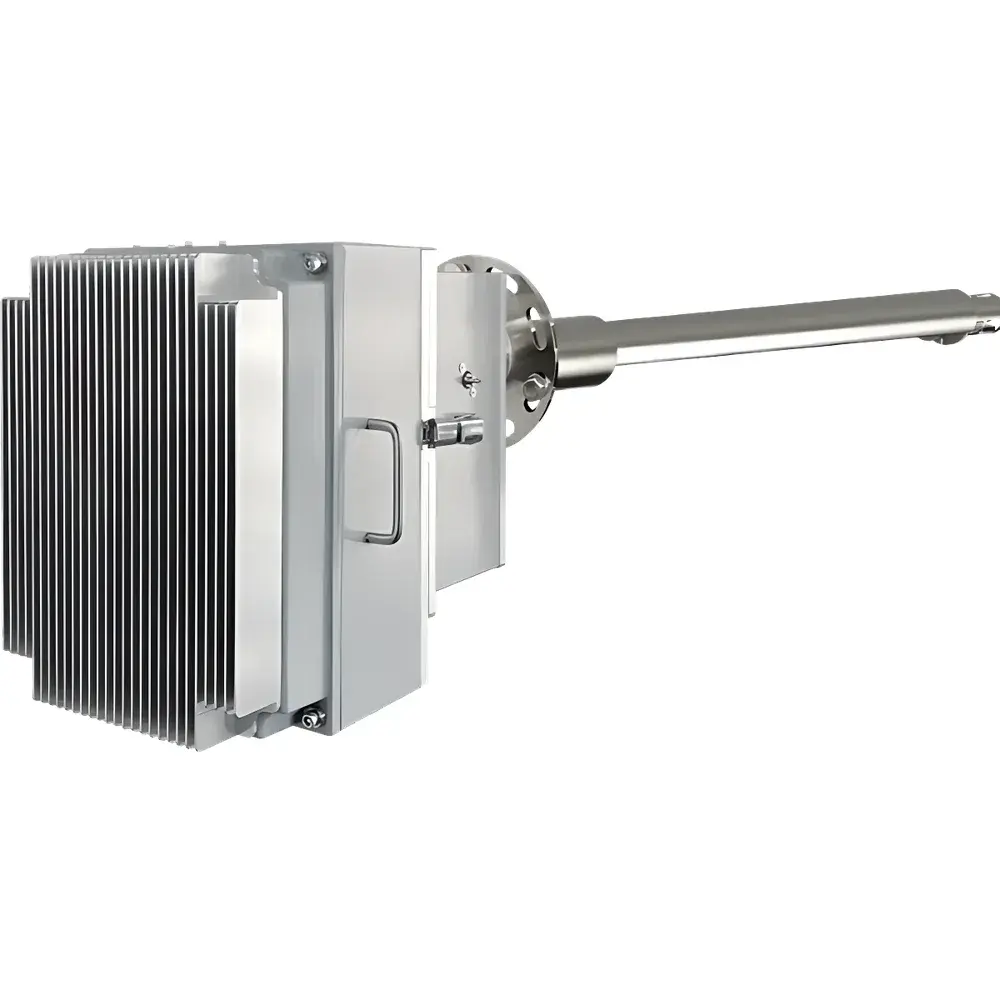
AnronX AGA800 In-Situ UV-DOAS Gas Analyzer for SO₂ and NOₓ
| Brand | AnronX |
|---|---|
| Origin | Jiangsu, China |
| Model | AGA800 |
| Measurement Principle | Ultraviolet Differential Optical Absorption Spectroscopy (UV-DOAS) |
| Installation Type | In-situ probe-mounted |
| Response Time | ≤8 s |
| Operating Temperature (Probe) | Up to 400 °C (heated optical path) |
| Target Gases | SO₂, NO, NO₂ (total NOₓ) |
| Calibration | Automated in-situ optical zero/span correction |
| Compliance Context | Designed for continuous emission monitoring systems (CEMS) per HJ 75-2017 & HJ 76-2017 (China), compatible with ISO 12039, EN 15267, and EPA Method 6C/7E requirements |
Overview
The AnronX AGA800 is an in-situ ultraviolet differential optical absorption spectroscopy (UV-DOAS) gas analyzer engineered for real-time, direct measurement of sulfur dioxide (SO₂) and nitrogen oxides (NOₓ — including NO and NO₂) within industrial flue gas streams. Unlike extractive CEMS configurations that require sample conditioning, transport lines, and dilution or cooling stages, the AGA800 deploys a robust optical probe directly into the stack or duct. Its dual-beam UV light path traverses the process gas at ambient temperature and pressure, enabling quantitative spectral analysis without physical sampling. This architecture eliminates condensation-related analyte loss—particularly critical for water-soluble gases such as SO₂ and NO₂—and mitigates errors induced by catalytic conversion, adsorption, or thermal decomposition in heated sample lines. The system is purpose-built for high-dust, high-moisture, and high-temperature environments typical of coal-fired power plants, waste incinerators, and cement kilns, supporting uninterrupted operation under flue gas temperatures up to 400 °C via fully heated optical windows and beam paths.
Key Features
- In-situ optical measurement with ≤8-second system response time—achieved through integrated light source, collimating optics, and high-sensitivity CCD spectrometer mounted directly on the probe assembly.
- Adaptive range-switching algorithm dynamically selects optimal spectral fitting windows and integration times based on real-time gas concentration levels, delivering high linearity across wide dynamic ranges (e.g., 0–500 mg/m³ and 0–2000 mg/m³ for NOₓ).
- Automated optical calibration subsystem performs periodic zero-reference (N₂ purge or spectral baseline interpolation) and span verification using built-in reference cells or stable LED-based spectral markers—eliminating manual intervention and reducing drift to <±1.5% FS/year.
- Heated optical path maintained at up to 400 °C prevents dew point crossing and ammonium salt deposition, ensuring mechanical integrity and chemical fidelity during SCR/SNCR ammonia injection operations.
- Robust mechanical design conforms to IP66 ingress protection and meets seismic qualification per IEC 60068-2-6 for installation on steel stacks and ductwork without external support frames.
Sample Compatibility & Compliance
The AGA800 operates without gas extraction, thereby preserving stoichiometric integrity of reactive species and avoiding artifacts from heterogeneous reactions on tubing surfaces. It is validated for use in flue gases containing particulate loadings up to 50 g/Nm³, moisture content up to 25 vol%, and H₂S concentrations ≤100 ppm. Regulatory alignment includes conformance with Chinese national standards HJ 75-2017 (CEMS technical specification) and HJ 76-2017 (performance testing methods), as well as functional equivalence to EN 15267-3 (QAL1 certification framework) and ISO 12039 (stationary source emissions — determination of SO₂ and NOₓ). Data output supports 4–20 mA analog channels and Modbus TCP/RTU protocols, enabling seamless integration into DCS and third-party CEMS data acquisition systems compliant with GB/T 16886 and ISO/IEC 17025 traceability requirements.
Software & Data Management
Embedded firmware provides local spectral acquisition, real-time DOAS fitting (using least-squares deconvolution of cross-section libraries for SO₂, NO, NO₂, H₂O, O₃, and aromatic interferences), and automatic interference compensation. The web-based configuration interface supports remote diagnostics, spectral quality flagging (e.g., low SNR, window fouling detection), and audit-trail logging per GLP principles. Raw spectra and processed concentration time-series are exportable in CSV/NetCDF formats. Optional OPC UA server module enables secure, timestamped data publishing to enterprise MES or environmental compliance platforms, with configurable alarm thresholds and event-triggered reporting aligned with ISO 50001 energy management workflows.
Applications
- Continuous emission monitoring (CEM) of SO₂ and NOₓ at coal-, biomass-, and waste-fired power plant stacks for regulatory reporting and carbon accounting integration.
- Process control feedback for selective catalytic reduction (SCR) and selective non-catalytic reduction (SNCR) systems—enabling closed-loop NH₃ dosing optimization and catalyst health assessment.
- Flue gas desulfurization (FGD) inlet/outlet monitoring to quantify removal efficiency and detect limestone reactivity decay.
- Co-firing and biomass combustion studies requiring speciated NOₓ differentiation and transient emission profiling during load ramping.
- Industrial boiler compliance verification under provincial environmental protection bureau (EPB) enforcement regimes, including real-time data upload to provincial CEMS cloud platforms.
FAQ
Does the AGA800 require periodic gas standard calibration?
No. It employs automated in-situ optical zero and span verification; certified gas audits are recommended annually for QA/QC but not required for daily operation.
Can it operate in high-sulfur coal flue gas without interference?
Yes. The UV-DOAS algorithm applies multi-component spectral fitting with cross-interference correction for SO₂, NO, NO₂, and H₂O, validated for total sulfur concentrations up to 5000 mg/Nm³.
Is the probe suitable for rectangular ducts with asymmetric flow profiles?
Yes. Probe placement follows ISO 7505 guidance; optional multi-point traverse mounting kits are available for velocity-weighted averaging across duct cross-sections.
What cybersecurity measures are implemented in the embedded controller?
Firmware supports TLS 1.2 encrypted web access, role-based user authentication, disabled default credentials, and firmware signature validation to meet IEC 62443-3-3 SL2 requirements.
How is optical window fouling detected and compensated?
Real-time spectral transmission monitoring triggers maintenance alerts when broadband attenuation exceeds 15%; optional auto-cleaning air-knife modules integrate with the probe housing.
Related Products







