
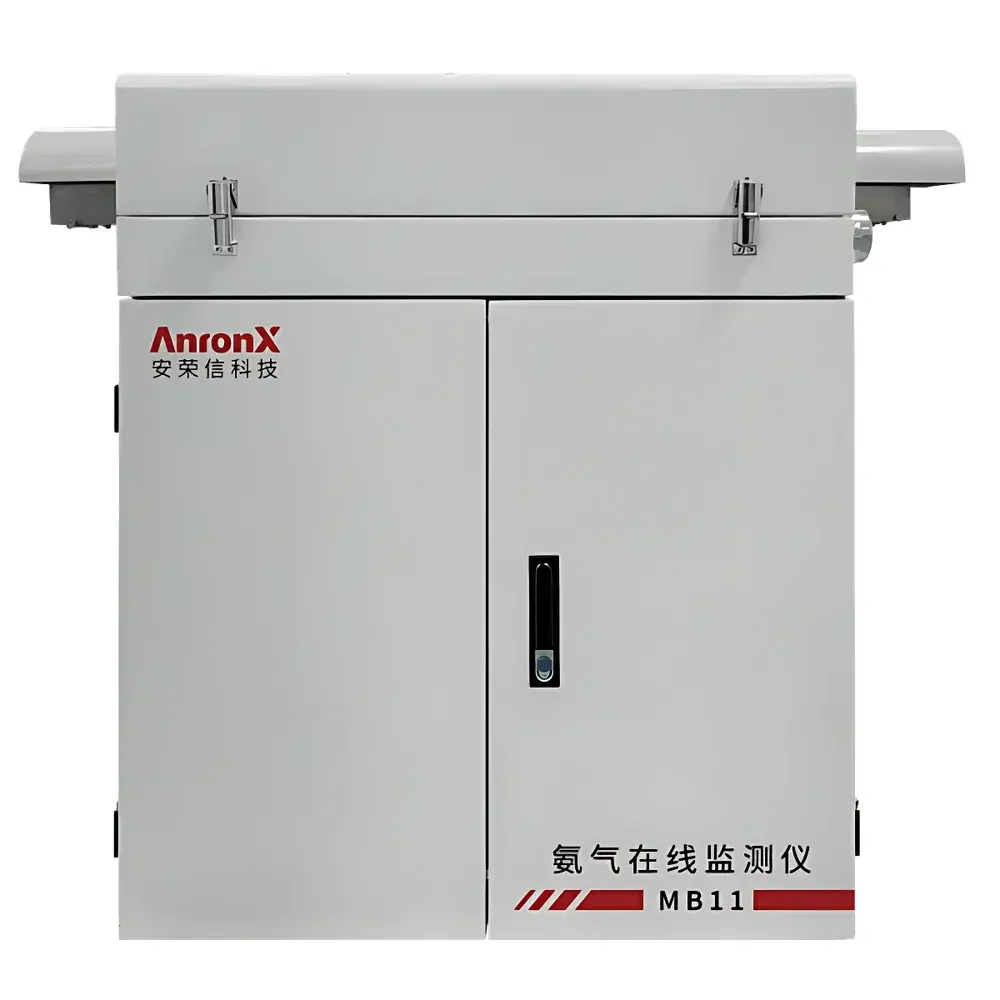
AnronX MB11 Online Ammonia (NH₃) Monitor
| Brand | AnronX |
|---|---|
| Origin | Jiangsu, China |
| Model | MB11 |
| Instrument Type | Online Gas Analyzer |
| Measurement Principle | Tunable Diode Laser Absorption Spectroscopy (TDLAS) |
| Optical Technique | High-Frequency Scanned Wavelength Modulation Spectroscopy with Dual-Wavelength Differential Compensation |
| Operating Environment | High-Temperature In-Situ or Extractive Sampling |
| Sample Handling | Heated Probe + Heated Sample Line (up to 200 °C) |
| Interference Resistance | Immune to H₂O, CO₂, SO₂, NOₓ, and Particulate Obscuration |
| Output Interfaces | 4–20 mA Analog, RS485 Modbus RTU, Relay Status Outputs, Optional Integrated Humidity Sensor |
Overview
The AnronX MB11 Online Ammonia (NH₃) Monitor is an industrial-grade, in-situ or extractive gas analyzer engineered for continuous, real-time measurement of trace ammonia concentrations in harsh flue gas and process streams. It employs Tunable Diode Laser Absorption Spectroscopy (TDLAS) — a quantitative optical technique based on Beer–Lambert law — operating in the near-infrared region where NH₃ exhibits strong, isolated rotational-vibrational absorption lines. Unlike electrochemical or metal-oxide semiconductor sensors, TDLAS delivers inherent selectivity, eliminating cross-sensitivity to common combustion gases (e.g., CO₂, SO₂, NO, O₂) and water vapor. The MB11 implements high-frequency wavelength modulation spectroscopy (WMS) combined with dual-wavelength differential compensation to suppress baseline drift caused by optical attenuation from dust deposition, window fouling, or thermal lensing — a critical capability for long-term unattended operation in cement kilns, waste incinerators, and coal-fired SCR exit ducts.
Key Features
- True TDLAS-based detection with sub-ppm sensitivity (typical lower detection limit: 0.5 ppmv @ 1 m path), optimized for post-SCR ammonia slip monitoring;
- Dual-wavelength differential compensation architecture actively corrects for signal attenuation due to particulate loading and optical surface contamination — enabling stable calibration intervals exceeding 90 days;
- Full-path heated sampling system: probe, filter, and transport line maintained at ≥180 °C to prevent NH₃ loss via ammonium bisulfate (ABS) or ammonium chloride (NH₄Cl) condensation;
- Jet-assisted extraction design ensures representative sampling under variable flow velocity, high dust load (>10 g/Nm³), and negative/positive pressure conditions;
- Integrated thermal management with PID-controlled heating zones minimizes thermal stress and ensures mechanical stability across ambient temperatures from −20 °C to +50 °C;
- Modular I/O architecture supports simultaneous analog output (4–20 mA, isolated), digital communication (RS485 Modbus RTU), dry contact alarms, and optional integrated capacitive humidity sensing (0–100% RH, ±2% accuracy);
- IP65-rated enclosure with stainless-steel housing and corrosion-resistant internal components for deployment in outdoor or semi-enclosed industrial environments.
Sample Compatibility & Compliance
The MB11 is validated for use in flue gas streams containing up to 20% vol. water vapor, ≤500 ppmv SO₂, ≤1000 ppmv NOₓ, and total particulate mass concentrations ≤30 g/Nm³. It meets CE marking requirements per Directive 2014/30/EU (EMC) and 2014/35/EU (LVD). While not certified to EN 15267 or MCERTS as a standalone CEMS, the analyzer complies with core functional specifications outlined in ISO 14956:2022 (air quality — performance criteria for automated measuring systems) and supports data integrity workflows aligned with EPA Method 320 and ASTM D6348–21 (standard test method for determination of gaseous compounds by GC/TDLAS). Its analog and digital outputs are compatible with third-party DCS/SCADA platforms used in power generation and waste-to-energy facilities operating under EU IED (Industrial Emissions Directive) and US Clean Air Act Title V permitting frameworks.
Software & Data Management
The embedded firmware provides local configuration via LCD touchscreen or web-based interface (HTTPS-enabled). All measurement data — including raw absorbance spectra, compensated concentration values, temperature/pressure readings, and diagnostic flags — are timestamped and stored onboard (≥30 days at 1-min resolution). Data export supports CSV over USB or Ethernet; Modbus registers expose real-time values, calibration status, fault codes, and maintenance counters. Audit trail functionality logs all parameter changes and calibration events with user ID and timestamp — supporting GLP-aligned operational records. Optional cloud telemetry enables remote diagnostics and predictive maintenance alerts via MQTT or RESTful API integration.
Applications
- Ammonia slip monitoring at Selective Catalytic Reduction (SCR) and Selective Non-Catalytic Reduction (SNCR) system outlets in thermal power plants, steel sintering machines, and glass melting furnaces;
- Process control and emission compliance verification in municipal solid waste (MSW) and hazardous waste incinerators;
- Real-time NH₃ concentration tracking in biogas upgrading units and anaerobic digestion off-gas streams;
- Leak detection and boundary monitoring in fertilizer production, refrigeration facilities, and chemical synthesis plants;
- Research-grade validation of low-emission combustion strategies where sub-ppm NH₃ quantification is required for catalyst deactivation studies.
FAQ
What is the recommended calibration frequency for the MB11 in continuous operation?
Calibration verification using certified zero and span gases is recommended every 30 days; full two-point calibration every 90 days — extended intervals possible with documented performance validation per site-specific QA/QC protocols.
Can the MB11 operate without an external chiller or air purge system?
Yes. The analyzer uses thermoelectric cooling for laser temperature stabilization and requires no external cooling media or purge gas — reducing infrastructure dependency and operational cost.
Is the MB11 suitable for measuring NH₃ in wet, unfiltered flue gas?
Yes, provided the heated sampling train (probe + line) is maintained above the acid dew point; integrated ceramic filtration upstream of the optical cell handles particulates up to 10 µm without clogging.
Does the instrument support integration with EPA-compliant CEMS data acquisition systems?
Yes — via 4–20 mA analog output with HART protocol compatibility and Modbus RTU over RS485, meeting interface requirements for EPA Performance Specification 18 (PS-18) compliant data acquisition and handling systems.
How does the dual-wavelength compensation mitigate window fouling effects?
One wavelength targets the NH₃ absorption line; the other monitors a nearby non-absorbing reference line. Ratioing their intensities cancels out broadband attenuation from dust or condensate, preserving measurement linearity without requiring frequent optical cleaning.







