
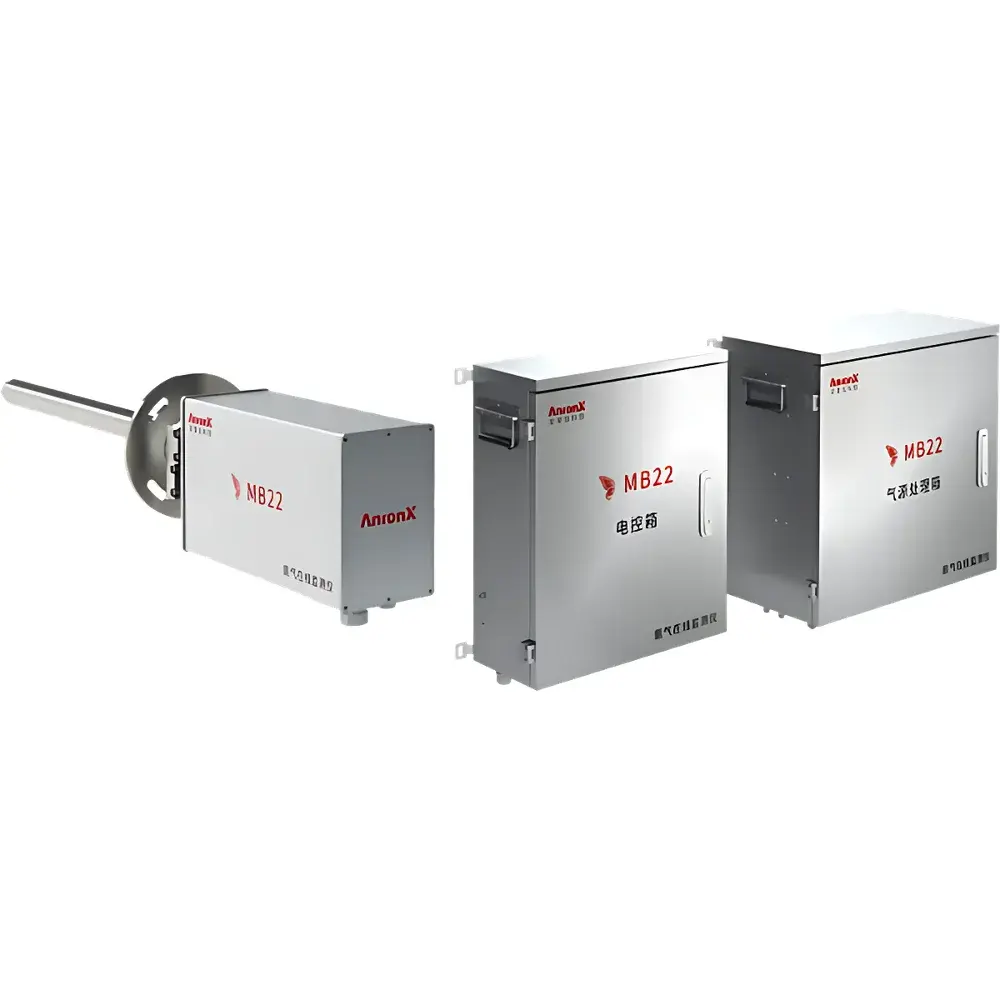
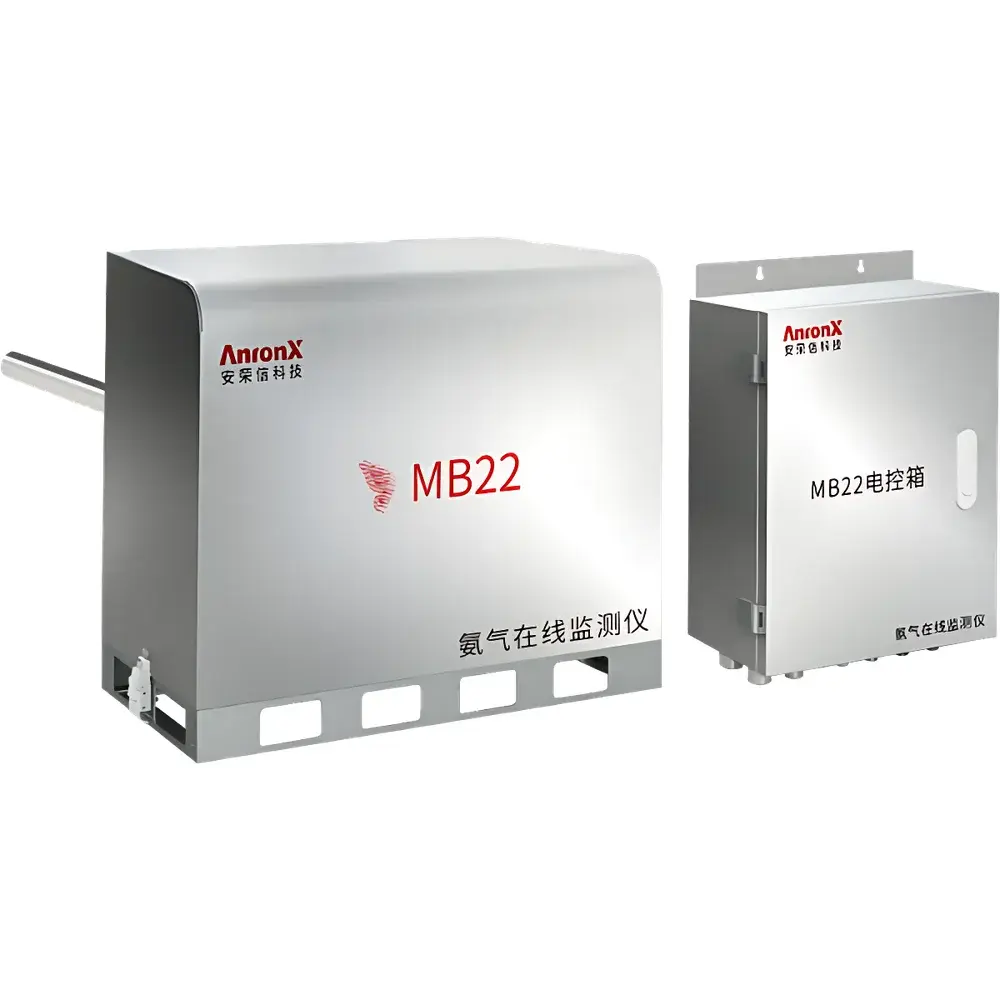
AnronX MB22-NH3 Online Ammonia Analyzer
| Brand | AnronX |
|---|---|
| Origin | Jiangsu, China |
| Model | MB22-NH3 |
| Type | Online Gas Analyzer |
| Measurement Principle | Tunable Diode Laser Absorption Spectroscopy (TDLAS) |
| Sample Path Temperature | Fully Heated to ≥180 °C (Adjustable) |
| Detection Limit | Sub-ppm Range (Typical LOD < 0.5 ppmv) |
| Response Time (T90) | < 10 s |
| Optical Path | Multi-Pass Herriott Cell with Pressure Compensation |
| Wavelength Stabilization | Integrated Reference Gas Cell |
| Calibration | Full-Path Zero/ Span Auto-Calibration |
| Environmental Rating | IP65 Enclosure |
| Operating Temperature | −20 °C to +50 °C |
| Power Supply | 220 VAC ±10%, 50/60 Hz |
| Output Interfaces | 4–20 mA, RS485, Modbus TCP, Optional Ethernet/Profibus |
Overview
The AnronX MB22-NH3 Online Ammonia Analyzer is an industrial-grade, in-situ gas monitoring system engineered for continuous, real-time quantification of ammonia (NH₃) concentration in challenging emission and process streams. It employs Tunable Diode Laser Absorption Spectroscopy (TDLAS), a physics-based optical technique that measures the characteristic near-infrared absorption lines of NH₃ molecules at high spectral resolution (~0.001 cm⁻¹). Unlike electrochemical or metal-oxide semiconductor sensors, TDLAS provides absolute, interference-free quantification without cross-sensitivity to CO, CO₂, H₂O vapor, SO₂, NOₓ, or particulate matter—critical for compliance monitoring at stack outlets, SCR/SNCR denitrification ducts, biogas upgrading units, and fertilizer production lines. The analyzer features a fully integrated probe housing that combines heated sampling, optical measurement, and signal processing in a single compact unit—eliminating external heated sample lines and cold spots that cause condensation-induced NH₃ loss. This design ensures trace-level accuracy, sub-10-second dynamic response, and long-term stability under continuous operation.
Key Features
- Fully heated optical path (up to 180 °C) with zero cold points—prevents NH₃ adsorption on surfaces and guarantees quantitative transfer from flue gas to detector;
- Multi-pass Herriott cell architecture with pressure-compensated spectral fitting algorithms—enhances effective optical path length (>20 m) and improves detection limit to <0.5 ppmv (3σ) at standard conditions;
- Onboard sealed reference gas cell containing pure NH₃—enables real-time wavelength lock and drift correction, ensuring calibration integrity over months without manual intervention;
- Automatic full-path calibration sequence with programmable zero (N₂ purge) and span (certified NH₃ standard) gas delivery—meets QA/QC requirements per EPA Method 30B and EN 15267;
- Integrated reverse-purge module using clean instrument air—self-cleans optical windows and sample inlet during idle cycles, reducing maintenance frequency in high-dust environments;
- Modular electronics architecture with dual-core ARM processor and isolated analog/digital I/O—supports redundant 4–20 mA outputs, Modbus TCP over Ethernet, and optional Profibus DP for DCS integration;
- IP65-rated stainless-steel enclosure rated for ambient operation between −20 °C and +50 °C—suitable for outdoor mounting on stacks, ducts, or skids without auxiliary climate control.
Sample Compatibility & Compliance
The MB22-NH3 is validated for direct measurement in wet, corrosive, and particulate-laden gas matrices typical of coal-fired power plants, waste incinerators, chemical synthesis reactors, and agricultural anaerobic digesters. It tolerates HCl concentrations up to 100 ppmv, SO₂ up to 2,000 ppmv, and dust loading ≤5 g/Nm³ without filter degradation—subject to optional high-corrosion probe configuration (Hastelloy C-276 wetted parts). All firmware and data handling comply with ISO/IEC 17025 traceability requirements. Audit trails, user access logs, and electronic signatures are implemented in accordance with FDA 21 CFR Part 11 for regulated facilities. System validation documentation supports compliance with EU Industrial Emissions Directive (IED) Annex VIII, US EPA Performance Specification 18 (PS-18), and Chinese HJ 1013–2018 standards for NH₃ CEMS.
Software & Data Management
The embedded Linux-based firmware includes AnronX AnalyzeLink™ v3.2 software suite, accessible via secure HTTPS web interface or local USB port. Real-time spectral visualization, peak-fitting diagnostics, and raw absorbance time-series logging are available for root-cause analysis. Data export formats include CSV, PDF reports, and OPC UA-compliant tags for PI System or Ignition SCADA ingestion. Configuration parameters—including alarm thresholds, calibration schedules, and purge intervals—are stored in non-volatile memory with SHA-256 hash verification. Firmware updates are delivered via signed binary packages with cryptographic signature validation to prevent unauthorized modification.
Applications
- Continuous Emission Monitoring Systems (CEMS) for NH₃ slip measurement downstream of selective catalytic reduction (SCR) and selective non-catalytic reduction (SNCR) systems;
- In-process ammonia concentration control in Haber-Bosch synthesis loops, caprolactam production, and nitric acid manufacturing;
- Biogas upgrading facilities—monitoring NH₃ content prior to membrane separation or amine scrubbing to prevent catalyst poisoning;
- Municipal wastewater treatment plants—tracking NH₃ volatilization from aerobic digesters and sidestream treatment units;
- Research laboratories conducting kinetic studies of NH₃ oxidation or heterogeneous catalysis—leveraging sub-second response for transient reaction profiling.
FAQ
Does the MB22-NH3 require periodic optical alignment or mirror cleaning?
No—optical components are factory-aligned and hermetically sealed; routine maintenance is limited to quarterly inspection of purge nozzles and annual verification of reference cell integrity.
Can it operate in explosive atmospheres (e.g., Zone 1)?
Yes—ATEX/IECEx-certified version (MB22-NH3-EX) with intrinsic safety barrier (Ex ia IIC T4 Ga) is available upon request.
Is third-party certification (e.g., TÜV, SGS) available for regulatory acceptance?
Yes—TÜV-certified QAL1 test reports and EN 15267-3 type approval documentation are provided with each shipment for EU market deployment.
How is moisture interference handled in high-humidity flue gas?
The fully heated path eliminates condensation; spectral water vapor compensation is applied in real time using H₂O-specific absorption bands adjacent to the NH₃ line, validated per ISO 14956.
What is the recommended calibration interval under continuous operation?
Zero/span calibration every 7 days is recommended for regulatory compliance; extended intervals (up to 30 days) are permitted with documented performance verification per EN 14181 QAL3.
Related Products







