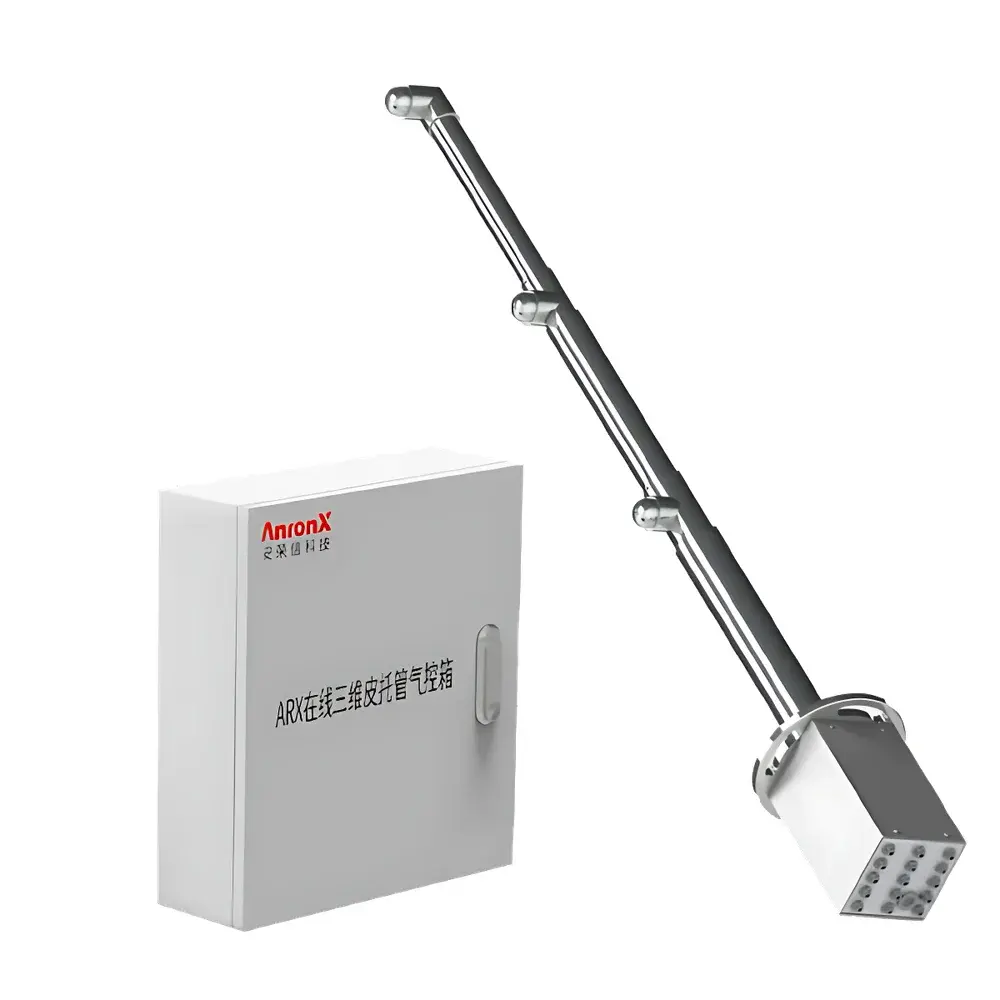
AnronX TDP2021 Online 3D Pitot Tube Velocity Analyzer
| Brand | AnronX |
|---|---|
| Origin | Jiangsu, China |
| Manufacturer Type | Authorized Distributor |
| Country of Origin | China |
| Model | TDP2021 |
| Pricing | Available Upon Request |
Overview
The AnronX TDP2021 Online 3D Pitot Tube Velocity Analyzer is an industrial-grade, in-situ flow measurement instrument engineered for high-fidelity characterization of turbulent, three-dimensional gas flows in flue ducts and process exhaust systems. Unlike conventional one-dimensional averaging devices—such as thermal mass flow meters or standard single-axis pitot tubes—the TDP2021 implements a true vector-based measurement principle grounded in differential pressure sensing across three orthogonal axes (X, Y, Z). This enables simultaneous acquisition of velocity magnitude, directional angle (yaw and pitch), and dynamic/static pressure differentials—providing full 3D velocity vector resolution under real-time operating conditions. Its design complies with the reference method stipulated in DL/T 2376–2021, “Technical Specification for Continuous Monitoring of CO₂ Emissions from Coal-Fired Power Plants,” which formally recognizes triaxial pitot tube methodology as a benchmark for flue gas velocity validation in emissions monitoring systems (CEMS) audits and stack testing protocols.
Key Features
- Vector-Resolved Flow Measurement: Measures instantaneous velocity components (u, v, w) via three independent differential pressure channels, enabling calculation of resultant velocity magnitude, flow angle (α, β), and turbulence intensity metrics.
- No Minimum Straight-Duct Requirement: Eliminates dependence on upstream/downstream straight pipe lengths—enabling representative point measurements across irregular cross-sections, bends, and transition zones where traditional averaging arrays fail.
- High Turbulence Robustness: Engineered for operation in high-turbulence-intensity environments (Turbulence Intensity > 15%), maintaining ≤2% full-scale accuracy per DL/T 2376–2021 Annex B verification procedures.
- Integrated Multi-Parameter Sensing: Co-located temperature (PT100 RTD), static pressure (capacitive sensor), total pressure (triaxial pitot array), and differential pressure transducers enable concurrent derivation of volumetric flow rate, mass flow (with gas composition input), and flow directionality—all within a single probe assembly.
- Industrial-Rated Construction: Stainless steel 316L probe body with ceramic-coated sensing ports; IP67-rated electronics housing; operating temperature range: –20 °C to +180 °C (extended options to +400 °C).
Sample Compatibility & Compliance
The TDP2021 is validated for continuous monitoring of flue gases containing particulates (up to 50 g/Nm³), moisture (up to 15% vol), SO₂, NOₓ, CO, and CO₂—typical of coal-, biomass-, and waste-fired combustion processes. It meets mechanical and electrical requirements outlined in IEC 61508 (SIL2-capable architecture) and conforms to electromagnetic compatibility standards IEC 61326-1. As a reference method device, it supports traceability to national metrological standards through factory calibration against NIST-traceable wind tunnel data (calibration certificate included). While not certified to ISO 5167 or ISO 9300, its use aligns with ISO 16911–1:2013 (“Stationary source emissions — Manual determination of velocity and volume flow rate of gas streams”) for field validation and QA/QC of CEMS installations.
Software & Data Management
The TDP2021 interfaces via 4–20 mA analog outputs (for velocity magnitude, direction angles, temperature, static pressure) and Modbus RTU over RS-485. Optional Ethernet/IP or Profibus DP modules support integration into DCS/SCADA platforms. AnronX-provided configuration software (TDP-Config v3.2) enables zero/span calibration, coordinate system alignment (duct-relative vs. absolute frame), and real-time vector visualization. All measurement data—including timestamped raw DP values, compensated velocity vectors, and diagnostic flags—are logged with audit-trail capability compliant with GLP/GMP documentation requirements. Data export formats include CSV and XML, compatible with EPA Method 203A reporting templates.
Applications
- Continuous emission monitoring system (CEMS) velocity validation and QA/QC auditing per DL/T 2376–2021 and EPA PS-11.
- In-stack flow profiling during performance testing of electrostatic precipitators, scrubbers, and selective catalytic reduction (SCR) systems.
- Real-time flow balancing across multi-duct boiler air systems (e.g., primary/secondary/tertiary air distribution).
- Commissioning and optimization of flue gas desulfurization (FGD) bypass ducts and induced draft fan control loops.
- Research-grade characterization of swirling flow fields in pilot-scale carbon capture test rigs and oxy-fuel combustion studies.
FAQ
Is the TDP2021 certified for regulatory compliance in U.S. or EU emissions monitoring?
The TDP2021 is designed to meet Chinese national standard DL/T 2376–2021 and supports EPA PS-11 field validation protocols. It is not EPA-certified as a primary CEMS component but serves as an approved reference method for velocity measurement under Method 2 and Method 203A.
Can it be installed in wet or corrosive flue gas environments?
Yes—the probe features ceramic-coated stainless steel sensing ports and optional Hastelloy C-276 sheathing for high-SO₂ or chloride-laden streams. Condensate drainage ports and heated purge air options are available upon request.
Does the system require periodic recalibration?
Annual field verification against a traceable standard is recommended. Factory recalibration intervals are specified at 24 months under stable operating conditions, per ISO/IEC 17025-accredited calibration procedures.
How is directional accuracy verified during installation?
AnronX provides a laser alignment jig and digital inclinometer app for duct-relative coordinate registration. Field validation uses dual-axis bubble level checks and rotational symmetry tests per DL/T 2376–2021 Section 7.4.
Related Products