
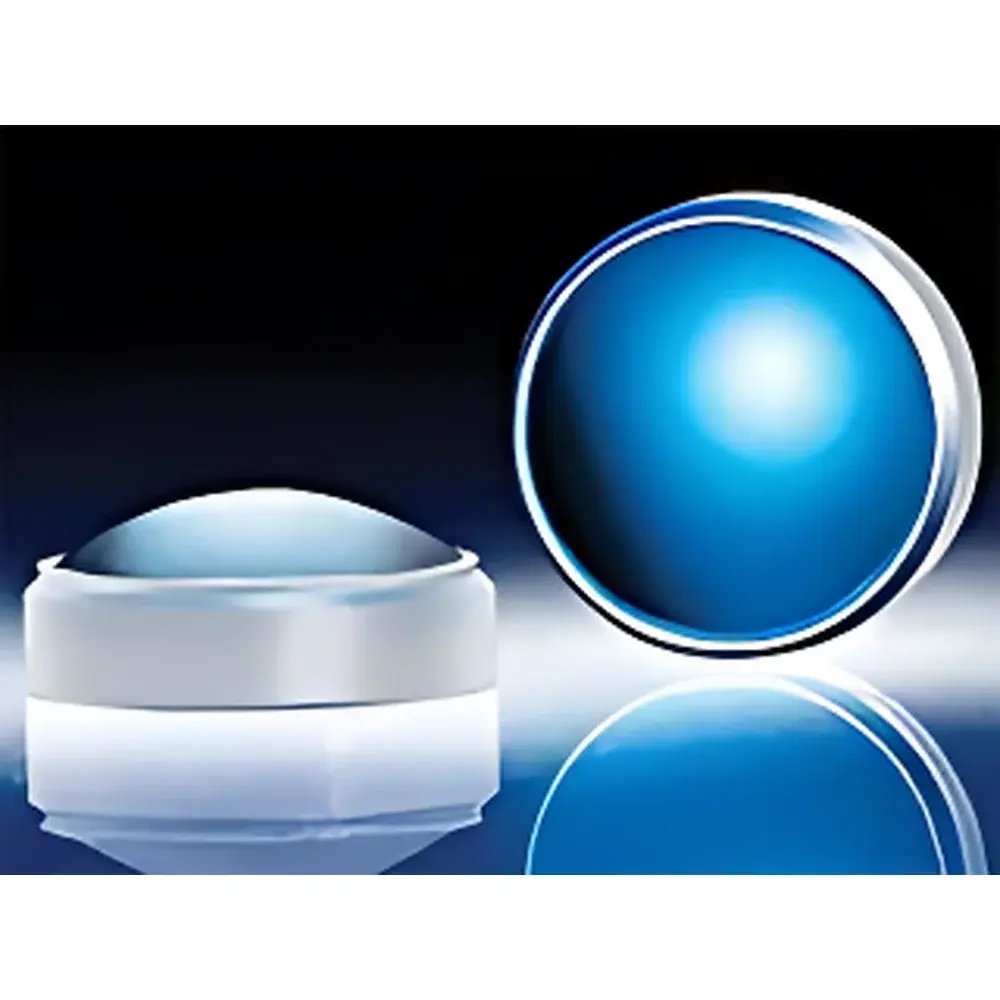
Anteryon Aspheric Lenses
| Brand | Anteryon |
|---|---|
| Origin | Netherlands |
| Type | Glass-Molded Hybrid Aspheric Optical Lens |
| Component Category | Optical Element |
| Compliance | ISO 10110-5, ISO 9001-certified manufacturing |
| Surface Irregularity | λ/25 to λ/15 RMS (633 nm), typical |
| Coating Options | AR (400–700 nm), NIR (780–1100 nm), or custom broadband anti-reflection coatings |
| Mounting | Unmounted (standard) |
| Material Substrate | BK7, SF10, or fused silica (model-dependent) |
Overview
Anteryon Aspheric Lenses are high-precision, glass-molded hybrid optical components engineered to correct spherical aberration and minimize higher-order wavefront errors in demanding imaging and collimation applications. Unlike conventional spherical lenses—whose fixed curvature introduces inherent off-axis blurring—these aspheres feature a non-uniform surface profile mathematically defined by a conic constant and polynomial departure terms. This enables diffraction-limited performance across the full clear aperture without requiring multi-element correction. Manufactured in the Netherlands using proprietary replication technology, each lens combines the thermal stability and laser-damage resistance of optical glass with the cost-efficiency and scalability of precision molding. The result is a class of optics that delivers performance comparable to hand-polished monolithic aspheres at a fraction of the lead time and unit cost—making them suitable for volume integration into OEM instrumentation, medical devices, and industrial sensing platforms.
Key Features
- Glass-molded hybrid construction ensures long-term dimensional stability under thermal cycling (−40 °C to +85 °C) and humidity exposure (IEC 60068-2-78 compliant)
- Surface irregularity controlled to ≤ λ/15 RMS (633 nm HeNe wavelength), verified via interferometric testing per ISO 10110-5
- High numerical aperture (NA) variants up to 0.55 support tight focusing and efficient coupling into single-mode fibers
- Standard anti-reflection coatings meet MIL-C-48497A specifications; custom V-coats available for specific laser lines (e.g., 405 nm, 1300 nm, 1350 nm)
- Consistent centering accuracy (< 3 arcmin) and wedge < 10 arcsec ensure low beam deviation in alignment-critical systems
- Full traceability: Each batch includes interferogram reports, surface roughness data (Ra < 5 nm), and coating spectral transmission curves
Sample Compatibility & Compliance
These lenses are compatible with standard optomechanical interfaces including SM1 (1.035″-40), SM05 (0.535″-40), and C-mount configurations. All models comply with RoHS 2011/65/EU and REACH SVHC regulations. Manufacturing adheres to ISO 9001:2015 quality management protocols, with full documentation supporting GLP and GMP environments. For regulated life-science instruments, lenses can be supplied with material certificates (EN 10204 3.1), coating durability test reports (ISO 9211-4 abrasion resistance), and batch-specific metrology records required for FDA 21 CFR Part 11 audit readiness.
Software & Data Management
Lens design files—including Zemax (.ZMX), Code V (.CFG), and Synopsys (.LDP) formats—are available upon request for system-level modeling and tolerance analysis. Anteryon provides a downloadable optical parameter database (CSV/Excel) containing measured focal length tolerances (±0.25%), effective focal length vs. wavelength curves, and MTF data at spatial frequencies up to 100 lp/mm. Integration-ready metadata supports automated procurement workflows in enterprise resource planning (ERP) systems such as SAP S/4HANA and Oracle Cloud SCM.
Applications
- Laser diode collimation and fiber coupling in telecom transceivers and biomedical OCT systems
- Miniaturized endoscopic objective assemblies requiring high NA and compact back focal length
- Barcode scanner optics where field flatness and distortion < 0.1% are critical for decode reliability
- Confocal microscopy scan lenses and tube lenses operating at visible and NIR wavelengths
- LiDAR transmitter/receiver optics in autonomous vehicle perception modules (AEC-Q200 qualified variants available)
- Optical data storage pick-up heads requiring sub-wavelength wavefront error control
FAQ
Are these lenses suitable for high-power laser applications?
Yes—glass substrates (BK7, SF10, fused silica) support continuous-wave laser operation up to 5 W/cm² at 1064 nm (tested per ISO 21254-1). Custom high-LIDT coatings are available.
Can I specify custom focal lengths or diameters outside the standard catalog?
Anteryon offers semi-custom engineering services for volume orders (>500 pcs), including modified base curves, aspheric coefficients, and substrate/coating combinations.
Do you provide mounting solutions or lens barrels?
Standard unmounted lenses ship with protective foam-lined trays. Optional kinematic mounts (K6X series), threaded lens cells (SM1-threaded), and vacuum-compatible titanium housings are available under separate part numbers.
What is the typical delivery lead time for standard models?
In-stock items ship within 3 business days from the Netherlands distribution hub; custom configurations require 6–8 weeks from order confirmation.
Is interferometric certification included with every shipment?
Batch-level interferograms and RMS wavefront error reports are provided for all orders ≥10 units; individual lens certification is available as a value-added service.




